




Speak with a licensed insurance agent

1-888-891-0229

Are Medicare Supplement Premiums Tax Deductible? 2026 and 2027 IRS Rules

Reviewed by Russell Noga, Licensed Medicare Insurance Broker (all 50 states) — Last updated November 7, 2026

Key Takeaway

Yes, Medicare Supplement premiums are tax deductible, but only in two situations: you itemize on Schedule A and your total unreimbursed medical costs top 7.5% of your adjusted gross income, or you’re self-employed and claim the self-employed health insurance deduction. Most retirees take the standard deduction instead, so the premium never lowers their tax, and a health savings account can’t be used to pay it at all.

2027 by the Numbers

7.5%

of AGI: the floor medical costs must clear on Schedule A (IRS Pub. 502)

$33,200

2027 standard deduction, married filing jointly, before age add-ons (Rev. Proc. 2026-35)

$6,000

senior deduction per person 65+, 2025 to 2028, itemizing or not (IRS)

$3,000

yearly cap on the retired public safety officer premium exclusion (IRS Form 7206 instructions)

A Plan G premium can run a few thousand dollars a year per person, so it’s natural to ask whether the IRS gives any of it back. The tax code treats a Medigap policy as health insurance, which makes the premium a medical expense. Whether that expense ever reduces your tax bill depends on which part of the return it lands on.

Below are the three federal routes, the dollar thresholds for the 2026 return you’ll file next spring and for tax year 2027, and a worked example for a retired couple. This is general tax information, not tax advice. A CPA, enrolled agent or the free IRS VITA and TCE programs can apply it to your own return.

Compare Medicare Supplement premiums in your ZIP code

Speak with a licensed insurance agent

1-888-891-0229

Three Federal Rules Decide Whether the Premium Counts

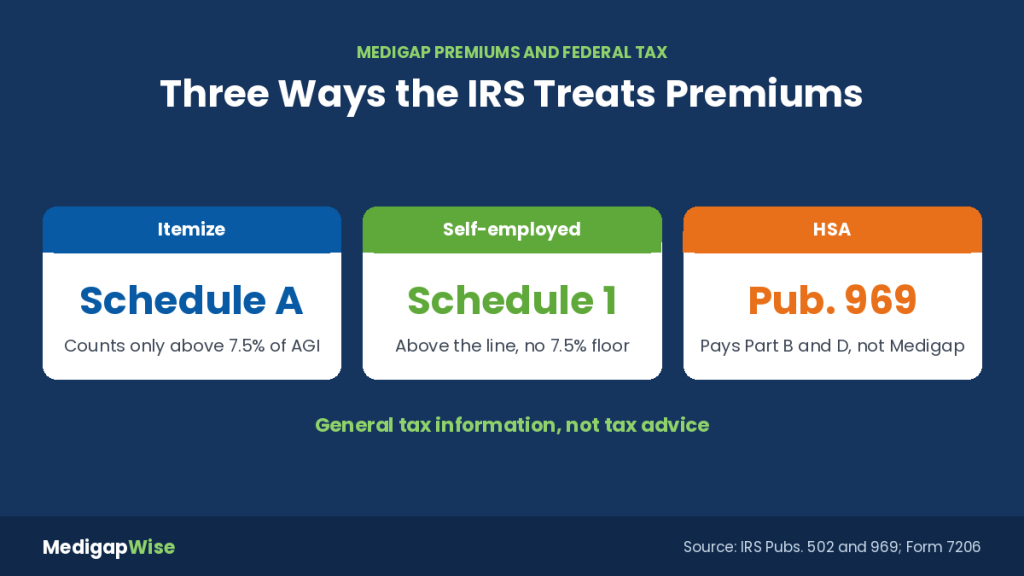
Three IRS routes for Medicare Supplement premiums: itemized medical deduction above 7.5% of AGI, self-employed health insurance deduction on Schedule 1, and HSA payments, which exclude Medigap

There’s no single Medigap deduction on the 1040. Instead, three separate rules touch the premium, and each has its own conditions:

✔
Itemized medical expenses (Schedule A). Anyone can use this route, but only the medical total above 7.5% of AGI is deductible, and you give up the standard deduction to claim it.
✔
Self-employed health insurance deduction (Schedule 1). Business owners with a net profit can subtract premiums before AGI is figured, with no 7.5% floor.
✔
Health savings account withdrawals. Not a deduction, but a tax-free way to pay some Medicare premiums. Medigap is the one premium the IRS leaves off the list.

The same dollar can’t be used twice. Premiums deducted on Schedule 1 or paid with tax-free HSA money can’t also be listed on Schedule A.

Schedule A: Medigap Premiums as an Itemized Medical Expense

IRS Publication 502 lets you include insurance premiums you pay for policies that cover medical care, and it names Medicare Part B and Part D premiums directly. A Medigap policy pays Medicare-approved hospital and doctor costs, so its premium belongs on the same list. Part A premiums count only if you buy Part A voluntarily; the Medicare payroll tax you paid while working doesn’t.

Add those premiums to your other unreimbursed costs for the year: dental work, glasses, hearing aids, prescription copays, the Part B deductible and long-term care premiums up to the IRS age limit ($4,960 at ages 61 to 70 and $6,200 above 70 for 2026, per Rev. Proc. 2025-32). Only the part of that total above 7.5% of AGI is deductible, reported on line 1 of Schedule A.

Social Security withholding still counts: A Part B premium taken out of your benefit check is a premium you paid. Your Form SSA-1099 shows the Medicare premiums withheld for the year, which saves digging through bank statements.

Why the Standard Deduction Usually Wins After 65

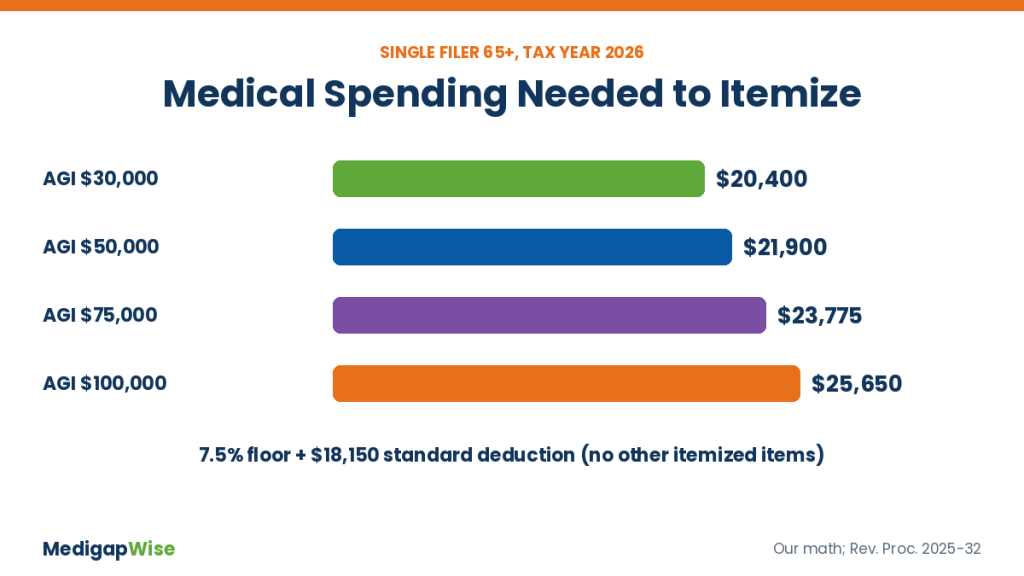
Medical spending a single filer 65 or older needs before itemizing beats the 2026 standard deduction: $20,400 at $30,000 AGI, $21,900 at $50,000, $23,775 at $75,000 and $25,650 at $100,000

For 2026 returns, Rev. Proc. 2025-32 sets the standard deduction at $16,100 for single filers and $32,200 for married couples filing jointly. Each person 65 or older adds $2,050 if unmarried or $1,650 if married, so a couple who are both over 65 start with $35,500. For tax year 2027, the base amounts rise to $16,600 and $33,200 under Rev. Proc. 2026-35, plus the age add-on.

Itemizing pays off only when the medical amount left after the 7.5% cut, plus state and local taxes, mortgage interest and charitable gifts, exceeds those figures. The chart shows how much medical spending a single person over 65 with no other itemized deductions would need in 2026 before Schedule A beats $18,150.

The $6,000 senior deduction doesn’t tip the scale: The enhanced deduction from the 2025 tax law, $6,000 per person 65 or older for 2025 through 2028, is available to itemizers and non-itemizers alike, according to the IRS. It phases out above $75,000 of modified AGI ($150,000 joint), and married couples must file jointly to claim it. Because you get it either way, it lowers your tax without changing which choice is better. The age add-on, by contrast, is lost when you itemize.

Worked Example: A Retired Couple on Plan G

Assumptions (tax year 2026): a married couple, both 66, filing jointly with $60,000 of AGI. Each pays $3,132 a year for Plan G, close to the Maryland rate for a 65-year-old woman shown in our Aetna Medicare Supplement Plan F premium table, plus the standard $202.90 monthly Part B premium and a $45 Part D premium. They spend $2,400 on dental, vision and copays, pay $5,000 in state and property taxes and give $1,500 to charity.

1
Add up the medical costs. $6,264 Plan G + $4,870 Part B + $1,080 Part D + $2,400 other = $14,614.
2
Apply the 7.5% floor. 7.5% of $60,000 is $4,500, so $10,114 is deductible.
3
Total the itemized deductions. $10,114 medical + $5,000 taxes + $1,500 charity = $16,614.
4
Compare with the standard deduction. $32,200 + 2 × $1,650 = $35,500. Itemizing would cost them $18,886 of deductions.
5
Find the break-even point. They would need about $29,000 of deductible medical expense, or roughly $33,500 of total medical spending, before itemizing helps.

The couple claims the $12,000 senior deduction under either option, since their income is under $150,000. Years that include a hospital stay, a nursing home bill or major dental work are when Schedule A comes into play. For everyone else, the practical way to cut the cost is a lower premium, which is covered in our guide to Medicare Supplement plans cost.

Get Plan G and Plan N quotes from several insurers

Speak with a licensed insurance agent

1-888-891-0229

Self-Employed? Medicare and Medigap Premiums Can Go Above the Line

If you still run a business or consult after 65, the self-employed health insurance deduction is the stronger route. It’s taken on Schedule 1, line 17, before AGI is figured, so there’s no 7.5% floor and you can keep the standard deduction. A 2012 IRS Chief Counsel memorandum (CCA 201228037) concluded that premiums for all Medicare parts qualify, and the current Form 7206 instructions accept Medicare premiums you voluntarily pay for insurance in your name. A Medigap policy is private health insurance in your name, so its premium counts too.

✔
Net profit cap: the deduction can’t exceed the earned income from the business that the plan is established under.
✔
Month-by-month test: any month you, or you through your spouse’s employer, could join a subsidized employer health plan is excluded, even if you didn’t enroll.
✔
Leftover premiums: the Form 7206 instructions say amounts you can’t deduct here can still go on Schedule A if you itemize.
✔
No self-employment tax break: the deduction lowers income tax, not the Social Security and Medicare tax on your business profit.

Form 7206 is required with more than one business, when long-term care premiums are included or with Form 2555; otherwise the worksheet in the Form 1040 instructions is enough.

Questions? Talk to a Licensed Agent

We compare Plan G, Plan N and more from several insurance companies at no cost to you.

☎ 1-888-891-0229

No cost, no obligation to enroll

Health Savings Accounts: Medicare Premiums Yes, Medigap No

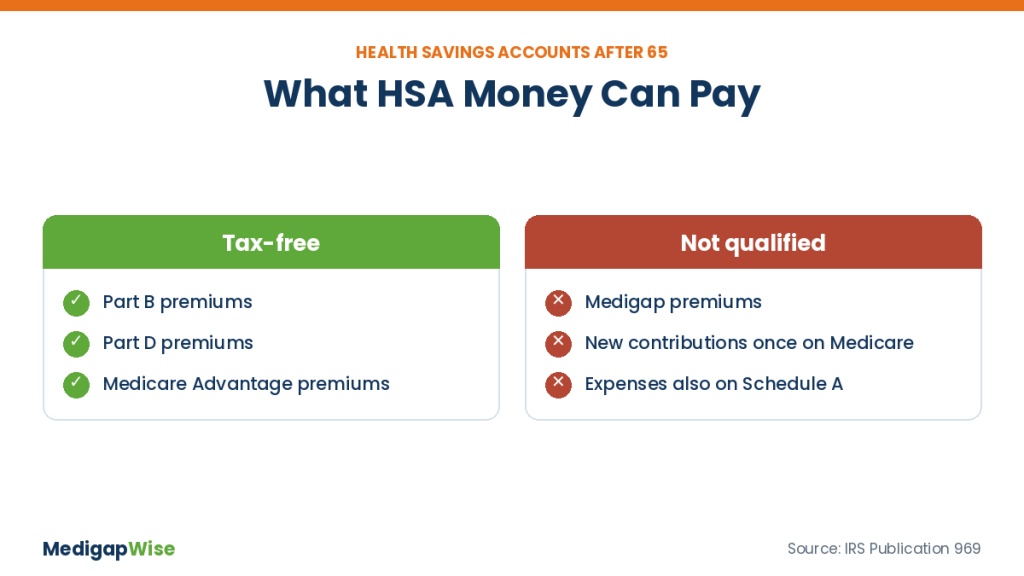
What HSA money can and can't pay after 65: Part B, Part D and Medicare Advantage premiums are allowed, Medigap premiums are not, and contributions stop once Medicare starts

IRS Publication 969 generally bars using HSA money for insurance, then makes exceptions. Once you’re 65, Medicare and other health coverage premiums are qualified expenses, which covers Part B, Part D and Medicare Advantage premiums. The exception carves out premiums for a Medicare supplemental policy, such as Medigap, by name.

Paying a Plan G premium from the account isn’t a disaster after 65: Pub. 969 drops the 20% additional tax at that age, but the withdrawal becomes taxable income. Paying Part B or Part D from the HSA and the Medigap premium from a checking account keeps every dollar tax-free. Contributions are a separate issue. Publication 969 sets your contribution limit at zero beginning with the first month you’re enrolled in Medicare, and Part A enrollment can be backdated up to six months when you sign up late.

Which Premiums Qualify Under Each Rule

The table sums up how each common Medicare-related premium is treated under the three federal rules covered above.

Premium Schedule A (itemized) Self-employed deduction Tax-free HSA payment
Medigap (Plan G, N, F) Yes, above 7.5% of AGI Yes No
Part B, incl. income surcharge Yes, above 7.5% of AGI Yes Yes, at 65+
Part D drug plan Yes, above 7.5% of AGI Yes Yes, at 65+
Medicare Advantage Yes, above 7.5% of AGI Yes Yes, at 65+
Part A, bought voluntarily Yes, above 7.5% of AGI Yes Yes, at 65+
Long-term care insurance Up to age-based limit Up to age-based limit Up to age-based limit

Sources: IRS Publications 502 and 969; 2025 Instructions for Form 7206; CCA 201228037. Drug costs and the Part D premium itself are explained in Medicare Part D cost.

Ask a licensed agent about lowering your premium

Speak with a licensed insurance agent

1-888-891-0229

Retired Police and Firefighters, State Returns and Records

Retired public safety officers have one more option. Under the federal rule known as the HELPS provision, up to $3,000 a year of distributions from an eligible government retirement plan used for health or long-term care premiums can be left out of taxable income. SECURE 2.0 dropped the requirement that the plan pay the insurer directly for premiums paid after December 29, 2022. Excluded amounts can’t also be deducted, and some plans limit the exclusion to coverage they sponsor, so ask your pension administrator whether a Medigap premium qualifies.

State income taxes don’t always follow the federal rules on medical deductions. Some states start from federal AGI, which carries the self-employed deduction through automatically, while others have their own itemizing rules or no income tax. Check your state revenue department’s instructions before assuming the federal result applies.

Keep each year’s premium statements, your SSA-1099 and receipts for other medical costs. If a lower-cost plan letter is under consideration, our Medicare Supplement Plan G guide covers what you’d keep and give up.

Keep Reading

BCBS Plan G Plus Cost 2027: what Blue Cross charges for Plan G with dental, vision and SilverSneakers, state by state, and whether the extras pay for themselves.

Medigap Premiums and Your Taxes: 8 Questions

➤ Can I deduct my Medigap premium if I take the standard deduction?

Not as a medical expense. Medical premiums only reduce tax on Schedule A, so taking the standard deduction means the premium gives no separate federal deduction unless you’re self-employed and use Schedule 1.

➤ Where do Medigap premiums go on the tax return?

For itemizers, on line 1 of Schedule A with other medical and dental expenses. For self-employed people, on Schedule 1, line 17, figured on Form 7206 or the Form 1040 worksheet.

➤ Can I include my spouse’s Medicare Supplement premium?

Yes, premiums you pay for your spouse are medical expenses on a joint return, and a self-employed person’s deduction can cover a spouse’s premiums too, subject to the same monthly employer-plan test.

➤ I’m self-employed but my wife has retiree coverage from her old job. Can I still deduct my Plan G?

Only for months you weren’t eligible to join a subsidized plan through her employer. If her retiree plan offers subsidized coverage to you, those months are excluded even if you decline it.

➤ Is it a mistake to pay a Medigap premium from my HSA?

After 65 there’s no 20% penalty, but Publication 969 doesn’t count Medigap premiums as qualified, so the withdrawal is taxable income. Paying Part B or Part D from the HSA avoids that.

➤ Does the new $6,000 senior deduction replace the medical deduction?

No. It’s a separate deduction for people 65 and older from 2025 through 2028, available whether or not you itemize, and it phases out above $75,000 of modified AGI for single filers or $150,000 for joint filers.

➤ Do premiums for the income-related Part B surcharge count?

They’re part of the Part B premium you pay, so they’re included with it as a medical expense or in the self-employed deduction.

➤ Who can help me decide whether to itemize?

A CPA or enrolled agent, or the free IRS VITA and Tax Counseling for the Elderly sites. Tax software also compares both totals automatically once your medical costs are entered.

Free Medigap Price Comparison

Call a Licensed Agent Now

Compare Plan G, Plan N and more from several insurance companies in one call.

☎ 1-888-891-0229

No cost, no obligation to enroll