




Speak with a licensed insurance agent

1-888-891-0229

Is Medicare Part D Worth It in 2027? The Penalty, the $2,400 Cap and When You Can Skip It

Reviewed by Russell Noga, Licensed Medicare Insurance Broker (all 50 states) — Last updated November 11, 2026

Key Takeaway

Yes, for most people on Original Medicare with a Medicare Supplement, Medicare Part D is worth it in 2027, even if you take no drugs today. The cheapest national plans cost a few dollars a month, while waiting adds a penalty you pay for life and leaves you exposed until the next enrollment window. The main exception is having other creditable drug coverage, such as from an employer, the VA or TRICARE.

2027 by the Numbers

$14.90

Monthly penalty, for as long as you have Part D, after a 3-year delay (2027 base premium, CMS)

$6.50

Projected 2027 average premium of the lowest-cost national drug plan (KFF)

$0

Standalone drug plans with no premium in 2027 for people without Extra Help (KFF)

$2,400

Most you pay for covered drugs in 2027 (Medicare.gov)

A Medicare Supplement plan pays your share of hospital and doctor bills, but it does nothing for the pills you pick up at the pharmacy. That leaves a choice many healthy 65-year-olds weigh: pay for a drug plan you may barely use, or hold off and save the premium.

This page treats it as a decision rather than a price list. We put the late penalty next to the premiums you would skip, run a high-cost brand-drug year through the 2027 rules, and spell out the situations where buying a plan really doesn’t make sense.

Ask a licensed agent whether you need Part D

Speak with a licensed insurance agent

1-888-891-0229

Why a Medigap Policy Leaves You Choosing on Drugs

Medigap policies sold since January 1, 2006 can’t include outpatient prescription coverage. So if you pair Original Medicare with a Medigap plan, the only way to get help with pharmacy costs is a standalone prescription drug plan (PDP) or other drug coverage that you already have.

Part D is voluntary, which is why the question comes up at all. Nobody forces you to buy it at 65. Instead, Medicare builds in two consequences for waiting, and they matter more than the premium itself:

✔
A permanent surcharge. Join late without other creditable coverage and a penalty is added to your premium for as long as you have Part D.
✔
A locked door. After your Initial Enrollment Period, you can generally join only during Open Enrollment, October 15 to December 7, with coverage starting January 1. A diagnosis in March can mean nine months of full-price prescriptions.

Our main Medicare Part D guide covers how the program works. Below, we focus on whether it pays off for you.

Penalty vs Premium: Our 10-Year Calculation

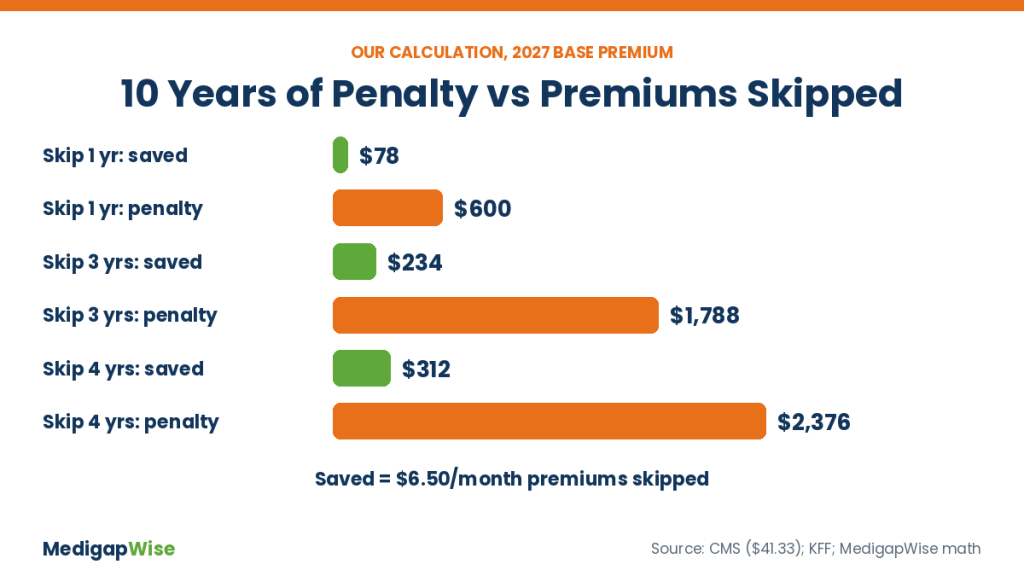
Our calculation: ten years of Part D late penalties after a 1, 3, 4 or 10-year delay compared with the premiums skipped in a $6.50 plan

The penalty is 1% of the national base beneficiary premium for each full month you went without coverage, rounded to the nearest $0.10. CMS set that base at $41.33 for 2027. Medicare.gov’s own example: 14 uncovered months means a 14% surcharge.

We compared the penalty with what you would have saved by skipping a cheap plan. Assumptions: the 2027 base premium held flat for 10 years, and skipped premiums of $6.50 a month, the projected 2027 average for the lowest-cost national plan in KFF’s review.

Months without coverage Penalty per month Penalty over 10 years Premiums you skipped
12 $5.00 $600 $78
24 $9.90 $1,188 $156
36 $14.90 $1,788 $234
48 $19.80 $2,376 $312
120 $41.30 $4,956 $780

In every row the surcharge wipes out the savings within about two years, and you keep paying it after that. The table is conservative, too: the base premium can grow up to 6% a year through 2029, and the penalty is recalculated with it every January.

The penalty also follows you: it stays when you switch plans, and you pay it on top of whatever premium your new plan charges.

Example 1: Healthy at 65 With No Prescriptions

Assumptions (illustrative): Linda turns 65 in 2027, buys Medigap Plan G and takes no regular medications. She has no employer drug coverage.

1
Option A, buy now. She picks a low-premium plan. At $6.50 a month, her first year costs $78, and she has protection if anything changes.
2
Option B, wait three years. She saves about $234. Then her doctor prescribes a brand-name drug, and she has to wait for the fall window to enroll.
3
The bill for waiting. Her coverage starts the next January with a 36% surcharge, $14.90 a month on top of her premium, or $178.80 a year.
4
The break-even. Her skipped premiums are gone after about 16 months of penalties. If she keeps Part D for 20 years, the surcharge totals about $3,576 at today’s base, more as it rises.

The verdict for Linda: a low-cost plan is cheap insurance. Think of the premium as the price of keeping the door open without a lifetime surcharge.

Example 2: A Costly Brand Drug Meets the $2,400 Cap

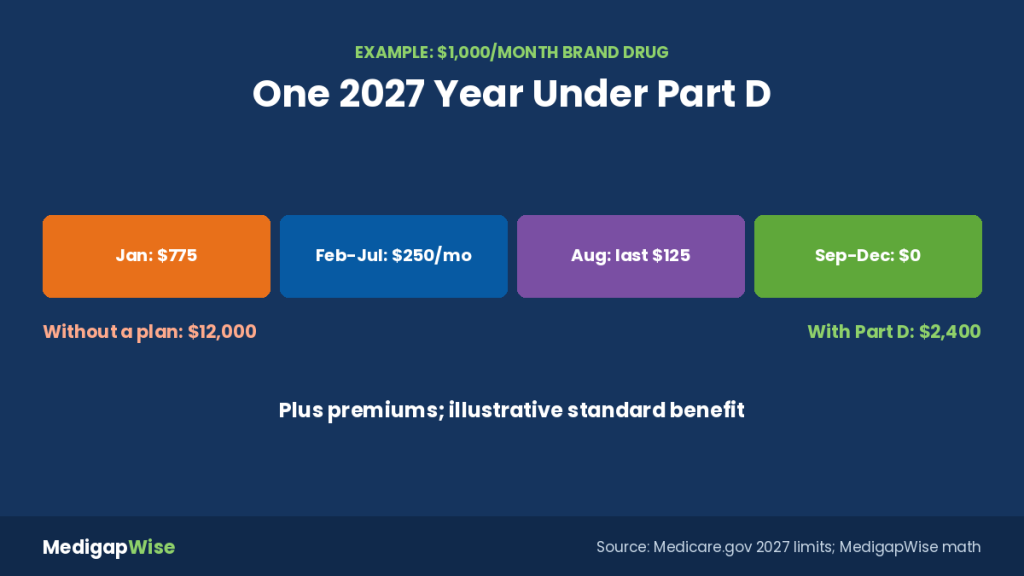
A $1,000-a-month brand drug in 2027: $775 in January, $250 a month through July, the $2,400 cap in August and $0 for the rest of the year

Now the other end. Assumptions (illustrative): Robert takes a brand-name drug that costs $1,000 a month at full price, $12,000 for the year, and his plan covers it with the standard 2027 design: the $700 maximum deductible, then 25% coinsurance until the cap.

✔
January: $700 toward the deductible plus 25% of the remaining $300, so $775.
✔
February through July: $250 a month, bringing his total to $2,275.
✔
August: he pays the last $125 and reaches $2,400.
✔
September through December: $0 for covered drugs.

With no drug plan, Robert would face the full $12,000, less whatever a discount card might shave off. With Part D he pays $2,400 plus premiums. Even at the CMS projected average of $36 a month, that’s $2,832, a gap of more than $9,000.

Real plans use negotiated prices and many use flat copays, so check your own drugs. The full premium, deductible and cap breakdown is on our Medicare Part D cost page.

Price a Medicare Supplement and drug plan together

Speak with a licensed insurance agent

1-888-891-0229

Smoothing the Bills With the Prescription Payment Plan

Robert’s year is front-loaded: $775 in January, nothing by fall. The Medicare Prescription Payment Plan is a free option inside every Part D plan that changes the timing, not the total. You pay $0 at the pharmacy for covered drugs, and your plan sends you a monthly bill instead.

If Robert opts in before his first fill in January, his $2,400 is spread across 12 bills of about $200, rather than a $775 hit followed by six $250 months. Medicare.gov is clear that it doesn’t lower drug costs, and it helps most when one expensive prescription would otherwise land early in the year.

Joining later shrinks the months: if you opt in mid-year, the remaining costs are divided over fewer bills, so each one is bigger.

Questions? Talk to a Licensed Agent

We compare Plan G, Plan N and more from several insurance companies at no cost to you.

☎ 1-888-891-0229

No cost, no obligation to enroll

When Part D May Not Be Worth Buying

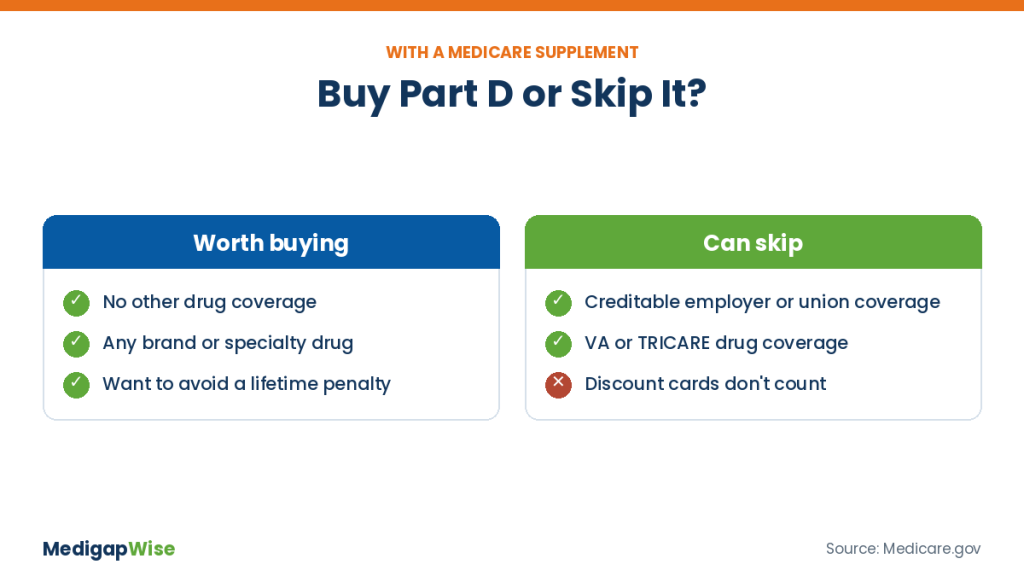
When Part D is worth buying with a Medicare Supplement versus when you can skip it because you have creditable drug coverage

You can skip a drug plan without a penalty if you have other creditable drug coverage, meaning coverage expected to pay at least as much as standard Part D. Common examples:

Usually creditable

✔Drug coverage through your or your spouse’s current employer or union
✔VA health care
✔TRICARE for military retirees
✔Federal employee (FEHB) plans

Check before relying on it

✔Retiree plans that change each year
✔Drug discount cards, which are not insurance
✔Old Medigap Plans H, I or J with drug benefits, generally not creditable

Employer and union plans must tell you each year, before October 15, whether their drug coverage is creditable. Keep those notices. If you lose that coverage, you have 63 days to join a Part D plan before the penalty clock starts.

If your income and savings are limited, Extra Help can cover most plan costs, see our Extra Help income limits page.

Our Verdict by Situation

Buy a low-premium plan

✔No other drug coverage and few or no prescriptions
✔You want to avoid a lifetime surcharge
✔You’d like protection if a new diagnosis comes up

Buy the plan that fits your drugs

✔One or more brand-name or specialty drugs
✔Total drug costs likely to reach the $2,400 cap
✔Premium matters less than how your drugs are covered

Skip it for now

✔Creditable coverage from work, the VA or TRICARE
✔You’ve confirmed it in writing
✔You’ll join within 63 days if it ends

Readers often ask us what a Part D plan costs on average. CMS projects $36 a month for standalone plans in 2027, but KFF found no $0-premium standalone option for people without Extra Help, so the floor has moved up a little this year.

Get help picking a 2027 drug plan before December 7

Speak with a licensed insurance agent

1-888-891-0229

How to Pick a Plan That Pays Off

Open Enrollment for 2027 runs through December 7, 2026. The plan with the lowest premium isn’t always the cheapest once your drugs are priced in.

1
List every prescription. Include dose and how often you fill it, plus the pharmacies you use.
2
Run Medicare’s Plan Finder. On Medicare.gov, enter your drugs and ZIP code to see estimated yearly costs, not just premiums.
3
Check each drug’s tier and rules. Look for prior authorization, step therapy or quantity limits.
4
Compare preferred pharmacies. The same plan can cost less at a preferred or mail-order pharmacy.
5
Re-check next fall. Formularies and premiums change every year, so review your plan before each December 7 deadline.

Compare drug plans in our list of the best Medicare Part D plans, and price your Medigap side in our guide to Medicare Supplement plans.

Keep Reading

2027 Part D Changes for Medigap Enrollees: the $2,400 cap, $700 deductible and Prescription Payment Plan renewal rules, and what to do before December 7.

Is Part D Worth It? Frequently Asked Questions

➤ Is Part D worth it if I don’t take any medications?

Usually, yes. A low-cost plan protects you from a lifetime penalty and from paying full price if you need a new drug before the next enrollment window. KFF found the lowest-cost national plan averages about $6.50 a month in 2027.

➤ How quickly does the late penalty cancel out the premiums I saved?

Fast. After a three-year delay, the 2027 penalty is $14.90 a month. That exceeds the roughly $234 saved by skipping a $6.50 plan in about 16 months, and you keep paying it as long as you have Part D.

➤ Can I just join Part D when I start needing prescriptions?

Not at any time. Outside your Initial Enrollment Period, you generally join during Open Enrollment, October 15 to December 7, with coverage starting January 1, unless you qualify for a special enrollment period.

➤ If I have VA or TRICARE drug coverage, should I still buy Part D?

Usually not. Both generally count as creditable, so you can delay Part D without a penalty. You may still choose a plan if, for example, you want to use retail pharmacies outside the VA system.

➤ Will my Medicare Supplement plan pay for pills from the pharmacy?

No. Medigap policies sold since 2006 don’t cover outpatient prescriptions. They only help with drugs covered under Part B, like some infusions given in a doctor’s office.

➤ Is there a free Part D plan in 2027?

Not as a standalone plan for people without Extra Help. KFF found no $0-premium PDPs for 2027. Extra Help members can still get $0 premiums in benchmark plans.

➤ Does the Medicare Prescription Payment Plan reduce what I owe?

No. It spreads your out-of-pocket drug costs into monthly bills across the year, which helps with cash flow, but the total stays the same.

➤ Can a Part D late penalty be removed?

You can ask for a reconsideration if you think it’s wrong, for example if you had creditable coverage. Use the form and deadline in your plan’s notice; an independent review entity under contract with Medicare decides, generally within 90 days.

Free Medigap Price Comparison

Call a Licensed Agent Now

Compare Plan G, Plan N and more from several insurance companies in one call.

☎ 1-888-891-0229

No cost, no obligation to enroll