




Speak with a licensed insurance agent

1-888-891-0229

Medicare Part D Extra Help Income Limits 2027: Who Qualifies, the Asset Test and What You'll Pay

Reviewed by Russell Noga, Licensed Medicare Insurance Broker (all 50 states) — Last updated November 6, 2026

Key Takeaway

To get Medicare Part D Extra Help going into 2027, your countable income must be under 150% of the federal poverty level, which is currently $23,940 a year for one person or $32,460 for a married couple living together, and your resources must be under $18,090 or $36,100. These are the latest official limits; Social Security switches to new 2027 figures once HHS publishes its poverty guidelines in early 2027.

2027 by the Numbers

$23,940

Single income limit, 150% of the 2026 poverty level (SSA)

$18,090

Single resource limit, includes $1,500 for burial (CMS, 2026)

$14.40

Most an Extra Help member pays for a brand drug in 2027; $5.80 for generics (CMS)

$5,700

Estimated yearly value of Extra Help (SSA)

Extra Help, also called the Part D Low-Income Subsidy (LIS), is a federal program run by Social Security and Medicare. It pays most of what a drug plan costs for people with modest incomes and savings.

The published figures are annual, but Social Security checks your income month by month and skips several kinds of money. Below you’ll find the current limits, the monthly figures after the disregard, the asset rules, a worked eligibility check and what members pay at the pharmacy in 2027.

Check your Part D options with a licensed agent

Speak with a licensed insurance agent

1-888-891-0229

The Current Income Limits, Annual and Monthly

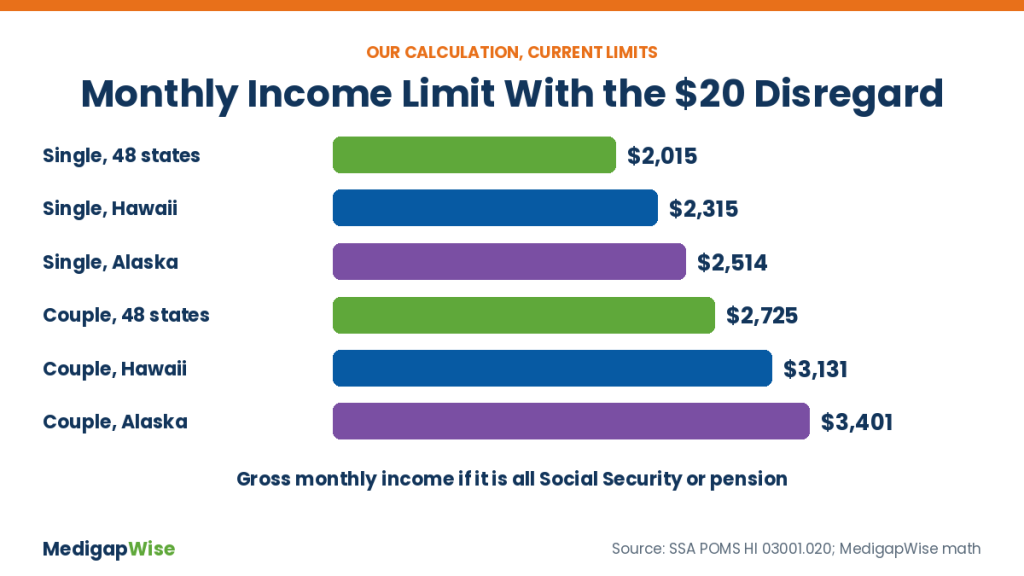
Medicare Extra Help monthly income limits after the $20 disregard: $2,015 single and $2,725 married in 48 states, higher in Hawaii and Alaska

Social Security compares your countable income with 150% of the federal poverty level (FPL) for your household size. A spouse you live with counts, and so does their income. Alaska and Hawaii have their own, higher poverty tables.

The annual column below comes from Social Security’s eligibility rules (POMS HI 03001.020). The monthly column is our own calculation: one-twelfth of the annual limit plus the $20 of unearned income each month that Social Security doesn’t count.

Household Annual limit (150% FPL) Monthly limit Monthly gross if all income is Social Security or pension
Single, 48 states + DC $23,940 $1,995 $2,015
Married, 48 states + DC $32,460 $2,705 $2,725
Single, Hawaii $27,540 $2,295 $2,315
Married, Hawaii $37,335 $3,111.25 $3,131.25
Single, Alaska $29,925 $2,493.75 $2,513.75
Married, Alaska $40,575 $3,381.25 $3,401.25

Bigger households get a higher limit. In the 48 states each additional family member living with you and relying on you for support adds $8,520 a year.

Why the 2027 Numbers Aren't Out Yet

Two different calendars drive the limits. The income test is tied to the HHS poverty guidelines, which are published in the Federal Register in mid-to-late January. The 2026 guidelines came out on January 15, 2026, setting the poverty line at $15,960 for one person in the 48 states.

Social Security’s manual says that until the new table is loaded, it keeps using 150% of the prior year’s table. So anyone applying this fall, or in January 2027, is measured against the $23,940 and $32,460 figures. Expect the 2027 limits to be a little higher once the new guidelines arrive.

Resource limits move separately. CMS raises them each year by inflation and announces them in a memo to drug plans; for 2026 the increase was 3.01%. As of November 6, 2026, CMS hadn’t posted the 2027 resource memo, so the 2026 limits below are the newest official ones.

Avoid early estimates: any exact 2027 Extra Help limit quoted before HHS and CMS publish is a projection until it appears on SSA.gov or CMS.gov.

The Asset Test: What Counts Toward $18,090 or $36,100

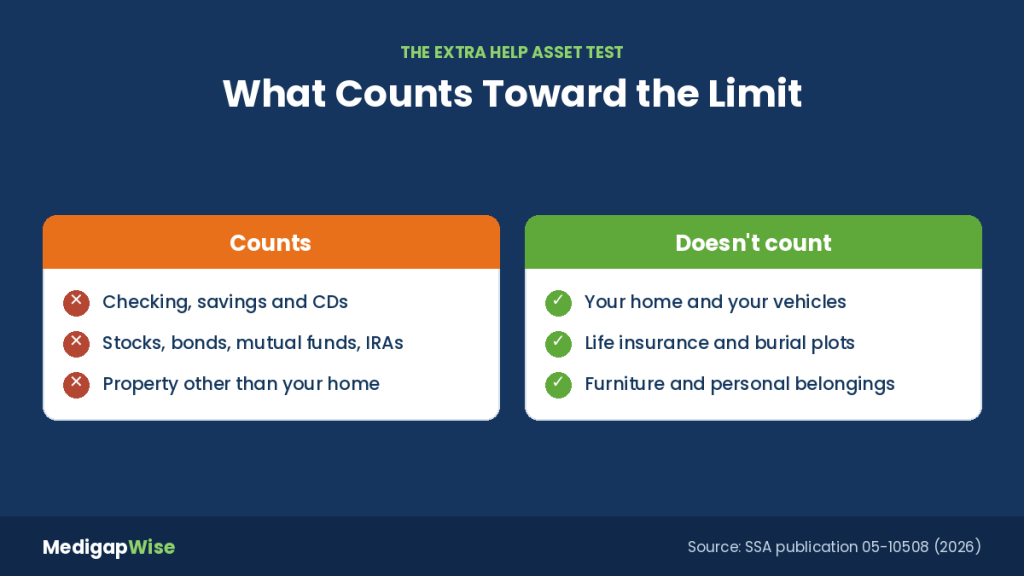
Which resources count toward the Extra Help asset limit, such as bank accounts and IRAs, and which do not, such as your home, car and life insurance

For 2026 the resource limit is $18,090 for one person and $36,100 for a married couple living together. Each figure already includes $1,500 per person that Social Security sets aside for funeral or burial costs. Without that allowance the limits are $16,590 and $33,100.

Counted: cash, checking and savings accounts, CDs, stocks, bonds, mutual funds, IRAs, 401(k)s and real estate other than the home you live in. Not counted: your primary home, vehicles, life insurance (including cash value), burial plots, irrevocable burial accounts and personal belongings such as furniture or jewelry.

Some money is ignored for nine months after you get it, including retroactive Social Security or SSI payments, certain tax refunds and state or local relocation assistance. If a back payment pushes your bank balance up, it won’t count against you right away.

Money Social Security Doesn't Count as Income

Countable income is lower than most people expect. Social Security looks at gross amounts, before any Medicare premium is taken out of your check, and then removes these:

✔
The first $20 a month of unearned income, such as Social Security, a pension, interest or dividends.
✔
About half of your wages from a job or self-employment, after a small earnings exclusion.
✔
Help from family with household bills. Since 2010, food or shelter someone else provides doesn’t count for Extra Help.
✔
Public benefits such as SNAP, housing assistance and home energy assistance.
✔
Other items like Earned Income Tax Credit payments, disaster aid, victim’s compensation and scholarships.

Working changes the math: because earnings are roughly halved, someone with a part-time job can have gross income well above the limit in the table and still qualify. The same is true if you support relatives who live with you.

Compare a Medicare Supplement and drug plan together

Speak with a licensed insurance agent

1-888-891-0229

Worked Example: Checking One Couple's Eligibility

Assumptions (illustrative, not a real household): a married couple in Ohio, both on Medicare. He gets $1,650 a month from Social Security. She gets $780 from Social Security and earns $400 a month at a part-time job. They own their house and one car and have $22,000 in savings and a $9,000 IRA. Figures use the current limits.

1
Unearned income. $1,650 + $780 = $2,430. Minus the $20 disregard, $2,410 counts.
2
Earned income. Roughly half of her $400, about $200, counts.
3
Income test. $2,410 + $200 = about $2,610 a month, under the $2,705 limit for a couple. Counted at face value, $2,830 would have failed.
4
Resource test. $22,000 + $9,000 = $31,000. The house and car don’t count. That’s under $36,100.
5
Result. Both pass, so Social Security would approve full Extra Help.

A $95 margin is thin. If her hours or their checks rise, the new 2027 limits decide whether they still qualify.

Questions? Talk to a Licensed Agent

We compare Plan G, Plan N and more from several insurance companies at no cost to you.

☎ 1-888-891-0229

No cost, no obligation to enroll

Your 2027 Costs With Extra Help

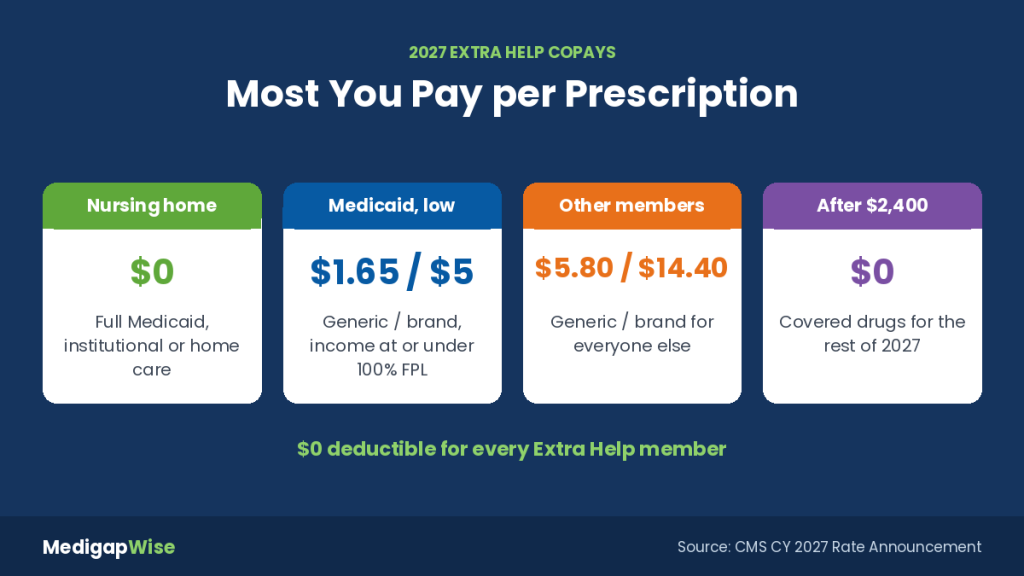
2027 Extra Help copays: $0 in a nursing home, $1.65 and $5.00 for full Medicaid under 100% FPL, $5.80 and $14.40 for others, $0 after $2,400

Everyone approved for Extra Help now gets the full subsidy. The old partial tier, with its sliding premium and 15% coinsurance, ended on January 1, 2024, when the Inflation Reduction Act extended full help to everyone up to 150% FPL.

For 2027, CMS set these per-prescription maximums:

✔
Full Medicaid and living in a nursing home or getting home and community-based services: $0.
✔
Full Medicaid with income at or below 100% FPL: $1.65 for generics and $5.00 for brand-name drugs.
✔
Everyone else with Extra Help: up to $5.80 for generics and $14.40 for brand-name drugs.
✔
Deductible: $0. After $2,400 in out-of-pocket drug costs, covered drugs are $0 for the rest of 2027.

Your monthly premium is $0 in a benchmark plan, one priced at or below your region’s low-income subsidy amount. In a pricier plan you pay the difference. Members also never owe the Part D late enrollment penalty. The broader picture of premiums and deductibles is on our Medicare Part D cost page.

Automatic Approval and the Ways to Apply

You don’t have to file anything if Medicare already knows your income is low. It deems you eligible if you get full Medicaid benefits, Supplemental Security Income (SSI), or help from a Medicare Savings Program, the state program that pays your Part B premium. You’ll get a purple letter from Medicare confirming it.

Everyone else applies through Social Security with Form SSA-1020:

✔
Online at ssa.gov/medicare/part-d-extra-help.
✔
By phone at 1-800-772-1213 (TTY 1-800-325-0778).
✔
In person at a local Social Security office.
✔
Free local help from your State Health Insurance Assistance Program (SHIP). The Extra Help application can also start a Medicare Savings Program application with your state.

If you lose automatic status, Medicare mails a gray letter in the fall, and it doubles as an application. Send it back so your help continues in January. Our Medicare Part D guide covers enrollment basics.

Ask an agent about Extra Help and your coverage

Speak with a licensed insurance agent

1-888-891-0229

Extra Help Alongside a Medicare Supplement Plan

Extra Help only covers Part D. It doesn’t pay a Medigap premium, and having a Medicare Supplement policy doesn’t count against you on the application, because a health insurance policy with no cash value isn’t treated as a resource. Many people combine the two: Medigap handles hospital and doctor bills, and Extra Help makes the drug plan nearly free.

The enrollment rules favor this pairing. Since January 1, 2025, anyone with Extra Help may switch once a month into Original Medicare with a standalone drug plan, or from one standalone plan to another. The old version allowed one change per calendar quarter. The monthly option doesn’t cover moving into a regular Medicare Advantage plan.

Two cautions apply. If you have full Medicaid or the QMB program, those already pick up most Part A and Part B cost sharing, so a Medigap policy usually duplicates coverage. And a Medigap policy still requires its own enrollment timing and, outside protected windows, health questions. Compare letters in our guide to Medicare Supplement plans, then pick a drug plan from our list of the best Medicare Part D plans.

Keep Reading

Is Medicare Part D Worth It in 2027?: our penalty-vs-premium math, a high-cost brand-drug example and the cases where you can safely skip a drug plan.

Extra Help Income Limits — Frequently Asked Questions

➤ What is the income limit for Extra Help in 2027?

Until the 2027 poverty guidelines are published in early 2027, the limit is $23,940 a year for one person and $32,460 for a married couple living together in the 48 states and DC. Alaska and Hawaii are higher.

➤ When will the official 2027 Extra Help limits come out?

HHS usually publishes new poverty guidelines in mid-to-late January, and Social Security updates the income limits after that. CMS releases the new resource limits in a separate memo to drug plans.

➤ Does my house or car count against the Extra Help asset limit?

No. Your primary home, your vehicles, personal belongings, life insurance and burial plots are all excluded. Bank accounts, investments, IRAs and second properties count.

➤ Is there still a partial Extra Help benefit?

No. Since January 1, 2024, everyone who qualifies with income up to 150% of the poverty level gets the full subsidy, including a $0 deductible.

➤ Can I keep my Medigap plan if I’m approved for Extra Help?

Yes. Extra Help applies only to your Part D drug plan, and a Medicare Supplement policy doesn’t affect whether you qualify. You keep paying the Medigap premium yourself.

➤ How much income can I have from a job and still get Extra Help?

More than the table suggests. Social Security counts only about half of your earnings, so wages are treated more favorably than Social Security or pension income.

➤ How often can I switch drug plans with Extra Help?

Once a month. Since 2025, you can join Original Medicare with a standalone drug plan, or change standalone plans, in any month. Moving into a regular Medicare Advantage plan needs another enrollment period.

➤ Do I have to reapply for Extra Help every year?

Usually not. Social Security may send a review form, and changes from a review take effect the next January. People who lose automatic status get a gray letter from Medicare in the fall that works as an application.

Free Medigap Price Comparison

Call a Licensed Agent Now

Compare Plan G, Plan N and more from several insurance companies in one call.

☎ 1-888-891-0229

No cost, no obligation to enroll