




Speak with a licensed insurance agent

1-888-891-0229

Medigap vs Medicare Advantage 2027: Costs, Networks and the Choice That's Hard to Undo

Reviewed by Russell Noga, Licensed Medicare Insurance Broker (all 50 states) — Last updated October 27, 2026

Key Takeaway

Medigap plus a Part D plan costs more every month, but it leaves you only small, predictable bills and lets you use any provider in the U.S. that takes Medicare; Medicare Advantage usually costs little or nothing each month, then charges copays up to a yearly limit inside a network. The bigger difference for 2027 is timing: after your first six months on Part B, most states let Medigap insurers ask health questions, so picking Medicare Advantage first can be hard to reverse.

2027 by the Numbers

$2,400

Part D out-of-pocket cap for 2027, up from $2,100; applies with either choice (CMS)

$12.00

CMS projection for the average monthly Medicare Advantage premium in 2027

$5,421

Average Medicare Advantage in-network out-of-pocket limit in 2026 (KFF)

99%

Share of Medicare Advantage enrollees in plans using prior authorization, 2026 (KFF)

Every person new to Medicare faces the same fork. One path keeps Original Medicare and adds a private Medicare Supplement (Medigap) policy plus a stand-alone drug plan. The other replaces that setup with a single Medicare Advantage plan from a private insurer.

Most comparisons stop at a pros-and-cons list. This one prices both paths for 2027 using real Medicare cost sharing, shows what each looks like in a calm year and in a year with a hospital stay, and explains why the order you choose in matters more than the price.

Compare Medigap and Medicare Advantage costs in your ZIP code

Speak with a licensed insurance agent

1-888-891-0229

Two Different Ways to Fill Medicare's Gaps

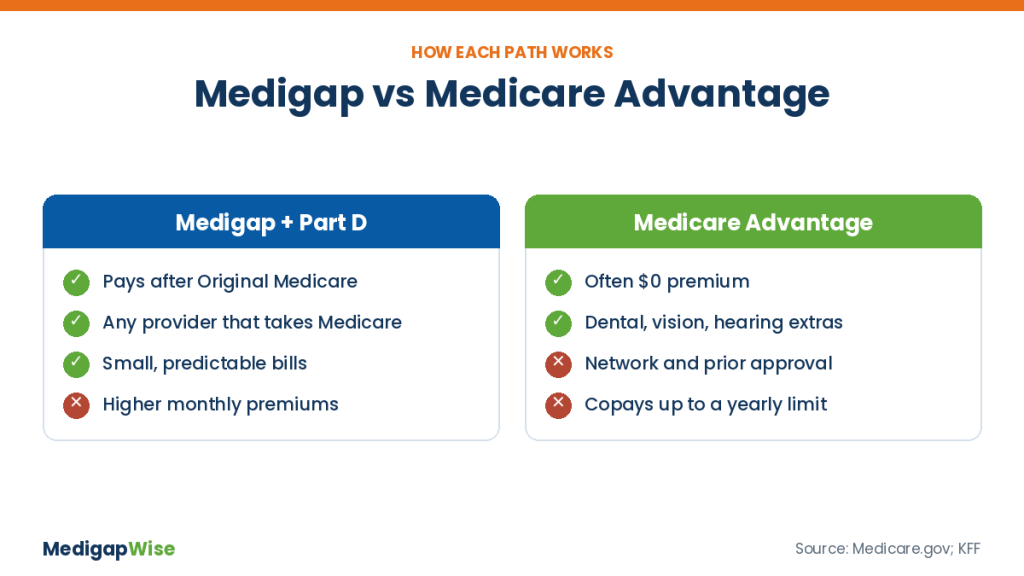
Medigap vs Medicare Advantage for 2027: Medigap pays after Original Medicare with any provider that accepts Medicare, while Medicare Advantage replaces it with a network, copays and a yearly limit

Original Medicare pays most of a covered bill and leaves you deductibles, daily hospital charges after day 60 and usually 20% of outpatient costs, with no yearly ceiling.

Medigap is a secondary payer. Medicare pays first, then the Medicare Supplement policy pays some or all of what’s left. Because Medicare stays primary, any U.S. doctor or hospital that accepts Medicare will take you. Drug coverage comes from a separate Medicare Part D plan.

Medicare Advantage (Part C) takes Original Medicare’s place. A private plan covers your Part A and B benefits, sets its own copays and usually bundles drug coverage. You still pay the Part B premium.

The 2027 Numbers Behind Both Options

Where each 2027 figure stood in early November 2026:

✔
Part D: the 2027 out-of-pocket cap on covered drugs is $2,400 and the maximum deductible is $700. It applies on both paths.
✔
Part B premium and deductible: CMS hadn’t released 2027 amounts at publication. The 2026 figures were $202.90 a month and $283 a year, and this page uses them as stand-ins.
✔
Part A deductible: $1,736 per benefit period in 2026; the 2027 amount is also due from CMS later this year.
✔
Medicare Advantage out-of-pocket ceiling: the federal in-network maximum was $9,250 for 2026. Published summaries of CMS’s final 2027 Part C standards put it at $9,850; each plan’s Summary of Benefits lists its own, often lower, limit.
✔
Premiums: CMS projects the average Medicare Advantage premium will drop to $12.00 a month in 2027, while stand-alone drug plans average about $36. Medigap premiums vary by insurer, age and ZIP code.

Medigap has caps of its own only on two cost-sharing letters: CMS’s 2027 notice raises the Plan K limit to $8,360 and Plan L to $4,180. Fuller plans such as G don’t need one.

Side-by-Side: Coverage Features Compared

Feature Medigap + Part D Medicare Advantage
Who pays the claim first Original Medicare, then the Medigap policy The private plan, in place of Original Medicare
Provider choice Any U.S. provider accepting Medicare Plan network (HMO) or higher cost out of network (PPO)
Advance approval Only what Original Medicare requires Plan may require prior authorization
Monthly premium Medigap premium plus Part D premium Often $0 beyond Part B
Yearly cap on medical costs None needed with Plan G beyond the Part B deductible Required by law; set by each plan
Prescription drugs Separate Part D plan Usually included
Dental, vision, hearing Not included Commonly included
Changing later Health questions in most states Annual window each fall

Plan letters are standardized, so a Plan G from one insurer pays the same as a Plan G from another. See every letter in our guide to Medicare Supplement plans.

What a Quiet Year and a Hospital Year Cost

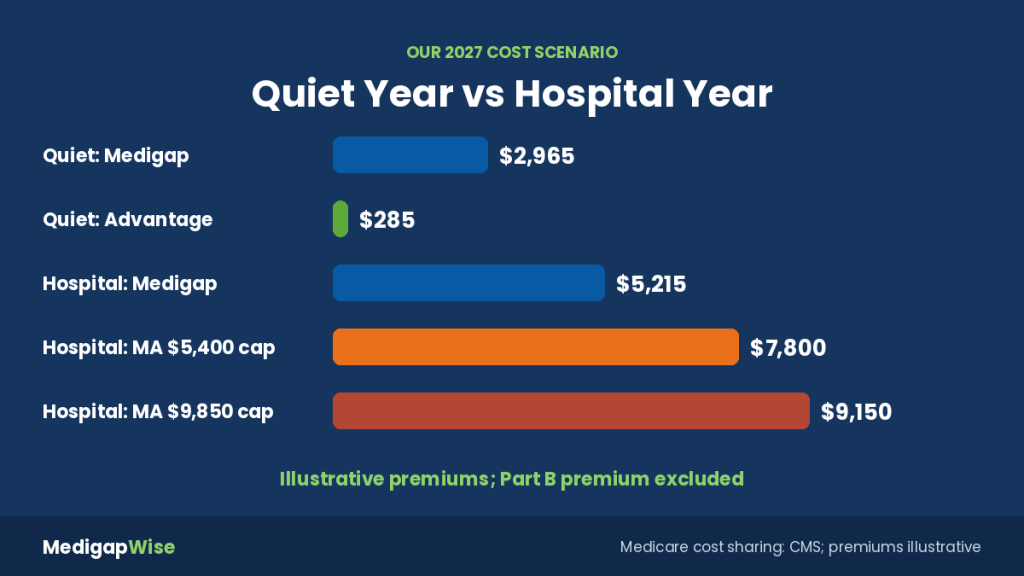
Our 2027 cost scenario: Medigap Plan G plus Part D costs $2,965 in a quiet year and $5,215 in a hospital year, versus $285 and $7,800 to $9,150 with Medicare Advantage

We ran two 2027 years through both paths. Our assumptions (illustrative, not quotes): Plan G at $175 a month; a stand-alone drug plan at the $36 CMS average; a $0-premium Medicare Advantage plan with $0 primary care visits, $45 specialist visits, $350 a day for hospital days 1 to 5, 20% coinsurance on outpatient surgery and Part B drugs, and a $5,400 in-network limit, close to KFF’s 2026 average. The Part B premium is left out because both paths pay it.

Quiet year

✔Three specialist visits, routine primary care, $150 in generic drug costs
✔Medigap: $2,100 + $432 + $283 Part B deductible + $150 = $2,965
✔Medicare Advantage: 3 × $45 + $150 = $285

Hospital year

✔Five-day stay, then $25,000 of outpatient surgery and infusions, plus brand drugs that reach the cap
✔Medigap: $2,100 + $432 + $283 + $2,400 = $5,215
✔Medicare Advantage: $1,750 + $5,000 = $6,750, capped at $5,400, + $2,400 = $7,800

Run the same hospital year through a plan whose limit sits at the $9,850 federal ceiling and the medical share stays at $6,750, for $9,150. Heavier use could reach $9,850 plus $2,400, or $12,250. With Plan G, covered medical costs stop at the Part B deductible.

The math to run on any plan: subtract the yearly Medigap and Part D premiums from what a Medicare Advantage plan could cost at its limit. That gap, not the monthly price, is the real trade. Our Medicare Supplement plans cost guide shows how premiums vary by age.

Price a hospital year with a licensed agent

Speak with a licensed insurance agent

1-888-891-0229

Networks, Prior Approval and Care Away From Home

A Medicare Advantage HMO generally pays only for in-network care, apart from emergencies, urgent care and out-of-area dialysis. A PPO pays out of network too, at higher cost sharing and with a separate, larger combined limit.

Plans can also require approval before certain services. KFF found 99% of Medicare Advantage enrollees were in plans that use prior authorization in 2026, most often for hospital stays and skilled nursing care.

Snowbirds and travelers

✔Medigap goes wherever Medicare is accepted in all 50 states
✔Medicare Advantage covers emergencies nationwide, but routine care away from home depends on the network

Outside the U.S.

✔Plans C, D, F, G, M and N pay 80% of emergency care abroad after a $250 deductible, up to a $50,000 lifetime limit
✔Some Medicare Advantage plans add foreign emergency coverage; check the plan’s documents

Questions? Talk to a Licensed Agent

We compare Plan G, Plan N and more from several insurance companies at no cost to you.

☎ 1-888-891-0229

No cost, no obligation to enroll

Dental, Vision and Hearing: Where Advantage Plans Add Value

This is the clearest win for Medicare Advantage. KFF reports that in 2026, more than 99% of individual-plan enrollees had some vision benefit, 98% had dental and 95% had hearing coverage built in.

Medigap pays only on services Original Medicare covers, so routine dental cleanings, eyeglasses and hearing aids are on you. A stand-alone dental, vision and hearing policy can fill that gap for an added premium.

Before counting the extras: read the dollar caps. A dental benefit with a modest annual maximum or a hearing allowance tied to one vendor is worth less than its headline, so compare the plan’s limits with what you’d actually use.

The One-Way Door: Why the Order of Your Choice Matters

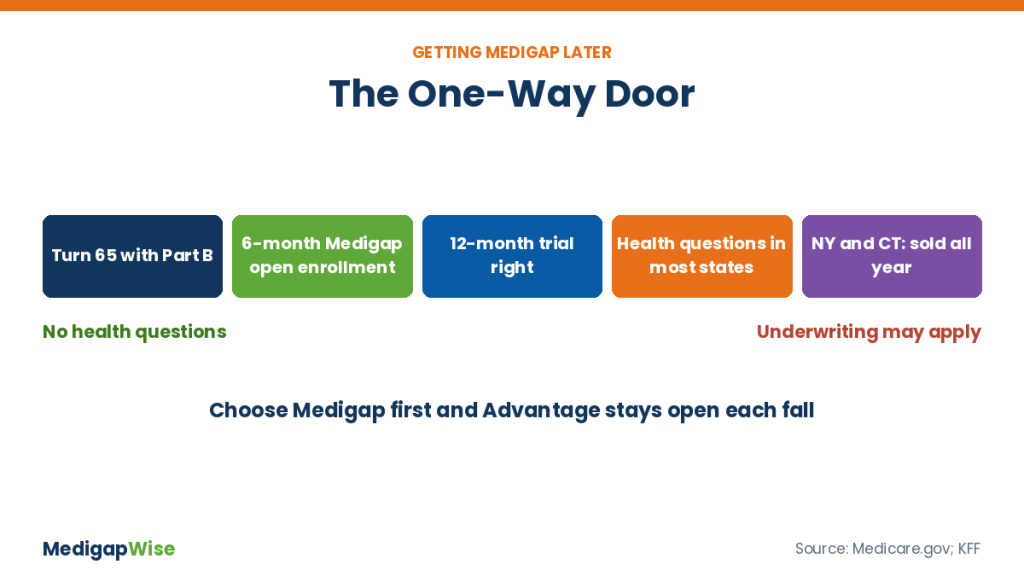
Timeline of the Medigap enrollment door: the 6-month open enrollment at 65, the 12-month trial right, then health questions in most states except New York and Connecticut

Your best chance to get Medigap is the six months that start when you’re 65 or older and enrolled in Part B. During that Medicare Supplement open enrollment period, insurers must sell you any plan they offer at their standard rate, whatever your health.

1
Start with Medicare Advantage at 65? A federal trial right lets you leave within the first 12 months and buy a Medigap plan without health questions. Details are in our Medigap trial right guide.
2
Past those windows? In most states, Medigap insurers can review your health history and decline you or charge more. Federal guaranteed issue rights apply only in set situations, explained in Medicare Supplement open enrollment vs. guaranteed issue.
3
Live in New York or Connecticut? Insurers there must sell Medigap all year without health screening. Massachusetts and Maine also have yearly windows, per KFF.
4
In a birthday-rule state? Those rules let current Medigap holders change policies; they don’t open the door for someone coming from Medicare Advantage.

Moving the other way is open every fall; if you already have a supplement, see switching from a Medicare Supplement to Medicare Advantage.

Ask whether you still have a Medigap open enrollment window

Speak with a licensed insurance agent

1-888-891-0229

Which Option Tends to Fit Which Situation

Medigap + Part D tends to fit

✔People who want any Medicare provider, including out-of-state specialists
✔Those who split the year between two states
✔Anyone who prefers a known yearly cost over low premiums
✔People still inside their six-month open enrollment

Medicare Advantage tends to fit

✔Budgets that need a low or $0 monthly premium
✔People whose doctors are all in one local network
✔Those who want dental, vision and hearing in one card
✔People who already can’t pass Medigap health questions

Most people choosing the Medigap path pick Plan G; our Medicare Supplement Plan G guide lists what it pays in dollars. Under 65 on disability? Federal law doesn’t guarantee Medigap sales to you, so check your state.

Keep Reading

Does Medicare Supplement Cover the Part B Deductible?: which plan letters pay it, the 2020 cutoff, the deductible by year and the break-even math.

Medigap or Medicare Advantage: Your 2027 Questions

➤ Is Medigap or Medicare Advantage cheaper in 2027?

Month to month, Medicare Advantage usually is; CMS projects a $12.00 average premium. In a year with a hospital stay, our illustrative example came out $2,585 lower with Plan G and Part D, because Medigap leaves only the Part B deductible for covered care.

➤ What is the most I could pay with Medicare Advantage in 2027?

Each plan sets an in-network limit, which can’t exceed the federal ceiling, reported at $9,850 for 2027. Drug costs are capped separately at $2,400, and PPO out-of-network care has its own higher limit.

➤ Does the $2,400 Part D cap help both choices?

Yes. It applies to stand-alone drug plans paired with Medigap and to the drug coverage built into Medicare Advantage plans, so drug costs alone rarely decide between them.

➤ Do Medigap premiums rise with age?

They can. Insurers price policies by community rating, issue age or attained age, and attained-age policies go up as you get older, on top of any general rate increases.

➤ Does prior authorization apply to Medigap?

Not from the Medigap insurer. If Original Medicare covers a service, the supplement pays its share. Medicare Advantage plans can require approval first, and KFF found 99% of enrollees in plans that do.

➤ Which states let people buy Medigap after 65 without health questions?

New York and Connecticut require insurers to sell year-round. Massachusetts and Maine have yearly windows. Elsewhere it takes open enrollment, the trial right or a federal guaranteed issue right.

➤ Do Medicare Advantage plans work in another state?

Emergency and urgent care are covered anywhere in the U.S. Routine care away from home depends on the plan; HMOs generally don’t pay out of network, while PPOs pay at a higher cost.

➤ Are dental and vision a good reason to choose Medicare Advantage?

They’re real value, but check the annual maximums and weigh them against network limits and the out-of-pocket ceiling.

Free Medigap Price Comparison

Call a Licensed Agent Now

Compare Plan G, Plan N and more from several insurance companies in one call.

☎ 1-888-891-0229

No cost, no obligation to enroll