




Speak with a licensed insurance agent

1-888-891-0229

Can I Sign Up for a Medicare Supplement Plan Anytime? 2027 Timing Rules

Reviewed by Russell Noga, Licensed Medicare Insurance Broker (all 50 states) — Last updated November 7, 2026

Key Takeaway

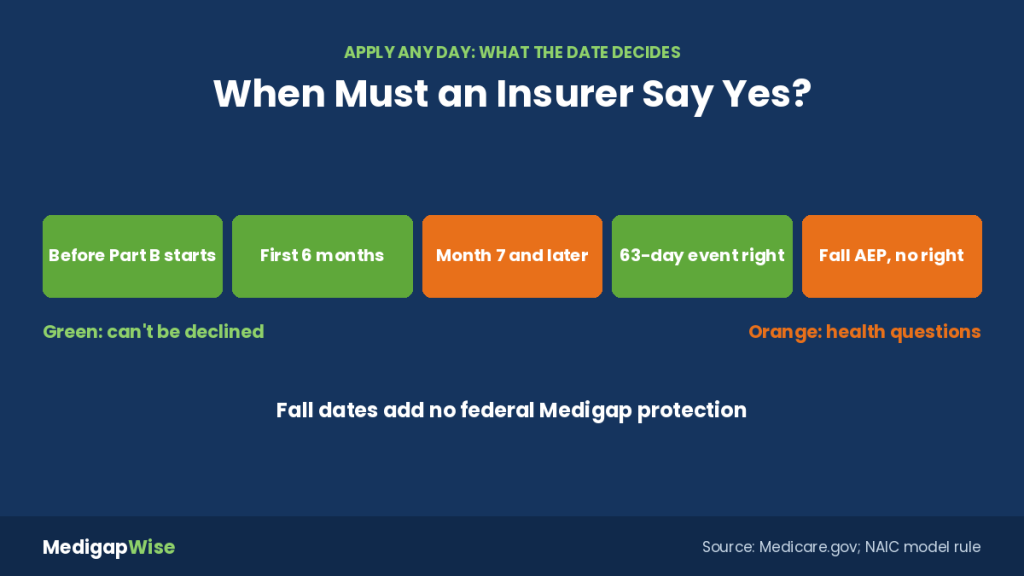
Yes, you can sign up for a Medicare Supplement plan any day of the year, since federal law sets no yearly Medigap enrollment deadline. The date only changes whether the insurer has to say yes: an application sent before or during your first 6 months with Part B at 65+, or under a guaranteed issue right, can’t be turned down, while one sent at any other time can be declined unless your state adds a right.

2027 by the Numbers

6 months

Longest a Medigap policy can delay paying for a pre-existing condition (Medicare.gov)

63 days

Largest break in earlier coverage that still earns waiting-period credit (Medicare.gov)

38 states

Require at least one Medigap policy for disabled enrollees under 65 (KFF, Oct. 13, 2026)

Medicare Supplement insurers process applications every business day, in January and in July, during the fall ad season and the quiet weeks after it. Nothing in federal law tells you to wait for a particular month. So the short answer to the question is yes.

The longer answer is that the calendar still matters, just not the one most people picture. Each application lands in one of a few timing buckets, and the bucket decides three things: whether the insurer can review your health, whether it can make you wait for coverage of a condition you already have, and when the policy can begin. This guide walks through each bucket in the order most people meet them.

Find out which timing bucket your application falls into

Speak with a licensed insurance agent

1-888-891-0229

Applications Are Open All Year; Acceptance Is Not

Medigap has no enrollment season in the way Part D drug plans and Medicare Advantage do. You can call an agent or an insurer in any month and submit an application. What federal law does instead is protect certain applications from being turned down. Medicare.gov puts the other side plainly: outside those protected situations, there’s no federal guarantee an insurer will sell you a policy, and if one does, the price may reflect past or present health problems.

That makes the useful question not “can I sign up?” but “which protection, if any, covers the day I sign?” Your first and strongest protection is the one-time window explained in our guide to Medicare Supplement open enrollment. The rest of this page sorts every other timing case around it.

Signing Before Your Part B Start Date

You can’t hold a Medigap policy without Part B, and Medicare.gov says you must sign up for Part B before you can buy one. That doesn’t mean waiting for the Part B card to take effect. Once your Part B enrollment is set with a future start date, many insurers will take an application months in advance, often up to about 6 months ahead, and date the policy to begin the same day as Part B. How early each company accepts varies.

The early application is protected, too. The NAIC model rule that states adopt, quoted in regulations such as Georgia’s Rule 120-2-8-.11, bars an insurer from denying or conditioning a policy when the application is submitted prior to or during the 6-month window. In other words, applying early doesn’t trade away your open enrollment rights. The paperwork itself is covered in how to sign up for Medigap.

Date math: Medicare usually begins on the first day of your birthday month, or the month before if you were born on the 1st. An early application lets the supplement start that same day, so no claim falls between Part B and the policy.

Signing During Your First Six Months With Part B

When you can sign up for a Medicare Supplement plan: before Part B starts, during the 6-month Medigap open enrollment period, after it with health questions, with a 63-day guaranteed issue right, and during the fall enrollment period

The 6-month Medigap Open Enrollment Period starts on the first day of the month you’re both 65 or older and enrolled in Part B. During it, an insurer must sell you any Medigap policy it offers, can’t charge more because of your health, and, as Medicare has explained, can’t make you wait for the policy itself to start.

One thing it still may do is delay coverage of a condition you already have. A pre-existing condition, for this rule, is one diagnosed or treated in the 6 months before the policy begins. The insurer can hold off paying its share for that condition for up to 6 months, while Original Medicare keeps paying its part. The next section shows how prior coverage erases most of that wait, and our page on Medicare Supplement pre-existing conditions lists examples of what counts.

Because the protection keys on when the application is submitted, an application sent in the sixth month is protected even if the insurer finishes processing it a few weeks later. Policies approved mid-month commonly start on the first of the following month, or on a later date you request.

How Earlier Coverage Shortens the Pre-Existing Wait

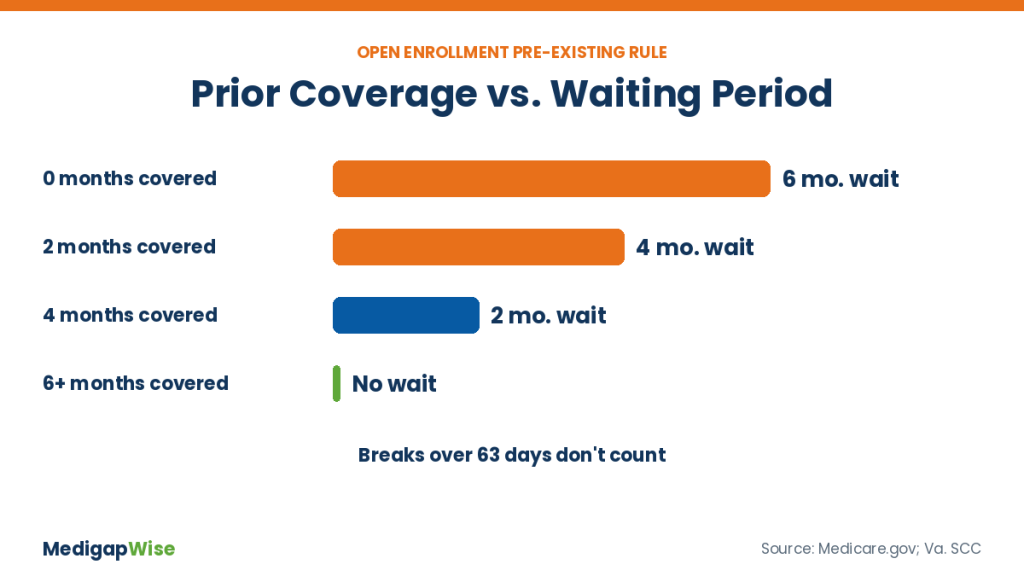
Medigap pre-existing condition waiting period by months of prior creditable coverage during open enrollment: 0 months means up to 6 months of waiting, 6 or more months means none

During open enrollment, the waiting period shrinks one month for every month of creditable coverage you had before the policy’s start date. Six months or more of continuous coverage means no wait at all. Two months means up to four. Coverage only counts if the break before the new policy was 63 days or less.

Creditable coverage is broad. Virginia’s State Corporation Commission lists Medicaid, Medicare Parts A and B, and group or individual health insurance as qualifying, so a worker who rolls straight off an employer plan usually arrives with full credit. People with a guaranteed issue right get an even better deal: Medicare’s guidance says the insurer can’t impose any pre-existing waiting period in that case.

Lapse check: A gap of 64 days or more between your old coverage and the Medigap start date wipes out the credit, which is one reason to line up the new policy before old coverage ends.

Questions? Talk to a Licensed Agent

We compare Plan G, Plan N and more from several insurance companies at no cost to you.

☎ 1-888-891-0229

No cost, no obligation to enroll

Signing After the Six Months, or During the Fall

From the seventh month on, an application with no guaranteed issue right is underwritten in most states. The insurer can ask about diagnoses, medications and planned treatment, then accept you at standard rates, accept you at a higher rate class, or decline. The kinds of questions are covered in Medigap underwriting questions. If accepted, the policy may also carry up to 6 months of waiting for a pre-existing condition, depending on the policy and state.

The fall Annual Enrollment Period, October 15 to December 7, doesn’t change that, since it governs Medicare Advantage and Part D rather than supplements. We explain what that window does and doesn’t do in changing Medicare Supplement plans during open enrollment. Event-based federal rights, such as losing employer coverage or a Medicare Advantage plan leaving your area, usually give 63 days to apply for a limited list of plan letters; see open enrollment vs guaranteed issue for the trigger list.

Compare Medicare Supplement prices before you apply

Speak with a licensed insurance agent

1-888-891-0229

Worked Example: One Applicant, Five Application Dates

Take a hypothetical applicant born July 20, 1962, who keeps employer coverage until June 30, 2027 and starts Part A and Part B on July 1, 2027. Her Medigap Open Enrollment Period runs July 1 through December 31, 2027. Here is what each application date gets her.

Application sent Timing bucket Can she be declined? Pre-existing wait Earliest start
Feb 10, 2027 Before Part B No None (6+ months employer coverage) Jul 1, 2027
Sep 15, 2027 Open enrollment, month 3 No None Oct 1, 2027
Nov 20, 2027 Open enrollment and fall AEP overlap No (protected by open enrollment, not AEP) None Dec 1, 2027
Mar 5, 2028 After open enrollment Yes, health questions apply Up to 6 months if the policy has one After approval
Nov 20, 2028 Fall AEP, no right Yes, health questions apply Up to 6 months if the policy has one After approval

Notice the third row: the November application is safe only because it still falls inside her six months. The same date a year later carries no protection. Start dates assume the common first-of-the-month practice; an insurer may offer other dates.

On Medicare Before 65: Apply Now, Then Shop Again at 65

People who qualify for Medicare through disability or kidney failure face a different starting point. Federal law doesn’t require insurers to sell them a Medigap policy, so the answer depends on the state. KFF’s October 13, 2026 review found 38 states require at least one policy for disabled enrollees under 65 during an initial window, while 12 states and DC require none. Some states add price limits; Virginia, for example, caps under-65 premiums at the age-65 rate for coverage bought or renewed after January 1, 2024.

Turning 65 brings a fresh 6-month open enrollment period for anyone already on Part B. Medicare has described it as a chance to buy with more choices and possibly a lower premium, and it applies even if no insurer would sell to you before. State rules for the under-65 group are compared in Medicare Supplement guaranteed issue rights by state.

States Where Any Day Can Work

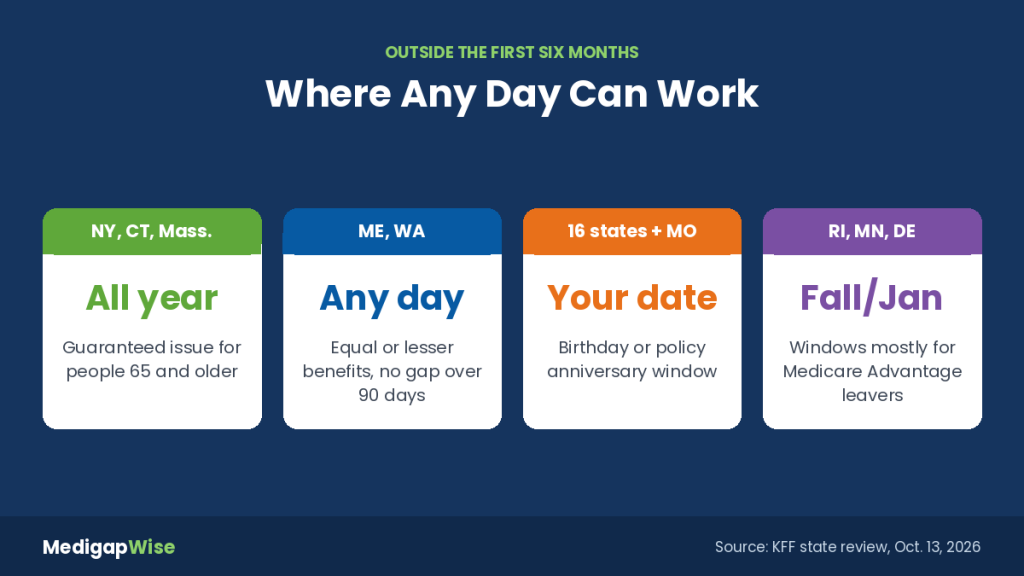
States where a Medicare Supplement application can be accepted without health questions outside the first six months: New York, Connecticut and Massachusetts all year, Maine and Washington with continuous coverage, birthday and anniversary states, and fall-window states

A few states take the timing question off the table for people 65 and older, and others open a door on a date tied to you. Grouped by how often the door opens:

Any day, anyone 65+

✔New York and Connecticut: guaranteed issue all year
✔Massachusetts: rule sets Feb. 1–Mar. 31, but insurers enroll year-round

Any day, if covered

✔Maine and Washington: switch to equal or lesser benefits with no gap over 90 days
✔Maine insurers also pick one month a year for Plan A

A date tied to you

✔16 birthday-rule states, including California and Illinois
✔Missouri: 30 days around the policy anniversary

Rhode Island, Minnesota and Delaware tie windows to the fall and January dates instead, mostly for people leaving Medicare Advantage. Birthday and anniversary rules only help someone who already holds a Medigap policy. Sources: KFF state review (October 13, 2026).

Ask an agent whether your state gives you a year-round right

Speak with a licensed insurance agent

1-888-891-0229

Keep Reading

Medicare Supplement Eligibility: who is allowed to buy a Medigap policy, including Medicaid, Medicare Advantage, under-65 and Plan F rules.

Applying for Medigap at Different Times: Common Questions

➤ Do Medicare Supplement applications have a cutoff date each year?

No. Insurers take Medigap applications in every month. The date matters only for whether the company must accept you, which depends on your open enrollment window, a guaranteed issue right or a state rule.

➤ How far ahead of turning 65 can I apply for a Medicare Supplement plan?

Many insurers accept an application up to about 6 months before your Part B start date, once Part B is scheduled. The exact lead time varies by company, so ask before you apply.

➤ When does a Medicare Supplement policy start once I’m approved?

If you applied before Part B began, it can start the same day as Part B. Otherwise, many insurers start policies on the first of the month after approval, or on a later date you choose.

➤ Does delaying Part B push back my Medigap open enrollment?

Yes. The six months begin only once you’re 65 or older and enrolled in Part B, so someone who delays Part B while covered by a current employer’s plan starts the window later.

➤ If my six months end while my application is still being processed, am I still protected?

The open enrollment rule applies to applications submitted before or during the window, so the submission date is what counts. Keep a copy of the signed, dated application.

➤ Does having Medicare Parts A and B count toward reducing a waiting period?

Yes. State guidance such as Virginia’s lists Medicare Parts A and B as creditable coverage, along with Medicaid and group or individual health insurance, as long as any break was 63 days or less.

➤ I bought Medigap before 65 because of a disability. Can I shop again at 65?

Yes. Turning 65 opens a new 6-month open enrollment period, during which you can buy any policy sold in your state without health questions, often at a lower premium than the under-65 rate.

➤ Can an insurer turn down an application I send in the fall?

Yes, unless you’re still in your first six months, have a guaranteed issue right, or live in a state with its own right. The October 15 to December 7 dates don’t protect Medigap applications.

Free Medigap Price Comparison

Call a Licensed Agent Now

Compare Plan G, Plan N and more from several insurance companies in one call.

☎ 1-888-891-0229

No cost, no obligation to enroll