






Speak with a licensed insurance agent

1-888-891-0229

Can I Switch From Plan N to Plan G? Rules, Health Questions and Costs for 2027

Reviewed by Russell Noga, Licensed Medicare Insurance Broker (all 50 states) — Last updated October 27, 2026

Key Takeaway

Yes, you can switch from Plan N to Plan G at any time of year, but in most states the new company can ask health questions and turn you down. Apply for Plan G first, keep Plan N until you’re approved, and work with an agent who times the switch so you’re never without coverage.

Plan N is a popular way to save on premiums, but some people later want the fuller coverage of Plan G, often after a few doctor or ER copays add up, or after moving to a state where doctors charge more than Medicare allows. The good news: there is no rule that locks you into Plan N.

The catch is timing. Outside your one-time open enrollment period, moving to Plan G usually means passing medical underwriting. Here is how switching from Plan N to Plan G works in 2027, where the exceptions are, and how to do it safely.

Compare Plan G prices in your area

Speak with a licensed insurance agent

1-888-891-0229

What Changes When You Move From Plan N to Plan G

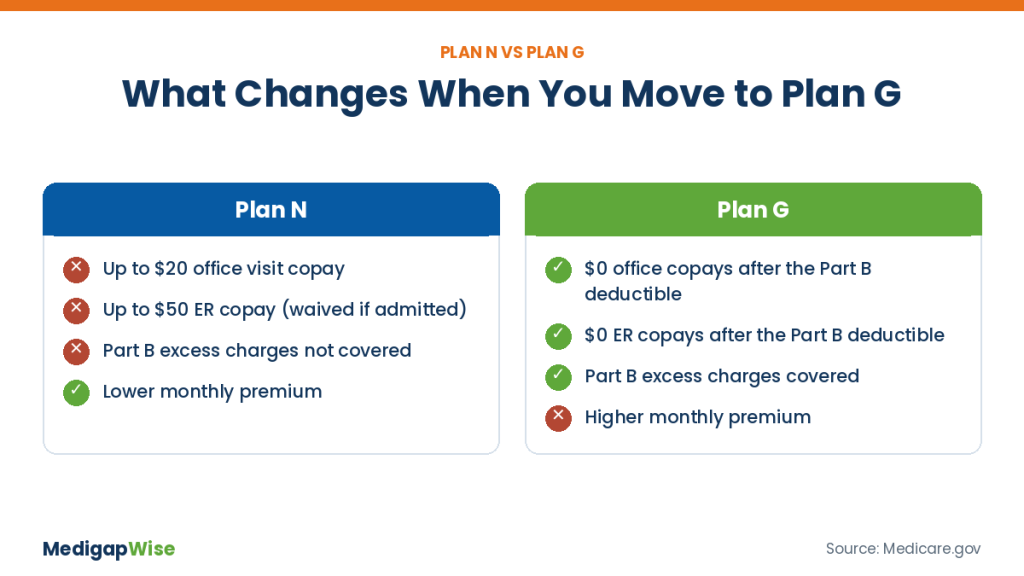
Switching from Medicare Supplement Plan N to Plan G: Plan G removes the office visit and ER copays and covers Part B excess charges

Plan N and Plan G cover the same core benefits: your Part A hospital costs, Part B coinsurance, skilled nursing coinsurance, the Part A deductible and foreign travel emergencies. Neither plan covers the Part B deductible. The differences are the copays and excess charges, and they are exactly what Plan G removes:

Benefit Plan N Plan G
Doctor office visits Up to $20 copay per visit $0 after the Part B deductible
Emergency room visits Up to $50 copay (waived if admitted) $0 after the Part B deductible
Part B excess charges Not covered Covered 100%
Part B deductible Not covered Not covered
Monthly premium Usually lower Usually higher

Part B excess charges are amounts some doctors may bill above the Medicare-approved amount, up to 15% more. A few states don’t allow excess charges at all, which makes Plan N’s gap smaller there. Learn more about every plan letter in our guide to Medicare Supplement plans.

Can You Switch Plans Any Time of Year?

Yes. Medicare Supplement plans don’t have an annual enrollment period like Medicare Advantage, so you can apply to change plans any month. What changes over time is whether a company has to accept you.

✔
During your 6-month open enrollment period (starts the month you are 65 or older and enrolled in Part B), companies must sell you any plan they offer, including Plan G, without health questions.
✔
After open enrollment, most states let companies use medical underwriting. They can decline you or charge more based on your health.
✔
With a guaranteed issue right, such as losing other coverage, you can buy certain plans without health questions, but these rights usually don’t apply to a simple Plan N to Plan G upgrade.

If you’re still inside your open enrollment window, this is the easiest time to move to Plan G. See the details in our guide to Medicare Supplement open enrollment.

See if you can switch to Plan G

Speak with a licensed insurance agent

1-888-891-0229

Will You Have to Answer Health Questions?

How to switch from Plan N to Plan G: compare companies, apply for Plan G, get approved, then cancel Plan N

In most states, yes. When you apply for Plan G outside open enrollment, the company asks about recent diagnoses, hospital stays, prescriptions and pending tests. Common reasons for a decline include:

✔
Recent cancer treatment, heart surgery or a stroke
✔
Kidney failure or dialysis
✔
Using oxygen or being scheduled for surgery
✔
Some combinations of prescription drugs that point to a serious condition

Good to know: Each company has its own underwriting rules. A decline from one insurer doesn’t mean every company will say no, which is why comparing several companies matters.

State exceptions: New York and Connecticut let you buy any Medigap plan at any time without health questions. Several states have birthday or anniversary rules, but those usually let you move only to a plan with equal or lesser benefits. Plan G has more benefits than Plan N, so in most birthday-rule states, switching from N to G still requires health questions.

How to Switch From Plan N to Plan G, Step by Step

When you can switch from Plan N to Plan G without health questions: open enrollment, guaranteed issue rights and states with year-round rules
1
Compare Plan G prices. Plan G benefits are the same with every company, so compare price, rate increase history and household discounts.
2
Apply for Plan G. Answer the health questions honestly. Keep paying your Plan N premium while you wait.
3
Wait for approval. Most companies give a decision within a few days to a few weeks.
4
Set your Plan G start date. Pick a start date that lines up with your Plan N paid-through date.
5
Cancel Plan N after Plan G is active. Call your Plan N company only once your new policy is approved and in force.

Work with us and we make the switch easy. A licensed agent times your new start date with your old policy, so you’re covered every day and don’t pay two premiums for the same month.

Questions? Talk to a Licensed Agent

We compare Plan G, Plan N and more from several insurance companies at no cost to you.

☎ 1-888-891-0229

No cost, no obligation to enroll

What Does Plan G Cost Compared With Plan N?

Plan G usually costs more each month than Plan N, because it covers the copays and excess charges Plan N leaves to you. Prices vary by age, ZIP code, tobacco use and company, so the gap can be small in some areas and larger in others.

Plan N makes sense if

✔You see the doctor a few times a year
✔You rarely go to the ER
✔Your doctors accept Medicare assignment

Plan G makes sense if

✔You see doctors or specialists often
✔You want no copays after the Part B deductible
✔Your doctors may charge excess charges

Example: if you see the doctor 10 times a year, Plan N’s copays could add up to $200, plus any ER copay. If Plan G costs less than about $17 a month more than your Plan N, it may cost about the same or less over a year. Run the numbers with a licensed agent using real quotes for your ZIP code. See more about pricing in our guide to Medicare Supplement plans cost.

Should You Stay With Plan N Instead?

Switching isn’t always the right move. Plan N still offers the same hospital and major medical protection as Plan G. Staying on Plan N can make sense if:

✔
You’re healthy, use few services and like the lower premium
✔
Your doctors accept Medicare assignment, so excess charges aren’t a concern
✔
You might not pass underwriting today and don’t want to risk your current coverage

Never cancel first: Don’t cancel Plan N before Plan G is approved. If you’re declined, you could end up without a Medicare Supplement plan and may not be able to get one back.

Mistakes to Avoid When Switching

✔
Canceling Plan N before Plan G is approved and active
✔
Leaving gaps in health answers, which can let the company rescind the policy later
✔
Comparing only premiums and ignoring rate increase history
✔
Assuming your state’s birthday rule covers an upgrade to Plan G
✔
Forgetting to ask about household discounts when you apply

Want the full background on plan choices? Read whether Medicare Plan G covers hearing aids and what else Plan G includes.

Get help switching Medicare Supplement plans

Speak with a licensed insurance agent

1-888-891-0229

Keep Reading

Should I Switch From Plan F to Plan G?: the 2027 costs, rules and state exceptions for moving from Plan F to Plan G.

Switching From Plan N to Plan G — Frequently Asked Questions

➤ Can I switch from Plan N to Plan G?

Yes. You can apply to switch from Plan N to Plan G any time of year. Outside your 6-month open enrollment period, most states let the company ask health questions and decline you, so apply for Plan G before you cancel Plan N.

➤ Do I have to answer health questions to switch from Plan N to Plan G?

In most states, yes. New York and Connecticut allow switching at any time without health questions. Birthday and anniversary rules in some states usually allow moves only to plans with equal or lesser benefits, which doesn’t include an upgrade from N to G.

➤ Is Plan G better than Plan N?

Plan G covers more: it has no office or ER copays after the Part B deductible and it covers Part B excess charges. Plan N usually costs less each month. Which is better depends on how often you see doctors and how much you want to spend on premiums.

➤ What is the difference between Plan N and Plan G?

Plan N has copays of up to $20 for office visits and up to $50 for ER visits that don’t lead to an admission, and it doesn’t cover Part B excess charges. Plan G covers both. Neither plan covers the Part B deductible.

➤ When is the best time to switch from Plan N to Plan G?

The easiest time is during your 6-month Medicare Supplement open enrollment period, when companies can’t use your health to decline you. After that, apply while you’re healthy, since underwriting looks at recent conditions.

➤ Can I switch from Plan N to Plan G with the same company?

Sometimes. Some companies let current customers change plans with simplified health questions, while others treat it as a new application. Ask your company and compare its Plan G price with other companies.

➤ Will I pay two premiums when I switch?

You shouldn’t. A licensed agent can set your Plan G start date to line up with your Plan N paid-through date, so you’re covered every day without paying for two policies in the same month.

➤ What happens if I’m turned down for Plan G?

Keep your Plan N policy. A decline from one company doesn’t mean every company will decline you, so an agent can check other insurers with different underwriting rules.

Free Medigap Price Comparison

Call a Licensed Agent Now

Compare Plan G, Plan N and more from several insurance companies in one call.

☎ 1-888-891-0229

No cost, no obligation to enroll