




Speak with a licensed insurance agent

1-888-891-0229

Can You Change Medicare Supplement Plans During Open Enrollment? 2027 Rules

Reviewed by Russell Noga, Licensed Medicare Insurance Broker (all 50 states) — Last updated November 5, 2026

Key Takeaway

You can apply to change Medicare Supplement plans during open enrollment, but the fall Annual Enrollment Period (October 15 to December 7) gives Medigap holders no special protection: it governs Medicare Advantage and Part D, so outside your one-time 6-month Medigap window, a guaranteed issue right or a state rule, the new insurer can still ask health questions. A Medigap application works the same way in November as in May.

2027 by the Numbers

Oct 15–Dec 7

2026 Annual Enrollment Period for 2027 Medicare Advantage and Part D (CMS)

Jan 1–Mar 31

Medicare Advantage Open Enrollment Period, for MA members only

$2,400

2027 Part D out-of-pocket cap, worth checking during the fall window (CMS)

20%

Minnesota lifetime surcharge on 2027 buyers who use its new fall window (Bulletin 2026-3)

Every October the mailbox fills with Medicare ads, and many people with a Medicare Supplement policy assume the fall season is their once-a-year chance to trade it in. It isn’t. Federal law has no yearly Medigap enrollment period, and the dates on the television commercials belong to other parts of Medicare.

That cuts both ways. Nothing stops you from shopping for a different Medigap policy this month, and nothing about December 7 closes the door. What the calendar does control is your drug plan, any move out of Medicare Advantage and, in three states, a new Medigap right built around these exact dates.

Check whether a cheaper Medigap policy will accept you

Speak with a licensed insurance agent

1-888-891-0229

Which Open Enrollment Are You Asking About?

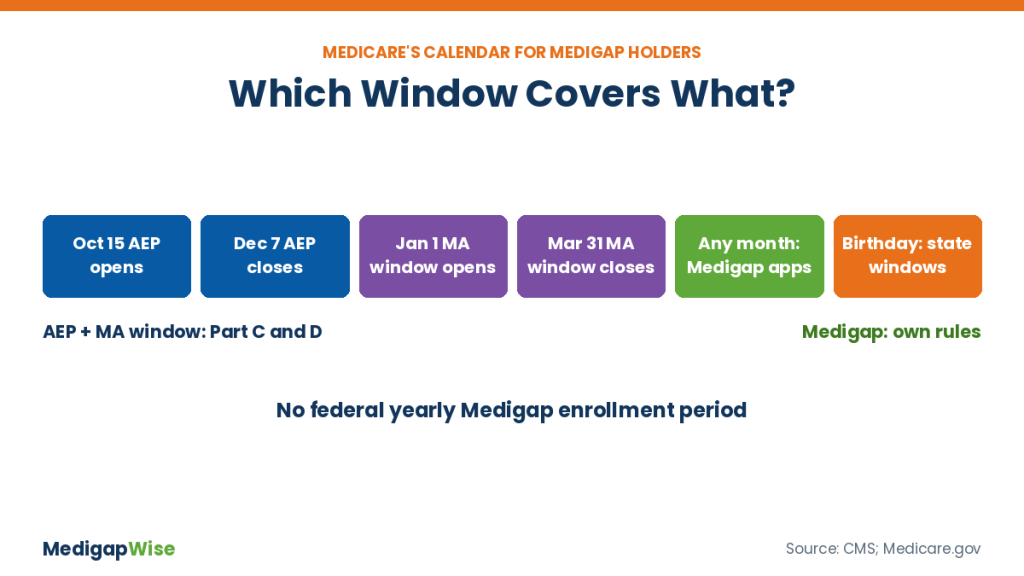
Medicare calendar for Medigap holders: Annual Enrollment October 15 to December 7, Medicare Advantage Open Enrollment January 1 to March 31, Medigap applications accepted any month and state birthday windows

Medicare uses the phrase open enrollment for several unrelated windows, which is the root of the confusion. The one running now, October 15 through December 7, 2026, is the Annual Enrollment Period. Changes made in it take effect January 1, 2027, and it applies to Medicare Advantage and Part D drug plans.

The Medicare Advantage Open Enrollment Period, January 1 through March 31, is narrower still: only people already in a Medicare Advantage plan can use it, for one change. Your Medigap open enrollment is a different thing entirely, a single 6-month stretch that begins the month you are 65 or older and enrolled in Part B. It never repeats. Our main guide to Medicare Supplement open enrollment covers how that first window is counted.

Bottom line on the calendar: A Medigap insurer treats an application dated November 20 the same way it treats one dated June 20. Neither date gives you a federal right to skip health questions.

What You Can Change, Window by Window

Line the windows up against the kinds of changes people ask about and the pattern is clear: the fall dates move drug and Medicare Advantage coverage, while Medigap runs on its own rules.

Window Dates Part D drug plan Medicare Advantage Medigap policy
Annual Enrollment Oct 15–Dec 7, 2026 Join, switch or drop Join, switch or leave Apply any time; underwriting usually applies
MA Open Enrollment Jan 1–Mar 31, 2027 Add one if leaving MA One switch or exit, MA members only Apply any time; underwriting usually applies
Medigap open enrollment 6 months from Part B at 65+ Not affected Not affected Any plan, no health questions
Federal guaranteed issue Usually 63 days after an event Depends on event Depends on event Listed plans, no health questions
State yearly rules Birthday, anniversary or set dates Not affected Not affected Protected switch in some states
Any other month Year-round Only with a special period Only with a special period Apply; insurer may decline or rate up

Sources: CMS enrollment period rules; Medicare.gov Medigap switching guidance; state insurance department rules summarized by KFF (October 13, 2026).

Compare Medicare Supplement prices for a January 1 start

Speak with a licensed insurance agent

1-888-891-0229

Changing Medigap Policies in November or Any Month

Since there is no seasonal gate, you can apply for a new policy whenever a lower price or a different plan letter appeals to you. The catch is the application itself. Outside protected windows, most insurers ask about recent diagnoses, hospital stays, prescriptions and planned surgeries, and they can decline you or place you in a higher rate class. The typical question set is laid out in Medigap underwriting questions.

Plan direction matters too. Moving to a plan with fewer benefits tends to be easier to approve than moving up. Common examples are covered in switching from Plan F to Plan G and the reverse-direction problem in switching from Plan N to Plan G.

Waiting period risk: Medicare.gov notes that if your current policy has been in force less than 6 months, the new insurer may make you wait before covering a pre-existing condition. Switching soon after buying can leave a short gap in coverage for that condition.

Where the Fall Window Does Reach Medigap Holders: Your Drug Plan

Medigap policies sold since January 1, 2006 can’t include prescription drug coverage, so almost every Medigap holder who has drug coverage gets it from a separate Part D plan. That plan is the piece the Annual Enrollment Period is built for. Premiums, formularies and pharmacy networks reset every January, and the window closing December 7 is the routine time to compare them.

For 2027, CMS set the standard Part D deductible at up to $700, up from $615, and the yearly out-of-pocket cap at $2,400, up from $2,100. Anyone on costly medicines should check how their current plan treats each drug in 2027 before the window closes. Plan options are explained in Medicare Part D, with 2027 premium and cap details in Medicare Part D cost.

✔
Your Medigap policy stays put when you switch drug plans; the two are separate contracts.
✔
Changing a drug plan doesn’t trigger any Medigap health questions, because the supplement isn’t being touched.
✔
Dropping Part D with no other creditable coverage can mean a late enrollment penalty if you rejoin later.

Questions? Talk to a Licensed Agent

We compare Plan G, Plan N and more from several insurance companies at no cost to you.

☎ 1-888-891-0229

No cost, no obligation to enroll

Leaving Medicare Advantage This Fall: Check Medigap Before You Leave

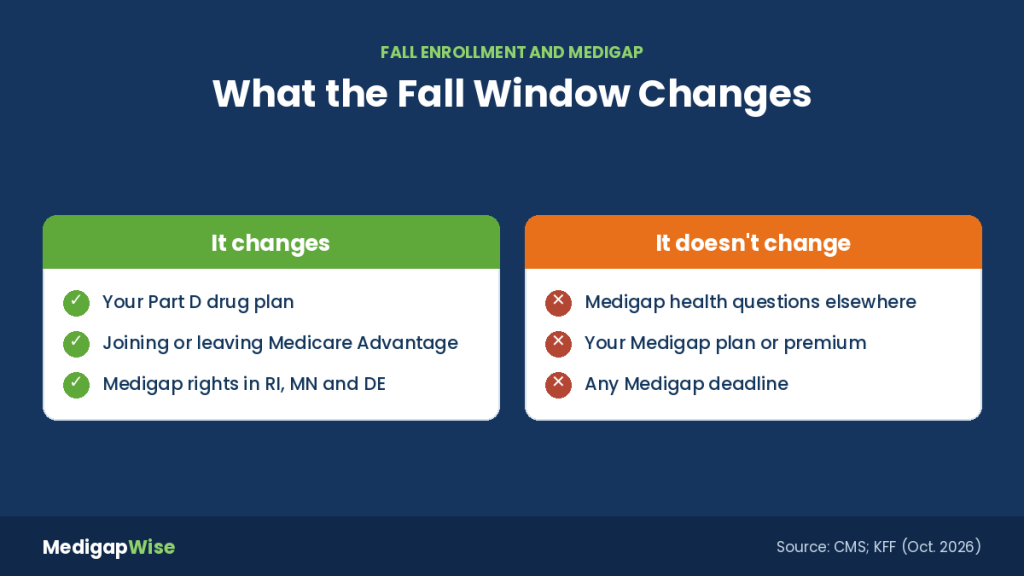
What the fall Annual Enrollment Period changes for Medicare Supplement holders, such as Part D plans and leaving Medicare Advantage, versus what it does not change, such as Medigap underwriting

The fall window, and the January to March window for current members, let you leave a Medicare Advantage plan and return to Original Medicare. Medicare will accept that move. A Medigap insurer doesn’t have to, unless you hold a guaranteed issue right or live in a state that grants one.

The main federal protection is the Medigap trial right, which covers people in their first 12 months of Medicare Advantage under specific conditions. Past that year, most applicants returning from Medicare Advantage go through underwriting. The order of steps matters: apply for the Medigap policy and get an approval before your Medicare Advantage disenrollment takes effect, so a decline doesn’t leave you on Original Medicare with no supplement.

Thinking about the opposite direction this fall? Read switching from a Medicare Supplement to Medicare Advantage first, since giving up a Medigap policy can be hard to undo.

Three States That Built Medigap Rights Around the Fall Dates

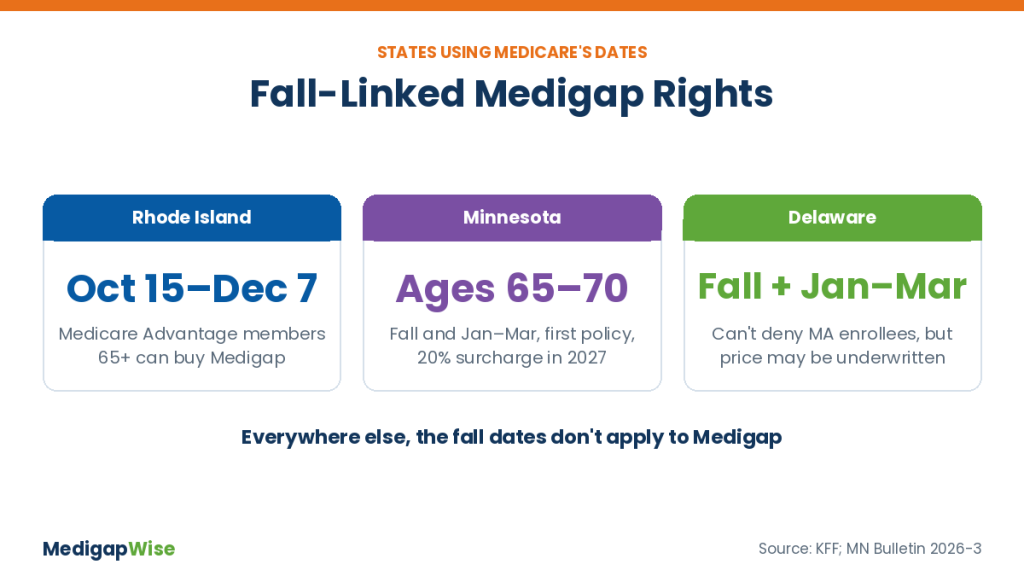
Three states that link Medigap rights to the Medicare fall calendar: Rhode Island October 15 to December 7, Minnesota ages 65 to 70 with a surcharge, and Delaware during both fall and January to March windows

A handful of states now borrow Medicare’s own calendar for Medigap, which makes the answer to the headline question yes for some residents. Each one works differently:

1
Rhode Island. Enacted in 2025, it gives Medicare Advantage enrollees 65 and older a yearly window to buy a Medigap plan during October 15 to December 7. KFF notes it doesn’t help people on Original Medicare who have no Medigap policy.
2
Minnesota, from August 1, 2026. Commerce Department Bulletin 2026-3 sets guaranteed issue for first-time Medigap buyers aged 65 to 70 during October 15 to December 7 (coverage starts January 1) and January 1 to March 31 (coverage starts the next month). KFF says the right can be used one time.
3
Delaware. KFF reports two yearly periods for Medicare Advantage enrollees 65 and older: the fall window and January 1 to March 31. Insurers can’t deny the application, but KFF says they may still use underwriting to set a higher premium.

Minnesota’s price tag: The bulletin attaches a surcharge under Minn. Stat. §62A.31, subd. 1r that lasts for the life of the policy: 15% for 2026 enrollees, 20% for 2027, rising 5 points a year to 35% for 2030 and later. Someone using the fall 2026 window for a January 2027 start should ask the insurer which year’s rate applies.

Ask an agent which fall changes apply to you

Speak with a licensed insurance agent

1-888-891-0229

Yearly State Windows That Follow Other Dates

Most state switching rules have nothing to do with the fall season. KFF’s October 13, 2026 review counts 16 birthday-rule states, where current policyholders get a window tied to their own birthday: California, Delaware, Idaho, Illinois, Indiana, Kentucky, Louisiana, Maryland, Nevada, New Mexico, Oklahoma, Oregon, Utah, Virginia, West Virginia and Wyoming. Missouri keys its window to the policy anniversary instead, and Connecticut and New York keep guaranteed issue open all year.

Maine and Washington let policyholders move to equal or lesser benefits at any time if their coverage hasn’t lapsed more than 90 days, with Washington limiting Plan A holders to another Plan A. The details of the 45-day Illinois version are in the Illinois Medicare Supplement birthday rule guide, the original model is in the California Medicare Supplement birthday rule guide, and every state’s window length sits in Medicare Supplement guaranteed issue rights by state.

How to Line Up a Medigap Switch for January 1

Many people like a new policy to start with the new year, alongside a new drug plan. The sequence below keeps you covered the whole way, whether or not your state gives you a protected window.

1
Price the same plan letter first. Benefits are standardized by letter, so the premium and the insurer’s rate history are what differ.
2
Apply in November or early December. Underwriting decisions can take a few weeks; an approval in hand before year-end leaves time to set dates.
3
Ask for a January 1 effective date. Then tell the old insurer, in writing, to end coverage December 31 so the two don’t overlap longer than needed.
4
Keep the old policy until the new one is issued. A pending application is not coverage, and a canceled policy usually can’t be reinstated.
5
Use the 30-day free look if needed. Federal rules give 30 days to review a new Medigap policy. Medicare.gov says you pay both premiums for the month you hold both.

Returning a new policy during the free look only works out if the old one is still active, as the Medicare Supplement free look period guide explains.

Keep Reading

Can I Sign Up for a Medicare Supplement Plan Anytime?: what happens to a Medigap application sent before Part B, in your first six months, after them, or with a state right.

Fall Enrollment and Your Medigap Policy: 8 Questions

➤ Does the October 15 to December 7 period let me switch Medigap plans without health questions?

Not under federal law. That window is for Medicare Advantage and Part D. A Medigap insurer can still underwrite you unless you’re in your first 6-month Medigap window, have a guaranteed issue right, or live in a state with its own rule.

➤ Is there a deadline to change Medicare Supplement plans before January?

No federal one. Medigap applications are accepted all year, so December 7 doesn’t end your chance to switch. Aim earlier only if you want the new policy to begin January 1.

➤ Can I use the January to March window to get a Medigap policy?

That window is for people already in Medicare Advantage, who can make one change, such as returning to Original Medicare. It doesn’t require a Medigap insurer to accept you, except in states like Minnesota and Delaware that tie a right to those dates.

➤ Should I change my Part D plan if I keep my Medigap policy?

It’s worth comparing every fall. Drug plan costs and formularies change each January, and for 2027 the deductible can reach $700 with a $2,400 out-of-pocket cap. Switching drug plans doesn’t touch your Medigap policy.

➤ Will my Medigap premium change during open enrollment?

Medigap rates don’t follow the fall calendar. Insurers file increases with the state and apply them on schedules they set, often on the policy anniversary or a set date.

➤ Can I go from Medicare Advantage back to Plan G this fall?

Medicare lets you leave Medicare Advantage during the fall window. Whether a Plan G insurer accepts you depends on underwriting, the federal trial right in your first year, or a state rule such as Rhode Island’s fall window.

➤ Who qualifies for Minnesota’s new fall Medigap window?

Residents aged 65 to 70 buying their first Medigap policy, starting August 1, 2026. Insurers add a surcharge for the life of the policy, set at 20% for 2027 enrollees.

➤ Where can I confirm my state’s switching rules before I apply?

Your state insurance department or State Health Insurance Assistance Program (SHIP) can confirm which windows apply to your policy and how the dates are counted.

Free Medigap Price Comparison

Call a Licensed Agent Now

Compare Plan G, Plan N and more from several insurance companies in one call.

☎ 1-888-891-0229

No cost, no obligation to enroll