




Speak with a licensed insurance agent

1-888-891-0229

Medicare Birthday Rule States 2027: All 16 States, Their Windows and the Fine Print

Reviewed by Russell Noga, Licensed Medicare Insurance Broker (all 50 states) — Last updated November 9, 2026

Key Takeaway

As of late 2026, 16 states have a Medicare Supplement birthday rule in effect for 2027 birthdays: California, Delaware, Idaho, Illinois, Indiana, Kentucky, Louisiana, Maryland, Nevada, New Mexico, Oklahoma, Oregon, Utah, Virginia, West Virginia and Wyoming. Missouri uses a policy-anniversary window instead, and New York and Connecticut skip health questions all year, so they need no birthday rule.

2027 by the Numbers

16 states

Birthday-based Medigap windows for 2027 (our count from state laws; KFF, Oct. 2026, also lists 16)

3 states

Open the window on the 1st of your birth month, not your birthday: NV, NM, WV (state statutes)

6 states

Require insurers to warn you before each window: CA, DE, MD, NV, NM, VA (state statutes)

71,380

New Mexico Medigap enrollees (Sept. 2024) newly covered on Jan. 1, 2027 (NM Aging & Long-Term Services)

A birthday rule is a state law, not a Medicare rule, so the answer to “can I switch my Medigap plan this year without health questions?” changes the moment you cross a state line. Two neighbors on the same Plan G can have very different options: one gets 63 days and any company in the state, the other gets 45 days and must stay with the same insurance group.

This hub puts every birthday-rule state on one page, built from each statute, regulation or insurance department notice rather than from other summaries. It shows how the windows differ, works out real 2027 dates for one birthday in every state and explains what to do if your state has no rule at all.

Check the birthday rule where you live

Speak with a licensed insurance agent

1-888-891-0229

Which States Have a Birthday Rule for 2027

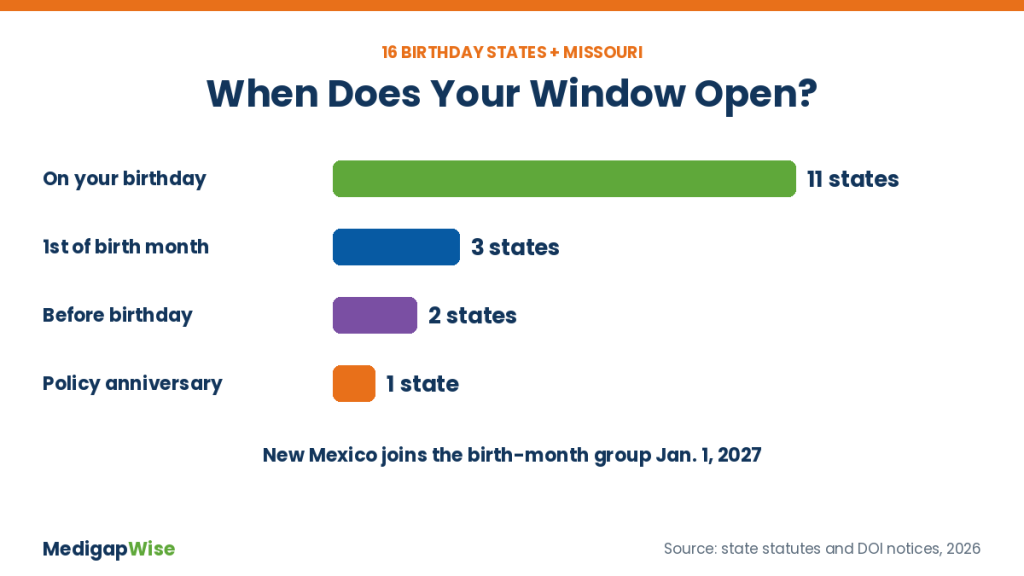
How Medicare birthday rule windows open by state: 11 states start on the birthday, 3 on the first of the birth month, 2 before the birthday, and Missouri on the policy anniversary

Every one of these laws does the same basic job: once a year, a person who already owns a Medigap policy can apply for a replacement and the insurer can’t use health to refuse, delay or reprice it. Where they split is the calendar. Sorting the 16 states by the day the window opens gives three groups:

✔
Opens on your birthday (11 states): California, Idaho, Illinois, Kentucky, Louisiana, Maryland, Oklahoma, Oregon, Utah, Virginia and Wyoming.
✔
Opens on the 1st of your birth month (3 states): Nevada, New Mexico (starting January 1, 2027) and West Virginia (since June 11, 2026).
✔
Opens before your birthday (2 states): Delaware, 30 days ahead, and Indiana, one month ahead, both starting January 1, 2026.

Seven of the 16 rules began in 2025 or later (Utah, Virginia, Wyoming, Delaware, Indiana, West Virginia and New Mexico), so lists published even a year ago tend to be short by several states. Hawaii appears on some older summaries, but the NAIC’s May 2026 chart gives no window length, plan rule or citation for it, so we left it off.

The 16 States Side by Side

Each row comes from the rule’s own text or the state insurance department’s guidance, checked against the NAIC chart dated May 11, 2026. “Equal or lesser” means the new policy can’t have more standardized benefits than the one you’re replacing.

State Window Switch to Which insurer Law / start
California 60+ days from birthday Equal or lesser Any Ins. Code §10192.11
Delaware 30 days before to 30+ after Same or lesser Any SB 71; Jan. 1, 2026
Idaho 63 days from birthday Similar or lesser Any IDAPA 18.04.10; Mar. 2022
Illinois 45 days from birthday, ages 65–75 Equal or lesser Current or affiliate 215 ILCS 5/363(8)
Indiana 1 month before to 1 month after Same plan letter A different insurer HEA 1226; Jan. 1, 2026
Kentucky 60 days from birthday Same plan A different insurer KRS 304.14-525; 2024
Louisiana 63 days from birthday Equal or lesser Current or affiliate R.S. 22:1112; Aug. 1, 2023
Maryland Birthday + 30 days after Equal or lesser Any Ins. §15-909; July 1, 2023
Nevada 60+ days from 1st of birth month Same or fewer Any NRS 687B.352
New Mexico 60+ days from 1st of birth month Equal or lesser value Any SB 21; Jan. 1, 2027
Oklahoma 60 days from birthday Equal or lesser Any OAC 365:10-5-129; Sept. 1, 2023
Oregon Birthday + 30 days after Same or lesser Any OAR 836-052-0143
Utah 60 days from birthday Comparable or lower Current only §31A-22-620; May 7, 2025
Virginia 60+ days from birthday Same benefits Any §38.2-3611; July 1, 2025
West Virginia 60 days from 1st of birth month Same or lesser Current or affiliate* §33-15F-1; June 11, 2026
Wyoming 63 days from birthday Same or lesser Any Bulletin 06-2025; June 2025

*West Virginia allows any insurer only if your company and its affiliates haven’t accepted applications for the same or lesser benefits for at least 12 months. Rows shaded blue changed or began in 2026 or 2027.

Two rows to double-check: Oregon’s rule text starts the window on your birthday, while the NAIC chart also lists 30 days before it, and Wyoming’s Bulletin 06-2025 update is newer than some state summaries. Confirm both with the state insurance department before you act.

Compare Medicare Supplement prices before your window

Speak with a licensed insurance agent

1-888-891-0229

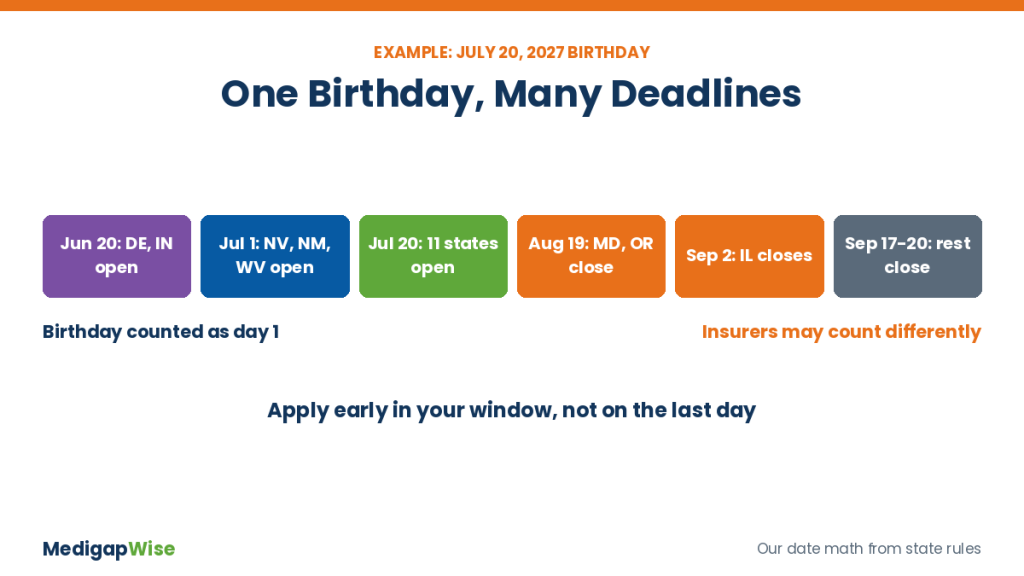
Example: One July 20, 2027 Birthday in Every State

Medigap birthday windows for a July 20, 2027 birthday: Delaware and Indiana open June 20, Nevada, New Mexico and West Virginia open July 1, Maryland and Oregon close August 19, 60-day states close September 17 and 63-day states September 20

The same birthday produces very different deadlines. We ran the dates for a policyholder born July 20, counting the birthday as day one, which is how Oklahoma’s insurance department tells insurers to count. Some companies count from the day after, so treat the closing dates as the earliest safe deadline, not the latest.

1
June 20, 2027: Delaware and Indiana open. Delaware’s window starts 30 days early and runs at least to August 19; Indiana’s runs from June 20 to August 20.
2
July 1, 2027: Nevada, New Mexico and West Virginia open. All three count from the 1st of the birth month, so applications close around August 30 even though the birthday is weeks later.
3
July 20, 2027: the 11 birthday-start states open. California, Idaho, Illinois, Kentucky, Louisiana, Maryland, Oklahoma, Oregon, Utah, Virginia and Wyoming begin on the birthday itself.
4
August 19, 2027: Maryland and Oregon close. These are the shortest windows, at the birthday plus 30 days.
5
September 2, 2027: Illinois closes. Day 45, for policyholders aged 65 through 75.
6
September 17 and 20, 2027: the rest close. The 60-day states (California, Kentucky, Oklahoma, Utah, Virginia) end September 17; the 63-day states (Idaho, Louisiana, Wyoming) end September 20.

Most windows only require the application to arrive in time. Oklahoma’s guidance and West Virginia’s statute both say the new policy may start after the window closes, often on the first of the next month.

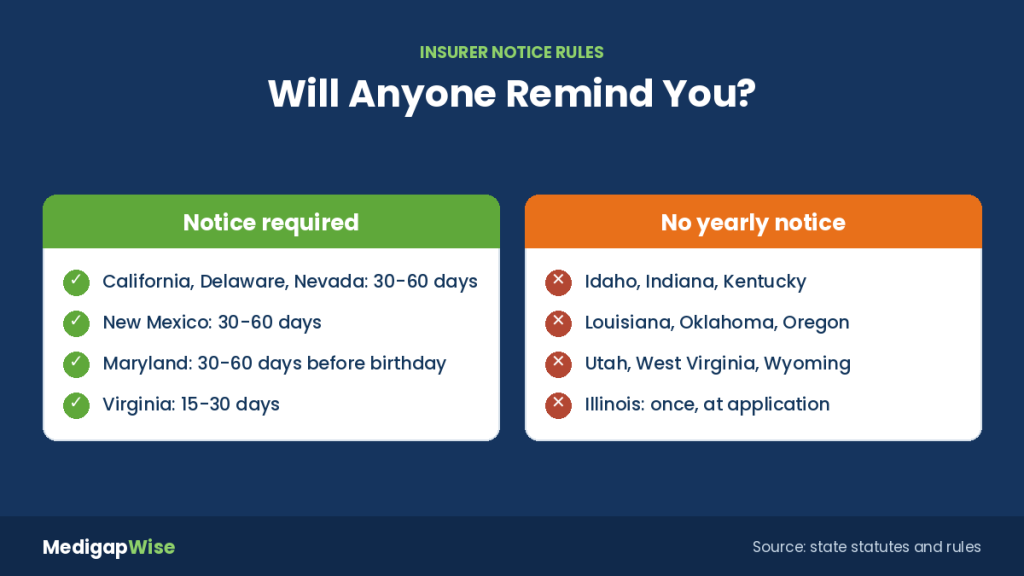
Which States Mail You a Reminder

Which Medicare birthday rule states require insurers to send advance notice: California, Delaware, Maryland, Nevada, New Mexico and Virginia do, while Idaho, Kentucky, Oklahoma, Oregon and others have no notice in the rule

A window you don’t know about is worth nothing, and only some states make the insurer tell you it’s coming. Reading the notice clauses side by side shows three approaches:

30 to 60 days ahead

✔California, Delaware, Nevada and New Mexico, counted from the window’s start
✔Maryland, counted from your birthday

15 to 30 days ahead

✔Virginia, with the window dates and any premium change in the letter

No yearly notice in the rule

✔Idaho, Indiana, Kentucky, Louisiana, Oklahoma, Oregon, Utah, West Virginia, Wyoming
✔Illinois tells you once, when you apply

In the third group, put your window dates on a calendar yourself. A state health insurance assistance program (SHIP) counselor can confirm how your state counts the days at no cost.

Questions? Talk to a Licensed Agent

We compare Plan G, Plan N and more from several insurance companies at no cost to you.

☎ 1-888-891-0229

No cost, no obligation to enroll

Equal-or-Lesser, Same-Plan and Same-Insurer States

The second big difference is what you’re allowed to buy. Most states use an equal-or-lesser test, so a Plan G holder could move to Plan G or a plan with fewer benefits, such as Plan N. A few are tighter:

✔
Same plan letter, new company: Kentucky and Indiana are built for price shopping. You keep your letter and move to a different insurer; Indiana’s fact sheet treats High-Deductible G to standard G as the same letter.
✔
Same benefits, any company: Virginia requires the new policy to match your current benefits, so stepping down a letter isn’t covered.
✔
Stay in the insurer family: Illinois, Louisiana and West Virginia let you move to your company or an affiliate; Utah limits you to your current insurer.
✔
Extra conditions: Oklahoma requires no gap in Medigap coverage longer than 90 days, West Virginia requires 24 months on your current policy, and Illinois stops at age 75.

If you’re stepping down a letter, compare what you’d give up first. Our pages on Medicare Supplement Plan G and Plan N lay out the coverage gap.

Have an agent count your window dates

Speak with a licensed insurance agent

1-888-891-0229

Missouri's Anniversary Rule and the Year-Round States

Missouri is the only state that ties its yearly window to the policy, not the person. Under 20 CSR 400-3.650, if you replace your Medigap policy within 30 days of its annual anniversary, any company selling the same plan must accept you, and a renewal or billing notice proves the date. Plan changes aren’t protected, only the same letter.

New York and Connecticut sit in a different category: insurers there sell Medigap to people 65 and older without health questions in any month, so a birthday window would add nothing. Maine, Washington, Massachusetts, Minnesota and Rhode Island have their own continuous-coverage or calendar windows, which our guide to Medicare Supplement guaranteed issue rights by state covers alongside the federal rights.

Getting Ready for Your 2027 Window

1
Confirm you qualify. Every birthday rule assumes a Medigap policy is in force. Medicare Advantage members and people with no supplement can’t use one; check Medicare Supplement eligibility if you’re unsure where you stand.
2
Write down your dates. Use the table above to find when your state opens and closes, and how it counts. A birth-month state opens weeks before your birthday.
3
Price the same plan elsewhere. Since benefits are standardized, compare premiums and each company’s history using our guide to Medicare Supplement rate increases.
4
Weigh any discount you’d lose. A household discount may not follow you to a new company.
5
Apply, then cancel. Keep the old policy until the new one is approved, and end it the day before the new coverage starts.

Your one-time Medicare Supplement open enrollment period still gives the widest choice of any window; birthday rules are a yearly second chance, not a replacement for it.

If Your State Has No Birthday Rule

In the other 34 states, you can still apply for a new Medigap policy any day of the year. The company will usually review Medigap underwriting questions, and a healthy applicant is often approved. If you aren’t, you keep the policy you have.

Federal guaranteed issue rights, such as your insurer going bankrupt or your Medicare Advantage plan leaving your area, apply everywhere. People who move should also check the new state’s rule: Idaho’s insurance department says newcomers get the same 63-day window, and Delaware’s rule reaches policies bought out of state by people who now live there.

For the two most-searched states in full, read the California Medicare Supplement birthday rule and the Illinois Medicare Supplement birthday rule guides.

Keep Reading

Do You Have to Renew a Medicare Supplement Plan Every Year?: why a Medigap policy renews on its own, what can change each year, and the few ways an insurer can end it.

Birthday Rule States: Questions People Ask

➤ How many states have a Medigap birthday rule in 2027?

Sixteen, counting New Mexico, whose law starts January 1, 2027. Missouri’s anniversary window works much like a birthday rule but is tied to the policy date, which would make 17.

➤ Which birthday-rule state gives the longest window?

Idaho, Louisiana and Wyoming each allow 63 days from the birthday. Indiana’s span of one month before through one month after is roughly as long, but it is limited to the same plan letter.

➤ Is Florida, Texas or Arizona a birthday rule state?

No. None of the three had a birthday window in the NAIC’s May 2026 chart or KFF’s October 2026 review. Health questions usually apply when you change policies there outside a guaranteed issue situation.

➤ Does the birthday rule apply to Medicare Advantage plans?

No. Every state’s rule covers only people who already hold a Medicare Supplement policy. Medicare Advantage has its own fall and January to March enrollment periods.

➤ Can I use the birthday rule if I just moved to a new state?

Often yes, because the rule follows where you live and the policy you hold. Idaho and Delaware say so directly. Ask the new state’s insurance department how it treats a policy bought elsewhere.

➤ Do I have to apply on my exact birthday?

No. You only need to apply inside the window. In Nevada, New Mexico and West Virginia the window opens on the 1st of your birth month, and in Delaware and Indiana it opens before your birthday.

➤ Will a birthday switch reset my deductible?

It can. Idaho and Delaware both warn that buying a new high-deductible plan mid-year may restart that deductible, while the Part B deductible you’ve already met with Medicare stays met.

➤ Can more states add a birthday rule?

Yes. Seven states adopted or expanded one between 2025 and 2027, and bills are filed most sessions. Check your state insurance department each year before relying on a list.

Free Medigap Price Comparison

Call a Licensed Agent Now

Compare Plan G, Plan N and more from several insurance companies in one call.

☎ 1-888-891-0229

No cost, no obligation to enroll