




Speak with a licensed insurance agent

1-888-891-0229

Do You Have to Renew a Medicare Supplement Plan Every Year? 2027 Renewal Rules

Reviewed by Russell Noga, Licensed Medicare Insurance Broker (all 50 states) — Last updated November 11, 2026

Key Takeaway

No, you don’t have to renew a Medicare Supplement plan every year: any Medigap policy issued since 1992 is guaranteed renewable, so it carries over automatically as long as you keep paying the premium and told the truth on your application. What moves from year to year is the price and the Medicare amounts the policy fills in, and your separate Part D drug plan is the piece that runs on the fall enrollment calendar.

2027 by the Numbers

$3,050

2027 deductible for High-Deductible Plans F and G (CMS)

$1,736

2026 Part A deductible that Plan G and Plan N pick up; 2027 amount not yet released (CMS)

30 days

Minimum notice before Medicare-driven benefit or premium changes (NAIC model rule §17)

$2,400

2027 Part D out-of-pocket cap, reviewed separately from Medigap (CMS)

Car insurance asks you to renew. So does a homeowner’s policy, and so does Medicare Advantage in a way, because the plan’s benefits and network are rewritten each January. It’s natural to expect a Medicare Supplement policy to work the same way, with a form to return or a deadline to watch every fall.

It doesn’t. A Medigap policy is closer to a standing contract: once issued, it stays in force year after year without any action from you. This guide covers the rules that make that true, the handful of things that still shift each year, the narrow ways a policy can end, and what deserves a once-a-year look anyway.

Check what your current Medigap policy costs elsewhere

Speak with a licensed insurance agent

1-888-891-0229

No Yearly Re-Enrollment: How Guaranteed Renewal Works

Medicare’s official guide, Choosing a Medigap Policy, puts it in one line: any new Medigap policy issued since 1992 is guaranteed renewable even if you have health problems. The insurer can’t decline to continue it because you were diagnosed with cancer, had a stroke or filed a large number of claims. Your policy simply rolls into the next policy year on its anniversary date.

The wording comes from the NAIC model regulation that states use to carry out the federal Medigap standards in Section 1882 of the Social Security Act. Section 8.1A(5) of that model says each policy shall be guaranteed renewable and that the issuer may not cancel or non-renew it for any reason other than nonpayment of premium or material misrepresentation. A separate clause bars cancellation solely on the ground of health status.

Older policies: A policy bought before 1992 doesn’t carry the same promise. Medicare’s guide says the insurer can refuse to renew one of those if the state approves the cancellation, so anyone holding a pre-1992 contract should keep an eye on renewal mail.

The Renewal Rules Side by Side

No single consumer source lines up the rules that keep a Medigap policy running. We pulled them from the model regulation, Medicare’s guide and three state statutes. Your own state’s version may number things differently, but the substance is similar across states.

Rule What it requires Where it comes from
Guaranteed renewable No cancellation or non-renewal except for unpaid premium or material misrepresentation NAIC model §8.1A(5); Medicare.gov guide
Health can’t end coverage Insurer may not cancel or non-renew solely because of health status NAIC model §8.1A(5)(a)
Medicare amounts update Benefits tied to Medicare cost sharing change automatically; premiums may be adjusted to match NAIC model §8.1A(3)
Advance notice Policyholders told no later than 30 days before the annual effective date of Medicare benefit changes NAIC model §17B
Claims paid back At least 65% of premiums (individual) or 75% (group) expected to go to benefits NAIC model §14A
Grace period, Minnesota At least 10 days for monthly premiums, 7 for weekly, 31 for other modes Minn. Stat. §62A.04
Lapse protection, Kansas Late-premium notice within 45 days of the due date; paying within 45 days of mailing reinstates with no new waiting period K.S.A. 40-2221a
Lapse protection, Maine Notice to you and a person you name before cancellation; 90 days to seek reinstatement for cognitive impairment 24-A M.R.S. §5016

Rows shaded blue are examples of state add-ons; many states have their own grace-period and lapse rules, so check the policy’s own grace-period clause or your state insurance department.

Compare Medicare Supplement prices before your next rate change

Speak with a licensed insurance agent

1-888-891-0229

What Still Changes Each January and at Your Anniversary

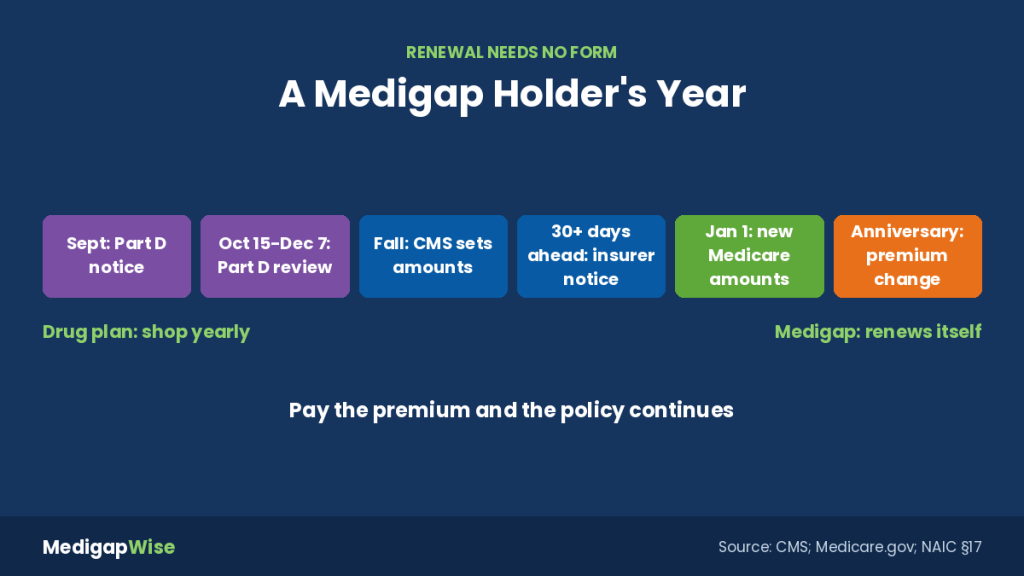
Yearly cycle for a Medigap policyholder: Part D notice in September, Part D review October 15 to December 7, insurer notice of Medicare changes, new Medicare amounts January 1, and the premium change on the policy anniversary

Renewal is automatic, but the numbers inside the policy aren’t frozen. Two different kinds of change reach you on different schedules.

✔
Medicare’s own amounts. CMS resets the Part A deductible, the Part B deductible and the Part B premium each year, normally in the fall. Under §8.1A(3), a plan that covers the Part A deductible, such as Plan G or Plan N, covers the new figure automatically. For 2026 that deductible is $1,736. As of November 11, 2026, CMS had not released the 2027 amounts.
✔
High-deductible thresholds. CMS has already set the 2027 deductible for High-Deductible Plans F and G at $3,050, so anyone on High-Deductible Plan G starts the year with a slightly higher amount to meet before the plan pays.
✔
Your premium. The insurer files rates with the state and usually applies changes on your policy anniversary or on a set company-wide date, not necessarily January 1.

Plan G never covers the Part B deductible ($283 in 2026), so that out-of-pocket amount also moves each January when CMS updates it. The policy adjusts; you don’t sign anything.

How the Premium Can Climb While the Policy Keeps Renewing

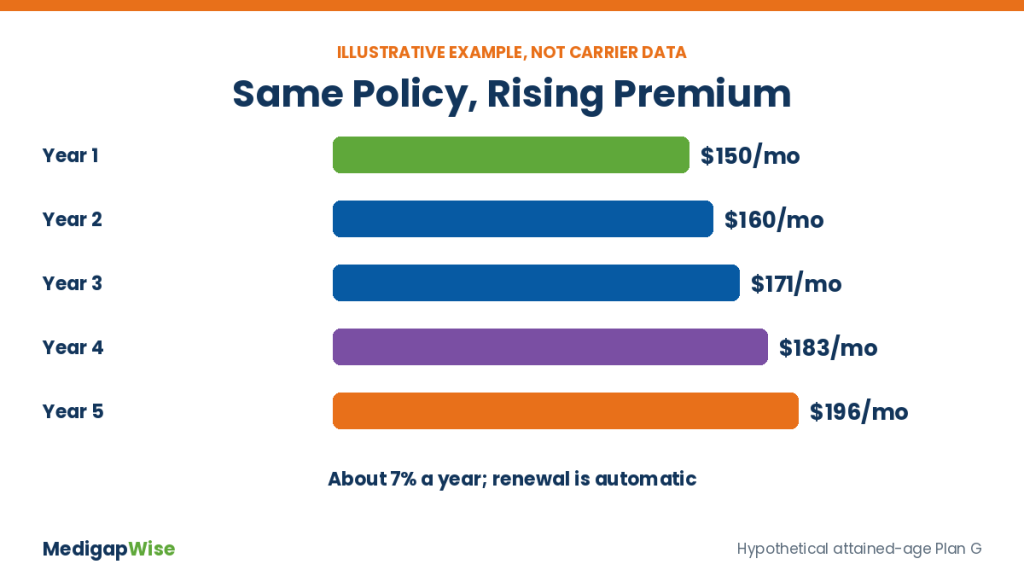
Illustrative five-year premium path for a renewing Medicare Supplement policy rising from 150 dollars to 196 dollars a month while coverage continues automatically

Medicare’s guide names three ways insurers price Medigap: community-rated, where everyone pays the same regardless of age; issue-age-rated, based on your age when you bought; and attained-age-rated, which rises as you get older. All three can also go up for inflation and claim costs. The loss-ratio standard in the table caps how much of each premium dollar can be kept rather than paid out, which is the check states apply when reviewing a rate filing.

Worked example (illustrative only, not a real carrier’s rates): suppose an attained-age Plan G starts at $150 a month at 65 and rises about 7% each year from age steps plus trend increases. The policy renews every year without a single form, but the monthly bill moves like this:

1
Year 1: $150 a month, $1,800 for the year.
2
Year 2: $160 a month, $1,920 for the year.
3
Year 3: $171 a month, $2,052 for the year.
4
Year 4: $183 a month, $2,196 for the year.
5
Year 5: $196 a month, $2,352 for the year, or $10,320 over five years.

If, in year 4, a healthy policyholder found the same Plan G for $160 elsewhere, the saving would be $23 a month, or $276 a year. That’s the reason to price the policy each year even though renewal needs nothing from you. Real carrier histories are tracked in our guide to Medicare Supplement rate increases.

Questions? Talk to a Licensed Agent

We compare Plan G, Plan N and more from several insurance companies at no cost to you.

☎ 1-888-891-0229

No cost, no obligation to enroll

The Narrow Ways a Medigap Policy Can End

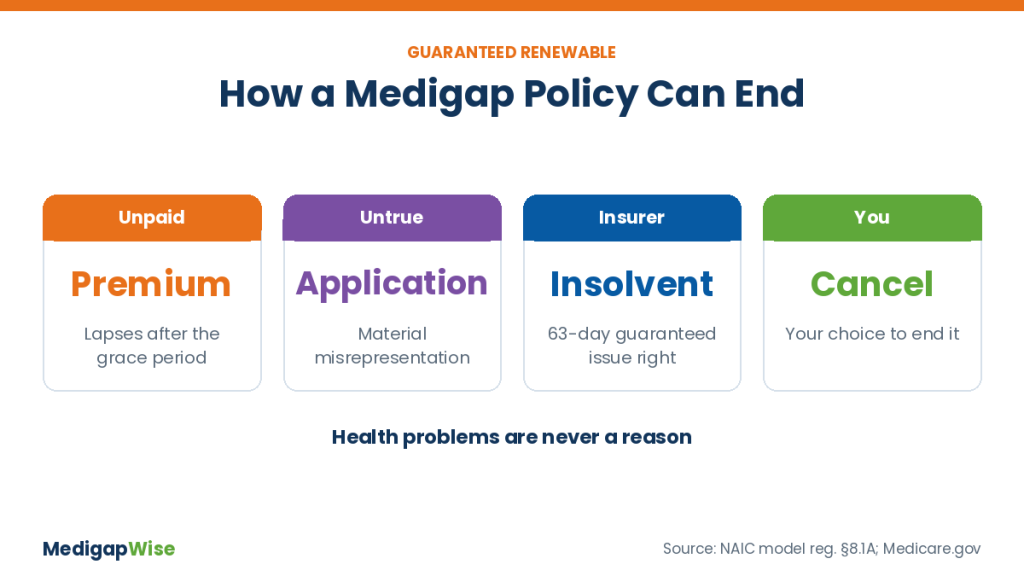
The only ways a Medicare Supplement policy ends: you stop paying the premium, you misstated facts on the application, the insurer becomes insolvent, or you cancel it yourself

Because the insurer’s hands are tied, nearly every Medigap policy that ends does so for one of four reasons:

Unpaid premium

✔Coverage lapses after the grace period in your policy
✔Some states give extra notice or a reinstatement path

Untrue application

✔Material misrepresentation is a lawful reason to cancel
✔Answer every health question accurately

Insurer failure

✔Bankruptcy or insolvency ends the policy
✔A federal guaranteed issue right follows, with 63 days to apply

Your own choice

✔You cancel or replace it
✔Coverage stops when you tell the insurer to stop it

The insolvency case is the only one where you’re protected going forward: Medicare.gov says you have 63 days from the end of coverage to buy a new policy without health questions, and the plan letters available are listed in open enrollment vs guaranteed issue. Keep the insurer’s termination letter as proof.

Auto-pay safeguard: Bank-draft billing is the simplest way to avoid a lapse, but a closed account or a new card can break it. Where your state allows, name a relative or friend to receive any late-payment notice, which is what Maine’s rule is built around.

Keep or Shop: The Once-a-Year Review

Medigap has no annual enrollment season, so the fall dates in Medicare ads don’t open or close anything for your supplement; the full calendar picture is in changing Medicare Supplement plans during open enrollment. You can still choose, once a year, whether to keep the policy or test the market.

In most states, switching means answering health questions. In the states covered in Medicare birthday rule states, a yearly window lets current policyholders move without underwriting, and Missouri ties its window to the policy anniversary. Outside those windows, a healthy applicant is often approved; the typical questions are in Medigap underwriting questions.

If you do switch, the new policy comes with a 30-day free look period. Keep the old policy in force until the new one is issued, and expect to pay both premiums for any month you hold both.

Ask an agent to review your renewal letter

Speak with a licensed insurance agent

1-888-891-0229

What to Do With a Renewal or Rate-Increase Letter

1
Find the effective date and new premium. The letter names both. Note whether the change comes from Medicare’s yearly amounts or from the insurer’s own rate filing.
2
Check what’s being paid for. Benefits for the same plan letter are identical across companies, so a higher bill doesn’t mean more coverage.
3
Look up your state’s window. If you live in a birthday or anniversary state, the letter may arrive just before your protected period.
4
Get quotes for the same plan letter. Compare price and each insurer’s rate history, and ask whether a household discount would carry over.
5
Do nothing if you’re staying. Keep paying the new premium; the policy renews on its own.

Our main guide to Medicare Supplement open enrollment explains the one-time window that gave you the policy in the first place, and why it’s the reason to think twice before letting a guaranteed renewable contract go.

Your Part D Plan Is the Part That Needs a Yearly Look

Medigap plans sold after 2005 don’t include prescription drug coverage, so most policyholders also carry a stand-alone Part D plan. That plan is a one-year contract with Medicare. It sends an Annual Notice of Change each September, and its premium, drug list and pharmacy network can all shift on January 1.

The fall Annual Enrollment Period, October 15 to December 7, is when you compare and switch drug plans, and doing so never touches your Medigap policy. For 2027, the standard Part D deductible rises to $700 and the out-of-pocket cap to $2,400. Plan choices are laid out in Medicare Part D.

Two contracts, two clocks: The supplement renews on its anniversary with no action needed; the drug plan deserves a fresh comparison every fall.

Keep Reading

Medicare Supplement for Disabled Under 65 (2027): the state laws that let people on disability buy Medigap before 65, the plan limits and price caps, and the reset at 65.

Medigap Renewal: 8 Questions Policyholders Ask

➤ Will my Medicare Supplement policy stop on December 31 if I do nothing?

No. A Medigap policy has no calendar-year end date. It continues into the next policy year on its own as long as the premium is paid.

➤ Do I need to send a renewal form back to my Medigap insurer?

No form is required. The insurer may mail a notice about new Medicare amounts or a premium change, but those are informational; paying the bill keeps the policy active.

➤ Can the company drop me after a serious diagnosis?

Not for a policy issued since 1992. Guaranteed renewability means health status can’t be a reason to cancel or refuse to continue it. Only unpaid premiums or a material misstatement on the application can.

➤ How much warning do I get when Medicare’s deductibles change?

The NAIC model rule requires insurers to notify policyholders at least 30 days before the annual effective date of Medicare benefit changes. Notice periods for the insurer’s own rate increases depend on state rules.

➤ What happens if a premium payment is a few days late?

Every policy has a grace period during which coverage stays in force. Minnesota, for example, requires at least 10 days on monthly billing and 31 days on other modes. Some states, such as Kansas and Maine, add notice or reinstatement rules.

➤ If my Medigap insurer goes under, will I be left without a supplement?

You get a federal guaranteed issue right. Medicare.gov says you have 63 days after coverage ends to buy a new policy from another company without health questions.

➤ Will Plan G cover the 2027 Part A deductible even though it isn’t announced yet?

Yes. Benefits tied to Medicare’s cost sharing update automatically, so Plan G pays whatever Part A deductible CMS sets for 2027. The 2026 figure is $1,736.

➤ Is it smart to switch Medigap companies every year for a lower price?

Not automatically. Comparing prices yearly is useful, but outside a state window you’ll usually face underwriting, and a household discount may not follow you to the new company. Switch only when the saving is real and you’re approved first.

Free Medigap Price Comparison

Call a Licensed Agent Now

Compare Plan G, Plan N and more from several insurance companies in one call.

☎ 1-888-891-0229

No cost, no obligation to enroll