




Speak with a licensed insurance agent

1-888-891-0229

Who Regulates Medicare Supplement Plans? Federal Law, CMS, the NAIC and Your State

Reviewed by Russell Noga, Licensed Medicare Insurance Broker (all 50 states) — Last updated November 7, 2026

Key Takeaway

Medicare Supplement plans are regulated mainly by your state insurance department, working inside rules set by federal law (Social Security Act §1882) and a model law written by the National Association of Insurance Commissioners. CMS defines the standardized plans and publishes the buyer’s guide, but no federal agency approves your premium.

2027 by the Numbers

65%

Minimum loss ratio for individual Medigap policies sold after Nov. 5, 1991 (OBRA 1990)

75%

Minimum loss ratio for group Medigap policies (Social Security Act §1882)

$3,050

2027 high-deductible amount, indexed each year by CMS (CMS, Oct. 2026)

3 states

Massachusetts, Minnesota and Wisconsin standardize Medigap their own way (CMS)

Your Medicare card is federal. Your Medicare Supplement policy is not. It’s private insurance, bought from a private company, and most of the day-to-day oversight sits in a state office few people ever call until something goes wrong.

That split explains a lot of confusion. People phone Medicare about a premium jump, and Medicare can’t help. People assume a state can freeze rates, and it usually can’t. This page maps who holds which lever, where to file a complaint, how to look up the paperwork behind your premium, and what a regulator can and can’t do for you.

Compare Medicare Supplement prices filed in your state

Speak with a licensed insurance agent

1-888-891-0229

Two Layers of Power, Not One Regulator

Think of Medigap oversight as a floor and a building. Congress and CMS pour the floor: minimum benefits, standardized plan letters, sales protections and loss-ratio minimums that apply nationwide. The states build on top of it. They license the companies and the agents, approve the policy forms, review premium filings and answer consumer complaints.

Before 1980, states did all of it alone. A Congressional Research Service history of Medigap describes that period as one with no federal standards at all, which is why the federal layer exists. Even now, CRS calls regulation primarily a state responsibility. Federal law mostly tells each state what its rules must include, then leaves the enforcement to the state insurance commissioner.

The quick rule: If your question is about what a plan letter must cover, the answer is federal. If it’s about your price, your agent or your claim, the answer is almost always your state.

The Federal Rulebook: Social Security Act §1882

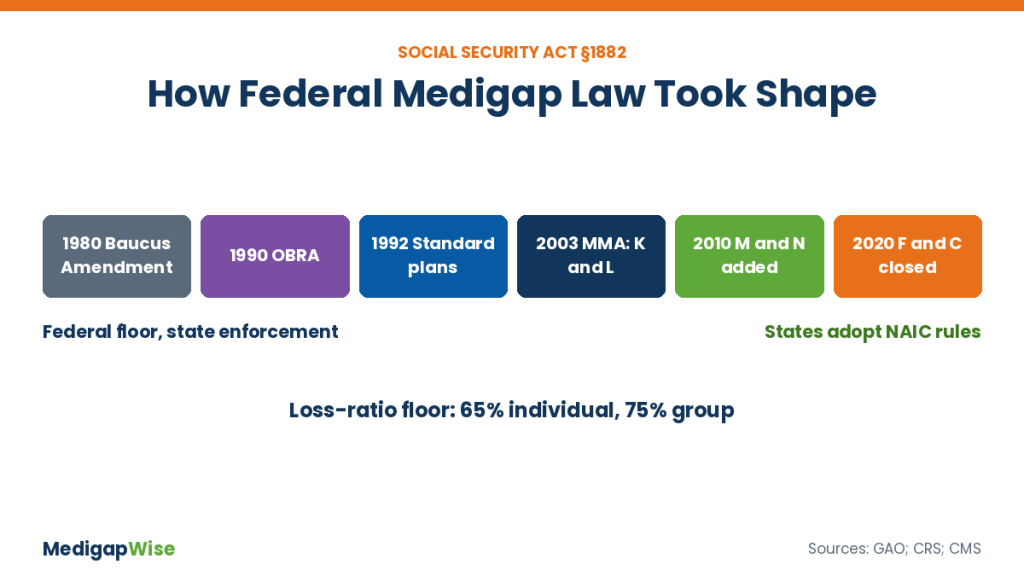
Timeline of federal Medicare Supplement law: Baucus Amendment 1980, OBRA 1990, standard plans in 1992, Plans K and L from the 2003 MMA, Plans M and N in 2010 and Plan F and C closed to new enrollees in 2020

Every federal Medigap rule traces back to section 1882 of the Social Security Act, codified at 42 U.S.C. 1395ss. It has been rewritten several times, and each change still shapes what you can buy today:

1
1980, the Baucus Amendment. Named for Senator Max Baucus and passed in the Social Security Disability Amendments of 1980, it created voluntary federal certification and the first loss-ratio floors: 60% for individual policies and 75% for group policies, according to GAO.
2
1990, OBRA. The Omnibus Budget Reconciliation Act limited sales to standardized plans, raised the individual floor to 65% for policies sold after November 5, 1991, and required refunds or credits when a policy pays out too little. States had until July 1992 to adopt the NAIC rules or face federal regulation.
3
1997 and 2003. The Balanced Budget Act added the high-deductible option, and the Medicare Modernization Act of 2003 created Plans K and L with out-of-pocket limits.
4
2008 to 2010. Later changes dropped Plans E, H, I and J for new sales and added Plans M and N, effective June 2010.
5
2015, MACRA. It barred selling plans that pay the Part B deductible, meaning Plans C and F, to anyone newly eligible for Medicare on or after January 1, 2020.

Section 1882 also makes certain sales practices federal violations, which matters for the complaint section below.

What CMS Does, and What It Leaves Alone

The Centers for Medicare & Medicaid Services administers Medicare, but its Medigap job is narrow. It publishes the standardized benefit rules, writes the annual “Choosing a Medigap Policy” guide and recalculates the high-deductible amount each year using the consumer price index. That figure, $3,050 for 2027, applies to the high-deductible versions of Plans F and G; our page on High-Deductible Plan F shows what it means for a policyholder’s yearly costs.

What CMS doesn’t do is price your policy. The federal guide says each insurance company decides how it sets its premium, and it sends readers with policy questions to their State Insurance Department, not to 1-800-MEDICARE. Nor does CMS license agents or pay any part of a Medigap premium.

A common mix-up: A premium increase letter is never a Medicare decision. Calling Medicare about it will usually get you redirected to your state.

The NAIC Model Law States Copy

The National Association of Insurance Commissioners is a standard-setting group made up of the chief insurance regulators of each state, not a federal agency. Its Medicare Supplement Insurance Minimum Standards Model Act (Model 650) and the regulation that carries it out (Model 651) are the text most states adopt, sometimes word for word, as their own Medigap law.

Federal law leans on these models directly. The plan letters, the benefit chart and the outline-of-coverage format you see when shopping come from the NAIC regulation, which Congress tied to section 1882. When the rules change, the NAIC amends the model, and CMS publishes notice of the change in the Federal Register. The NAIC also runs SERFF, the electronic system insurers use to send rate and form filings to the states, and it publishes a yearly chart of state-approved “new or innovative” benefits.

Questions? Talk to a Licensed Agent

We compare Plan G, Plan N and more from several insurance companies at no cost to you.

☎ 1-888-891-0229

No cost, no obligation to enroll

Your State Insurance Department Does the Daily Work

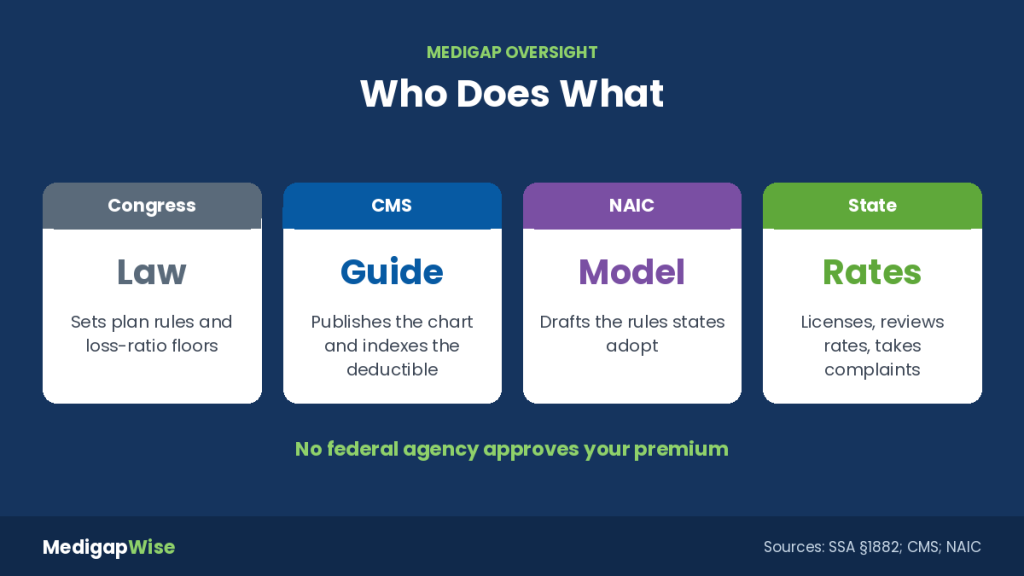
Four regulators of Medicare Supplement plans: Congress writes federal law, CMS publishes plan rules and indexes the high-deductible amount, the NAIC drafts model rules and state insurance departments license, review rates and take complaints

Once a company wants to sell Medigap in a state, the state’s insurance department is its regulator. The table lines up each layer against the decisions people actually ask about:

Decision Federal law CMS NAIC State insurance dept. Insurer
What each plan letter covers Sets the rules Publishes the chart Drafts the model Adopts and enforces Must follow
Which plans are offered Requires Plan A No role No role Can add sales rules Chooses its lineup
Premium level and increases Loss-ratio floor No role Model filing rules Reviews filings Proposes rates
Licensing companies and agents No role No role Model standards Licenses and disciplines Appoints agents
Consumer complaints Some federal crimes Refers to state No role Investigates Responds
High-deductible amount Sets the formula Indexes yearly No role No role Applies it

Sources: Social Security Act §1882; CMS “Choosing a Medigap Policy”; NAIC Models 650 and 651.

States can also go beyond the federal floor. That’s why some have yearly switching rights or under-65 rules; our state-by-state guaranteed issue chart collects them.

Get Medigap quotes from several insurers

Speak with a licensed insurance agent

1-888-891-0229

How States Review Rate Filings: Three Examples

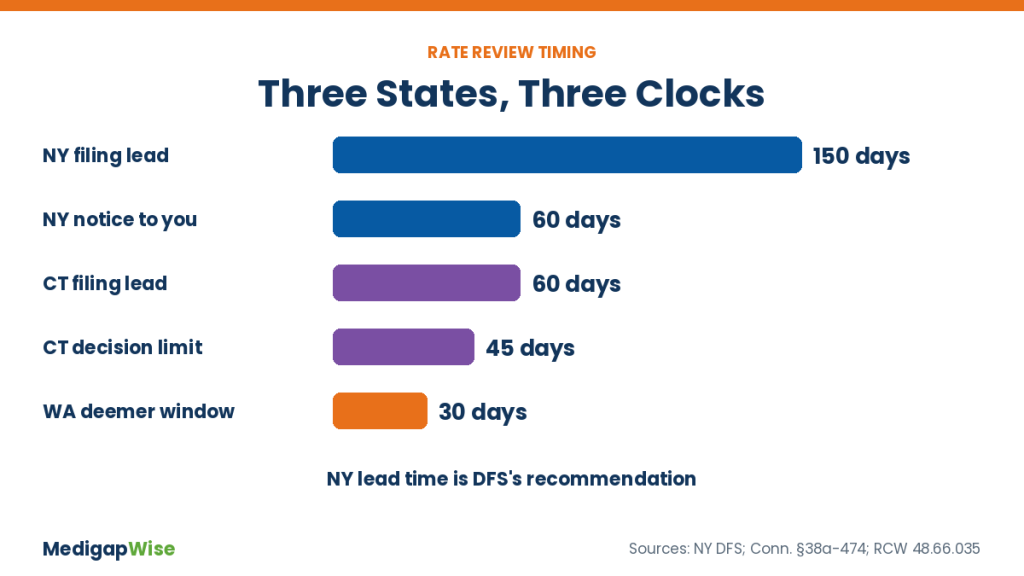
Medigap rate review timing in three states: New York recommends filing 150 days ahead and requires 60 days notice, Connecticut requires 60 days filing and decides within 45 days, Washington deems a rate approved after 30 days

Every state reviews Medigap rates, but the process varies more than most guides admit. Three state laws show the range:

New York

✔Prior approval by the Department of Financial Services
✔Draft notice to policyholders comes first
✔30-day consumer comment period
✔60 days’ written notice of the approved change

Connecticut

✔Filed at least 60 days before the effective date
✔Public hearing required on every increase
✔Commissioner rules within 45 days
✔Age can’t be used as a rating factor

Washington

✔No rate may be used until approved
✔Filed at least 30 days ahead
✔Deemed approved after 30 days without action
✔Can be extended up to 15 days

Sources: NY DFS Medicare supplement rate filing instructions; Conn. Gen. Stat. §38a-474; Rev. Code Wash. §48.66.035. Rules in your state may differ, so check its insurance department’s site.

To read a filing yourself, use SERFF Filing Access, the NAIC’s public portal, which links to filing searches for most states. Search by the insurer’s legal company name, not its brand.

Worked Example: From Filing to Your Bill

Here’s a hypothetical increase moving through a prior-approval state that follows New York’s timeline. The dollar figures are an illustration, not a real filing.

An insurer’s block of Plan G policies has paid out more in claims than projected. About 150 days before the policy anniversary, it files a request for a 12% increase, with actuarial exhibits showing the block’s loss ratio. Policyholders get an initial notice and a 30-day window to send comments. Regulators check whether the higher premium still meets the minimum loss ratio and whether the claims data supports it. Suppose they approve 8% instead.

At least 60 days before the anniversary, each policyholder gets written notice of the approved change. On a $200 monthly premium, the requested 12% would have added $24 a month, or $288 a year. The approved 8% adds $16 a month, or $192 a year, so the new bill is $216.

The process can trim a request, but it rarely stops one when claims really did rise. For what to do once the notice arrives, see our guide to Medicare Supplement rate increases.

Ask an agent to check your policy's rate history

Speak with a licensed insurance agent

1-888-891-0229

Filing a Complaint and Knowing a Regulator's Limits

Where to go depends on what went wrong:

✔
Price, claims, cancellation or an agent’s conduct: your state insurance department. Most take complaints online and can tell you whether a company has a complaint record.
✔
Someone claiming to be from Medicare, or a sale of duplicate coverage: these can break federal law. The federal guide points to the HHS Inspector General hotline, 1-800-HHS-TIPS (1-800-447-8477).
✔
Free help sorting it out: your State Health Insurance Assistance Program (SHIP). SHIPs give free counseling and aren’t tied to any insurer.

Know the limits too. A state can make an insurer justify a rate, cut a request or deny one that fails the loss-ratio test. It generally can’t stop an increase the claims data supports, set your price below that, or force a company to accept you outside your open enrollment or a guaranteed issue right. For a full overview of the plan letters themselves, start with our guide to Medicare Supplement plans.

Keep Reading

Medicare Supplement Foreign Travel Coverage 2027: which plan letters pay for emergency care abroad, the $250 deductible, the $50,000 cap and the 60-day trip rule.

Medigap Oversight: 8 Questions People Ask

➤ Does Medicare approve Medigap premium increases?

No. No federal agency approves Medigap premiums. Each insurer sets its own rates, and your state insurance department reviews them. CMS’s role covers plan standards and the yearly high-deductible amount.

➤ Is the NAIC a government agency?

No. The NAIC is an association of the top insurance regulators from each state. It writes model laws that states can adopt, and its Medigap models became the basis for federal plan standards.

➤ Who do I complain to about a Medigap agent?

Your state insurance department, which licenses agents and can discipline them. If the agent claimed to work for Medicare, you can also report it to the HHS Inspector General at 1-800-HHS-TIPS.

➤ Can my state insurance department lower my premium?

Only in limited ways. It can approve a smaller increase than requested or deny one that fails the minimum loss-ratio test, but it won’t set your premium below what the claims data supports.

➤ Why are Medigap plans different in Massachusetts, Minnesota and Wisconsin?

These three states standardized Medigap before the 1990 federal law and kept their own systems. Massachusetts uses Core and Supplement plans, Minnesota uses Basic and Extended Basic plans, and Wisconsin uses a Basic plan with optional riders.

➤ Do insurers ever have to refund Medigap premiums?

Yes. Since OBRA 1990, if a policy’s loss ratio falls below the federal minimum, 65% for individual policies or 75% for group, the insurer must refund or credit the shortfall to policyholders.

➤ Can an insurer add extra benefits to a standardized plan?

Only with state approval. The NAIC model allows new or innovative benefits that a state’s commissioner approves, and the NAIC publishes a yearly chart of those approvals by state.

➤ Is it legal to sell me a Medigap policy if I have Medicare Advantage?

Generally no. The federal guide lists it as illegal unless you’re switching back to Original Medicare. Selling you a second Medigap policy you don’t need is also prohibited.

Free Medigap Price Comparison

Call a Licensed Agent Now

Compare Plan G, Plan N and more from several insurance companies in one call.

☎ 1-888-891-0229

No cost, no obligation to enroll