




Speak with a licensed insurance agent

1-888-891-0229

Do Medicare Supplement Plans Cover Foreign Travel? 2027 Guide to Emergency Care Abroad

Reviewed by Russell Noga, Licensed Medicare Insurance Broker (all 50 states) — Last updated November 8, 2026

Key Takeaway

Yes, some do: Medicare Supplement Plans C, D, F, G, M and N, plus the high-deductible versions of F and G, include a foreign travel emergency benefit that pays 80% of billed charges for emergency care abroad after a $250 yearly deductible, up to a $50,000 lifetime maximum, for care that begins in the first 60 days of a trip. Plans A, B, K and L don’t include it.

2027 by the Numbers

$250

Calendar-year deductible for the foreign travel emergency benefit (CMS Choosing a Medigap Policy)

80%

Share of billed charges the plan pays after the deductible (NAIC standardized benefit)

$50,000

Lifetime maximum for foreign travel emergency care (NAIC model rule)

60 days

Care must begin within the first 60 consecutive days of each trip (NAIC model rule)

A broken hip in Lisbon or a heart scare on a river cruise in Germany is exactly the moment people learn how little Original Medicare does outside the country. Medicare almost never pays a foreign hospital. A Medicare Supplement policy can, but only some plan letters carry the benefit, and it comes with four limits that matter more than the headline.

Below: the letters that include it, what those limits do to a real bill, three state exceptions, when to add a travel policy and how to file a claim from overseas.

Find a Medicare Supplement plan with foreign travel coverage

Speak with a licensed insurance agent

1-888-891-0229

What Original Medicare Pays Outside the U.S. (Almost Nothing)

For Medicare purposes, the U.S. means the 50 states, the District of Columbia, Puerto Rico, the U.S. Virgin Islands, Guam, the Northern Mariana Islands and American Samoa. Anywhere else is foreign, and Medicare.gov says Original Medicare pays for hospital, doctor and ambulance services there only in rare cases. The exceptions are narrow:

✔
Nearest-hospital rule: you’re in the U.S. when an emergency happens and a hospital in Canada or Mexico is closer than the nearest U.S. hospital that can treat you.
✔
Alaska route: you’re traveling through Canada without unreasonable delay by the most direct route between Alaska and another state, and a Canadian hospital is closer when the emergency happens.
✔
Border residents: you live in the U.S. and a foreign hospital is closer to your home than the nearest U.S. hospital that can treat your condition, emergency or not.
✔
Cruise ships: Part B may pay for medically necessary care on a ship that’s in a U.S. port or no more than 6 hours away from one, with conditions.

When one of these exceptions applies, Medicare pays first and a Medicare Supplement policy generally picks up its usual share. Everything else, from a fall in Rome to a stroke in Cancún, is where the plan’s own foreign travel benefit comes in.

Plan-by-Plan: Which Letters Include the Foreign Travel Benefit

Federal rules standardize the benefit, so it reads the same in every policy that includes it, whatever the insurer. Our letter-by-letter view for 2027, from the CMS chart and eligibility rules:

Plan letter Foreign travel emergency Who can buy it in 2027 What to know
Plan G Yes, 80% Anyone eligible Most common pick for new enrollees
High-Deductible G Yes, 80% Anyone eligible Separate $250 travel deductible applies
Plan N Yes, 80% Anyone eligible Copays at home don’t change the travel benefit
Plan D Yes, 80% Anyone eligible Sold by fewer insurers
Plan M Yes, 80% Anyone eligible Rarely offered
Plan F Yes, 80% Eligible before 1/1/2020 only Closed to new Medicare enrollees
High-Deductible F Yes, 80% Eligible before 1/1/2020 only Separate $250 travel deductible applies
Plan C Yes, 80% Eligible before 1/1/2020 only Closed to new Medicare enrollees
Plans A, B, K, L No Anyone eligible No coverage for care abroad
Plans E, H, I, J Yes, 80% No longer sold Kept only if bought before June 1, 2010

Sources: CMS “Choosing a Medigap Policy” benefit chart; MACRA; CMS high-deductible notice for 2027.

On the high-deductible plans, the federal guide says you pay a separate $250 yearly deductible for foreign travel emergency care on top of the $3,050 high deductible for 2027. How an insurer applies the high deductible to a claim from abroad is spelled out in its outline of coverage, so check that page before you rely on it. For the full benefit lists of every letter, see our guide to Medicare Supplement plans; plan-specific detail is on Medicare Supplement Plan G and High-Deductible Plan G.

Compare Plan G and Plan N quotes before your trip

Speak with a licensed insurance agent

1-888-891-0229

The Four Limits Written Into the Benefit

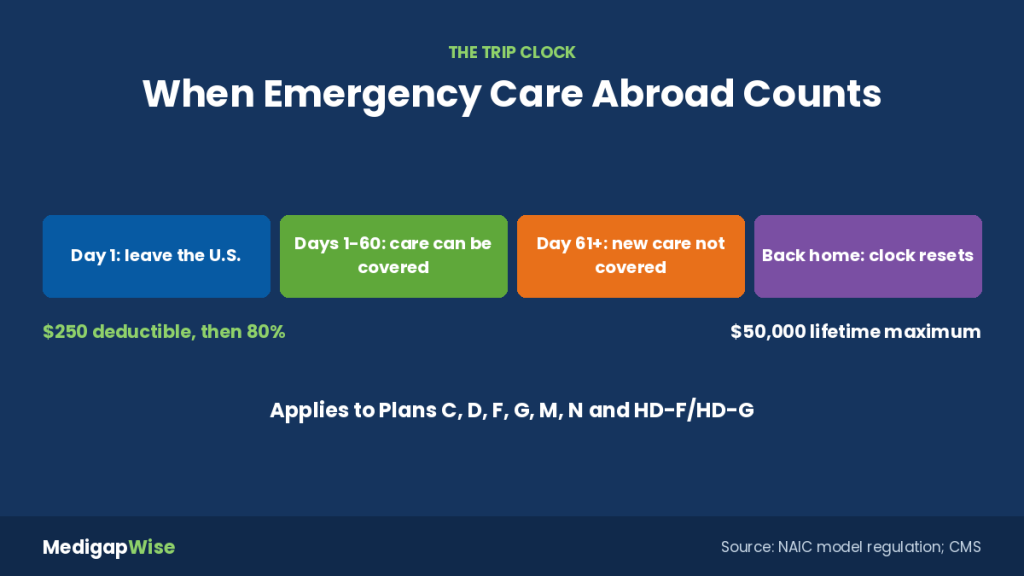
The 60-day trip clock for Medicare Supplement foreign travel coverage: emergency care that begins in days 1 to 60 of a trip can be covered, care that begins on day 61 or later is not

The standardized wording, from the NAIC model regulation that states adopt, is more specific than most summaries. The benefit pays 80% of the billed charges for Medicare-eligible expenses for medically necessary emergency hospital, physician and medical care received in a foreign country, care Medicare would have covered in the U.S., that began during the first 60 consecutive days of each trip. It’s subject to a $250 calendar-year deductible and a $50,000 lifetime maximum.

Emergency only

✔Sudden illness or injury
✔No routine checkups or planned surgery
✔Must be care Medicare covers at home

Billed charges

✔80% of what the foreign provider bills
✔Not tied to a Medicare-approved amount
✔You owe the other 20% with no yearly cap

Trip clock

✔Care must begin in days 1 to 60
✔An emergency on day 61 isn’t covered
✔Lifetime total stops at $50,000

Clock check: The 60-day window counts from the day a trip begins, not from the start of the year. Snowbirds who spend a full winter abroad, or anyone on a long cruise outside U.S. waters, should look at how the insurer defines a trip and plan for days 61 and beyond.

What a $12,000 Hospital Bill Abroad Would Cost You

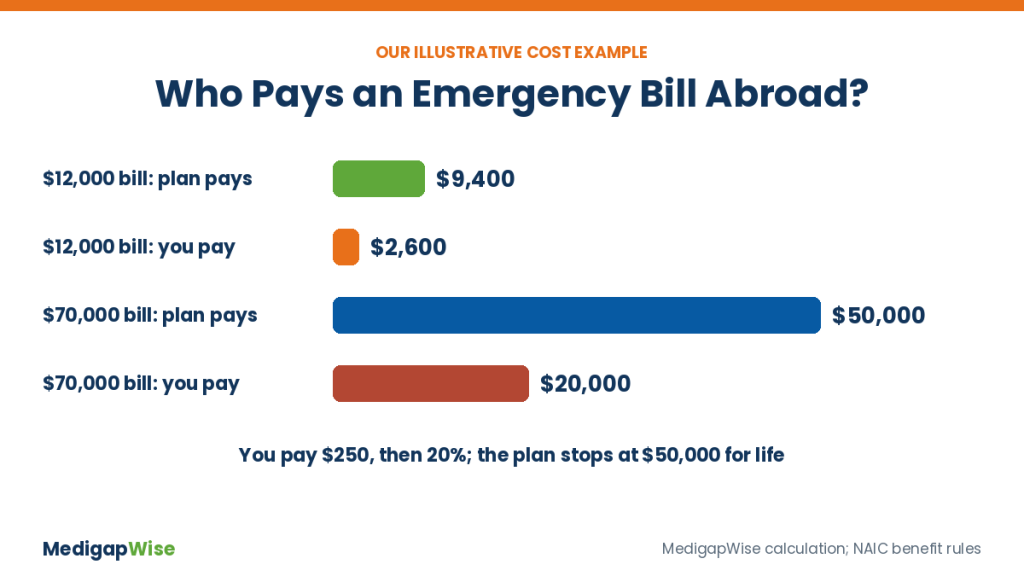
Our cost example for a Medicare Supplement foreign travel emergency: on a $12,000 bill the plan pays $9,400 and the traveler pays $2,600; on a $70,000 bill the plan pays its $50,000 lifetime maximum and the traveler pays $20,000

Here’s how the math works with Plan G or Plan N, using round illustrative bills. These are our calculations, not insurer quotes.

1
The bill. An emergency appendectomy and two-night stay in a private hospital overseas comes to the equivalent of $12,000, and the trip is in its first 60 days.
2
Your deductible. You pay the first $250, which satisfies the foreign travel deductible for the calendar year.
3
The split. The remaining $11,750 is split 80/20. The plan pays $9,400 and you pay $2,350.
4
Your total. $250 plus $2,350 is $2,600 out of pocket, and $9,400 of your $50,000 lifetime maximum is used.

A bigger event shows where the cap bites. On a $70,000 intensive care stay, 80% of the amount above $250 would be $55,800, but the plan stops at its $50,000 lifetime maximum. You’d owe about $20,000, and the benefit would be exhausted for every future trip.

Ask an agent which plan fits how you travel

Speak with a licensed insurance agent

1-888-891-0229

Massachusetts, Minnesota and Wisconsin Do It Differently

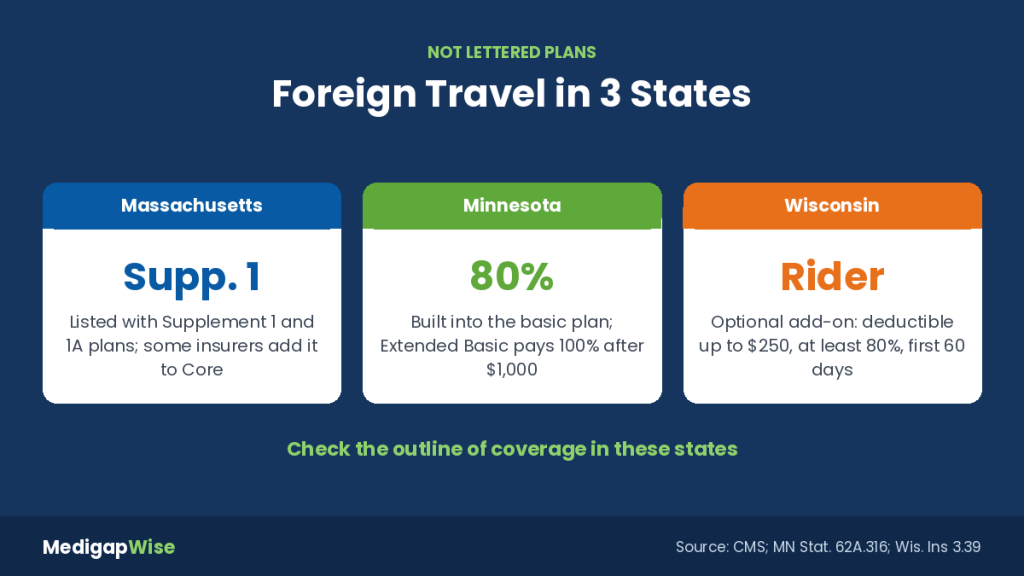
How Massachusetts, Minnesota and Wisconsin handle Medicare Supplement foreign travel coverage: Massachusetts in its Supplement plans, Minnesota in its basic plans at 80 percent, Wisconsin as an optional rider

These three states don’t sell the lettered plans, so the plan table above doesn’t apply. Each standardizes Medicare Supplement coverage under its own law, and the foreign travel benefit is treated differently in each:

✔
Massachusetts: the federal guide lists foreign travel emergency care with the state’s Supplement 1 and Supplement 1A plans; some insurers also add it to their Core plan. Read the insurer’s outline of coverage for the exact terms.
✔
Minnesota: state law builds foreign travel into the basic plan, paying 80% of hospital and medical expenses from a medical emergency outside the U.S. The federal guide shows the Extended Basic plan paying 80% of care in a foreign country and then 100% after $1,000 of out-of-pocket costs in a calendar year.
✔
Wisconsin: the basic plan doesn’t include it. Foreign travel is an optional rider; the state’s rule says it covers at least 80% of emergency care outside the U.S. after a deductible of no more than $250, for care beginning in the first 60 days of a trip, with a lifetime maximum of at least $50,000.

Each state’s insurance department oversees these designs, a split covered in who regulates Medicare Supplement plans.

Questions? Talk to a Licensed Agent

We compare Plan G, Plan N and more from several insurance companies at no cost to you.

☎ 1-888-891-0229

No cost, no obligation to enroll

When to Add Travel Medical or Evacuation Coverage

The Medigap benefit is a backstop, not a full travel policy. It doesn’t pay for trip cancellation, lost luggage or prescriptions filled abroad, and a medical evacuation or repatriation flight back to the U.S. generally falls outside it, since that isn’t care Medicare would cover at home. Part D doesn’t cover drugs bought outside the country either.

A separate travel medical or medical evacuation policy is worth pricing if any of these apply:

✔
Your trip lasts longer than 60 days, or you take several trips a year
✔
Your plan letter is A, B, K or L, or you live in Wisconsin without the rider
✔
A large bill could run past the $50,000 lifetime maximum, or 20% of it would strain your savings

Before you book: Travel medical policies sold to people 65 and older often have age limits, pre-existing condition rules and caps of their own. Compare the medical maximum, evacuation maximum and whether the policy pays first or after other coverage.

How to File a Foreign Claim With Your Medigap Insurer

Medicare won’t process a claim from a foreign hospital outside its narrow exceptions, so there’s no Medicare notice to wait for. The claim goes straight to your Medicare Supplement company, and foreign hospitals often expect payment up front.

1
Pay and keep proof. Hold on to receipts and card statements showing what you paid and the exchange rate.
2
Get itemized bills. Ask for bills that list each service, the date, the diagnosis and the provider, not just a total.
3
Arrange a translation. Bills in another language usually need an English translation; ask the insurer whether it handles this.
4
Prove the trip dates. Boarding passes, passport stamps or an itinerary show the care began within the first 60 days.
5
Use the insurer’s claim form. Call the number on your card for its foreign claim form, mailing address and filing deadline.

Medicare Advantage Abroad: The One-Paragraph Version

A Medicare Supplement policy can only be used with Original Medicare. Medicare Advantage plans aren’t required to cover routine or emergency care outside the U.S., though some include emergency and urgent care abroad, often with their own dollar limits; the terms vary plan by plan. Broader trade-offs are on Medigap vs. Medicare Advantage. If travel coverage matters to you, the best time to pick a plan letter that includes it is your Medicare Supplement open enrollment period, when insurers can’t use your health to turn you down.

Keep Reading

Medicare Supplement Plan F 2027: every benefit Plan F pays with the Medicare amounts behind it, the 2020 newly eligible rule and its edge cases, and how F compares with Plans C and G.

Traveling Abroad With Medigap: 8 Common Questions

➤ Does Plan G cover me in Europe or Mexico?

Yes, for emergencies. Plan G’s foreign travel benefit applies in any foreign country and pays 80% after the $250 deductible, for care that begins in the first 60 days of the trip, up to $50,000 over your lifetime.

➤ Is the $250 foreign travel deductible the same as the Part B deductible?

No. It’s a separate calendar-year deductible that applies only to emergency care abroad. Paying it doesn’t count toward the Part B deductible, and paying the Part B deductible doesn’t satisfy it.

➤ What happens if I get sick on day 70 of a long trip?

The standardized benefit covers care that begins within the first 60 consecutive days of a trip, so an emergency that starts on day 70 wouldn’t qualify. A separate travel medical policy is the usual fix for long stays.

➤ Does Medigap cover a cruise?

When the ship is in a U.S. port or within 6 hours of one, Medicare Part B may pay for medically necessary care. Farther out, only the plan’s foreign travel benefit or a travel policy would help.

➤ Is the $50,000 limit per trip or per year?

Neither. It’s a lifetime maximum for the foreign travel emergency benefit under that policy, so a large claim can use most of it for good.

➤ Can I buy a Medicare Supplement plan if I live overseas?

Medicare Supplement plans are built for people living in the U.S. and using Original Medicare. The travel benefit is for trips, not routine care abroad.

➤ Does Plan K or Plan L include any coverage abroad?

No. Neither plan includes the foreign travel emergency benefit, and neither do Plans A and B.

➤ Will the foreign hospital bill my Medigap company directly?

Usually not. Expect to pay the hospital, then send itemized, translated bills and proof of your travel dates to your insurer for reimbursement.

Free Medigap Price Comparison

Call a Licensed Agent Now

Compare Plan G, Plan N and more from several insurance companies in one call.

☎ 1-888-891-0229

No cost, no obligation to enroll