




Speak with a licensed insurance agent

1-888-891-0229

Medicare vs Medigap 2027: What Original Medicare Leaves Unpaid and How a Medicare Supplement Fills It

Reviewed by Russell Noga, Licensed Medicare Insurance Broker (all 50 states) — Last updated November 11, 2026

Key Takeaway

Medicare vs Medigap isn’t an either-or choice: Original Medicare (Parts A and B) is the federal program that pays your claims first, and a Medigap policy, also called a Medicare Supplement, is private insurance you add on top to pay the deductibles, daily hospital charges and 20% coinsurance Medicare leaves behind. You can’t buy Medigap without both Part A and Part B, and it never covers prescription drugs.

2027 by the Numbers

$1,736

2026 Part A deductible, owed again with each new benefit period (CMS)

No cap

Yearly out-of-pocket limit in Original Medicare without supplemental coverage (Medicare.gov)

$66,836

Our total of Part A cost sharing for a 150-day hospital stay at 2026 CMS rates

$3,050

2027 deductible for High-Deductible Plan G (CMS)

People type “Medicare vs Medigap” expecting two products to weigh against each other. That framing trips up a lot of new enrollees. Original Medicare is the coverage itself. Medigap is a secondary policy that only works when Original Medicare is already in place, and it pays nothing on its own.

So the useful comparison is Original Medicare alone versus Original Medicare with a supplement. Below we list every cost Medicare leaves you with, show which plan letters pay each one, explain how a bill moves from Medicare to the insurer, and price one realistic year both ways. CMS hadn’t published 2027 Part A and Part B amounts when this page went live on November 11, 2026, so dollar figures are 2026 amounts, labeled as such.

Price a Medicare Supplement on top of your Medicare

Speak with a licensed insurance agent

1-888-891-0229

One Pays First, the Other Pays What's Left

Original Medicare is run by the federal government. Part A covers inpatient hospital, skilled nursing facility and hospice care; Part B covers doctors, outpatient services and equipment. Most people pay no Part A premium after 40 quarters of work, while Part B costs a standard $202.90 a month in 2026.

Medigap is sold by private insurance companies under state and federal rules. Each plan letter has a fixed set of benefits, so Plan G pays the same from every insurer. You pay the insurer a premium in addition to Part B, and the policy covers one person only.

Original Medicare

✔Primary payer on every covered claim
✔Sets the Medicare-approved amount
✔Has deductibles, coinsurance and no yearly cap

Medigap policy

✔Secondary payer; never pays first
✔Pays only on Medicare-approved care
✔Requires both Part A and Part B

The real decision between two competing setups is Medigap against Medicare Advantage, which replaces Original Medicare instead of adding to it. That trade-off is laid out in Medigap vs Medicare Advantage.

Every Cost Original Medicare Leaves Behind

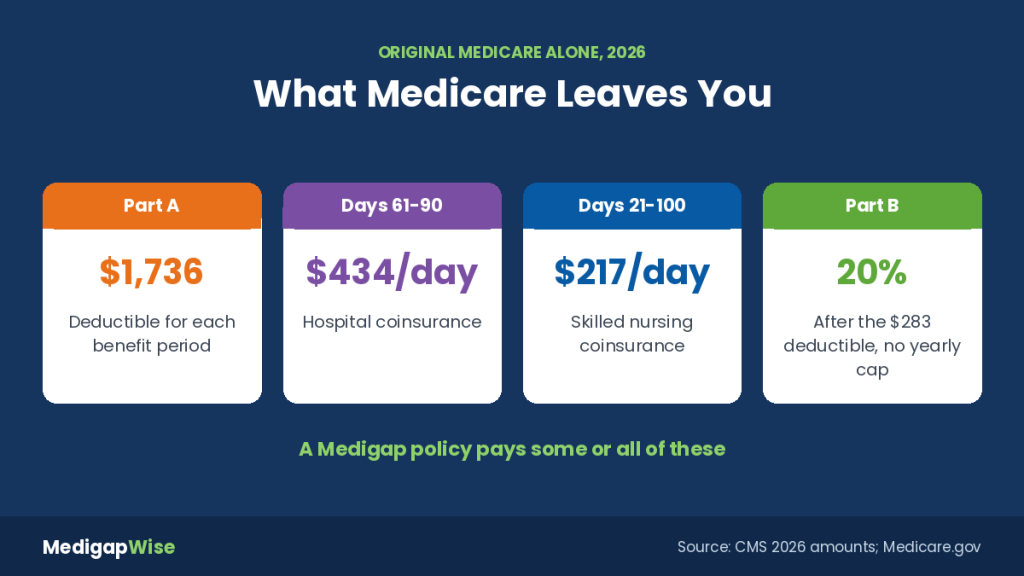
What Original Medicare leaves you paying in 2026: a $1,736 Part A deductible per benefit period, $434 a day for hospital days 61 to 90, $217 a day for skilled nursing days 21 to 100, and 20% of Part B costs with no yearly cap

Here’s the list of what you’d owe with Parts A and B alone, using CMS’s 2026 figures:

✔
Part A deductible: $1,736 for each benefit period, not each calendar year. A new benefit period starts after you’ve been out of the hospital and skilled nursing care for 60 days in a row, so two separate stays in one year can mean two deductibles.
✔
Hospital days 61–90: $434 a day. Days 91–150: $868 a day, drawn from 60 lifetime reserve days that never refill. After that, the full bill.
✔
Skilled nursing days 21–100: $217 a day; Medicare pays nothing after day 100.
✔
Part B deductible: $283 a year, then usually 20% of the approved amount for doctor and outpatient services.
✔
Outpatient hospital copays: charged per service, though Medicare.gov notes a single service’s copay usually can’t exceed the Part A deductible.
✔
Excess charges: a provider who doesn’t accept assignment can bill up to 15% above the Medicare-approved amount.
✔
Care abroad: Original Medicare generally pays nothing outside the U.S.

The missing ceiling: Medicare.gov states there is no yearly limit on what you pay out of pocket in Original Medicare unless you have supplemental coverage. That one sentence is the strongest case for adding a policy.

What a Long Hospital Stay Adds Up To Without a Supplement

We added up the Part A side for one benefit period at 2026 rates to show where the exposure peaks:

1
Days 1–60: the $1,736 deductible.
2
Days 61–90: 30 days at $434, or $13,020.
3
Days 91–150: all 60 lifetime reserve days at $868, or $52,080.
4
Total through day 150: $66,836, with every reserve day gone for life. Day 151 onward, you pay everything.

Every standardized Medigap plan, even basic Plan A, pays the hospital coinsurance on days 61 through 150 and then covers up to 365 more hospital days after Medicare’s run out. Long stays are rare, but this is the risk that is hardest to save for.

Which Plan Letter Fills Which Gap

The table matches each gap above to three common plan letters: Plan A (the minimum every insurer must offer), Plan N and Plan G.

Medicare gap (2026) Medicare alone Plan A Plan N Plan G
Part A deductible, $1,736 You pay You pay Pays Pays
Hospital days 61–150 $434–$868/day Pays Pays Pays
365 extra hospital days Not covered Pays Pays Pays
Skilled nursing days 21–100 $217/day You pay Pays Pays
Part B deductible, $283 You pay You pay You pay You pay
Part B 20% coinsurance You pay Pays Pays, minus copays Pays
Part B excess charges You pay You pay You pay Pays
Blood (first 3 pints) You pay Pays Pays Pays
Hospice coinsurance You pay Pays Pays Pays
Emergency care abroad Not covered Not covered 80% 80%

Plan N’s copays are up to $20 for some office visits and up to $50 for an ER visit that doesn’t end in admission. The foreign travel benefit carries a $250 yearly deductible and a $50,000 lifetime limit, for emergencies in the first 60 days of a trip. People first eligible for Medicare before 2020 have one more option, Medicare Supplement Plan F, which also pays the Part B deductible. Every letter is profiled in our guide to Medicare Supplement plans.

Compare Plan G and Plan N premiums in your ZIP code

Speak with a licensed insurance agent

1-888-891-0229

Who Pays the Bill: Medicare, Then the Policy

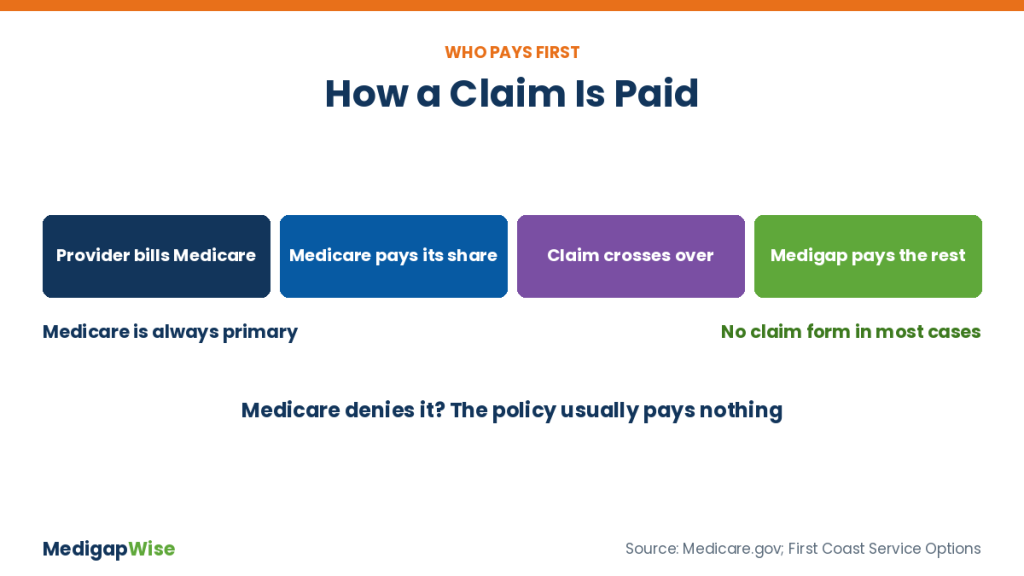
How a claim is paid with Medicare and Medigap: the provider bills Medicare, Medicare pays its share, the claim crosses over to the Medigap insurer, and the policy pays what is left

With both in place, you show your red, white and blue Medicare card and your Medigap card at every visit. The money moves in a fixed order:

1
The provider bills Medicare. Medicare decides whether the service is covered and what the approved amount is.
2
Medicare pays its share, such as 80% of a Part B charge, and sends you a Medicare Summary Notice.
3
The claim crosses over. First Coast Service Options, a Medicare contractor, explains that most Medigap insurers receive claims automatically through an eligibility file, with no form from you.
4
The policy pays the rest of the approved amount that its plan letter covers.

If a claim stalls: Medicare.gov notes that most policies get Part B claim data straight from Medicare. When one doesn’t cross over, call the insurer, and ask whether the doctor accepts assignment so the insurer can pay the doctor directly.

The order also sets a limit: if Medicare denies a service, a Medigap policy generally has nothing to pay, because it only fills cost sharing on Medicare-approved care.

Questions? Talk to a Licensed Agent

We compare Plan G, Plan N and more from several insurance companies at no cost to you.

☎ 1-888-891-0229

No cost, no obligation to enroll

One Year Priced Three Ways: Hospital Stay Plus Outpatient Surgery

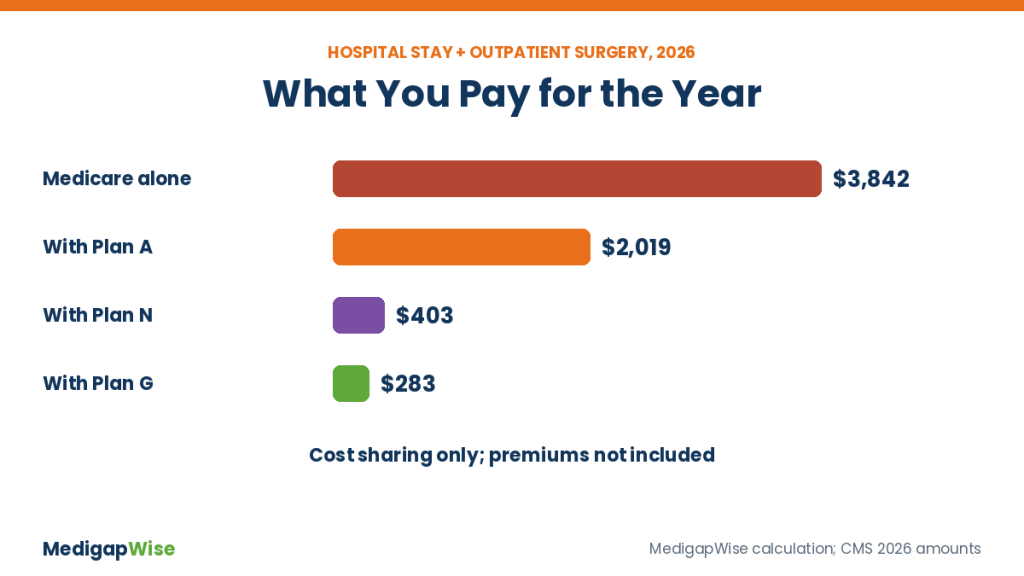
Worked example at 2026 amounts for a five-day hospital stay, outpatient surgery and six office visits: $3,842 with Original Medicare alone, $2,019 with Plan A, $403 with Plan N and $283 with Plan G

The scenario, at 2026 amounts: in March, a five-day hospital admission with $2,500 of Medicare-approved doctor charges during the stay. In June, outpatient knee surgery approved at $6,000 for the surgeon and facility. Six follow-up office visits at $150 each. Every provider accepts assignment. That’s $9,400 of Part B charges in all.

Cost item Medicare alone Plan A Plan N Plan G
Part A deductible $1,736 $1,736 $0 $0
Part B deductible $283 $283 $283 $283
20% of remaining $9,117 $1,823 $0 $0 $0
Office copays (up to $20 × 6) — — $120 $0
You pay for the year $3,842 $2,019 $403 $283

The hospital stay met the Part B deductible in March, so all six follow-up visits could draw Plan N’s copay. Add your own premium quotes to each column to compare full yearly cost; Medigap premiums depend on insurer, age, ZIP code and how the policy is rated.

One change flips the gap: Suppose $3,000 of the surgery came from a surgeon who doesn’t accept assignment. An excess charge of up to 15% adds as much as $450. Plan G pays it; Medicare alone, Plan A and Plan N leave it with you.

Ask a licensed agent which gaps matter most for you

Speak with a licensed insurance agent

1-888-891-0229

Monthly Costs: Medicare Only vs. Medicare Plus a Supplement

Medicare only

✔Part A: $0 for most people
✔Part B: $202.90 a month in 2026
✔Cost sharing: open-ended, as listed above

Medicare + Medigap

✔Same Part A and Part B premiums
✔Plus the insurer’s monthly premium
✔Cost sharing: from $0 up to the Part B deductible with Plan G

Lower-premium option

✔High-Deductible Plan G
✔Pays after $3,050 in covered costs in 2027
✔Then works like standard Plan G

CMS usually releases the next year’s Part A and Part B amounts in November; until it does, treat the 2026 figures as placeholders. How premiums differ by plan and age is covered on our Medicare Supplement plans cost page.

Before Adding a Policy: Requirements and Timing

✔
Enroll in both Part A and Part B. A supplement can’t be sold to someone holding Part A alone. The full rule set is on our Medicare Supplement eligibility page.
✔
Apply in your first six months. Your Medigap open enrollment period starts the month you’re 65 or older and enrolled in Part B; during it, insurers can’t use your health to refuse or surcharge you. Timing details are in Medicare Supplement open enrollment.
✔
Leave Medicare Advantage first. A Medigap policy can’t pay an Advantage plan’s costs.
✔
Add drug coverage separately. Medigap plans sold after 2005 don’t include it; see Medicare Part D.

Medigap also skips routine dental, vision, hearing aids, eyeglasses, long-term custodial care and private-duty nursing, since Original Medicare doesn’t cover those either.

Keep Reading

Silver Sneakers Medicare Supplement Plans 2027: which Medigap insurers include SilverSneakers or another fitness program, which sell it as a paid extra, and what each route costs over a year.

Medicare and Medigap: Questions People Ask

➤ Is Medigap the same thing as Medicare?

No. Medicare is the federal program. Medigap, or a Medicare Supplement, is a private policy that pays part or all of the cost sharing Original Medicare leaves after it pays first.

➤ Can I buy a Medigap plan if I only have Part A?

No. Medicare.gov says you generally need both Part A and Part B. If you delayed Part B, you can apply once it starts, and your six-month open enrollment period begins then.

➤ Do I keep paying the Part B premium after buying a supplement?

Yes. The Medigap premium is an extra bill. The Part B premium, $202.90 a month in 2026, continues as long as you have Part B.

➤ Will my Medigap policy pay if Medicare denies a claim?

Generally not. A supplement fills cost sharing on services Medicare approves, so a service Medicare won’t cover usually gets nothing from the policy either.

➤ Do I need to send claims to my Medigap insurer?

Usually not. Most Medigap insurers receive Medicare claims automatically through the crossover process. If a claim doesn’t cross over, contact the insurer for instructions.

➤ Is there a yearly out-of-pocket maximum in Original Medicare?

No. Without supplemental coverage there is no yearly limit. Plan G limits covered medical costs to the Part B deductible, and Plans K and L carry their own yearly caps.

➤ Does Medigap help with prescription costs?

No. Policies sold since 2006 carry no drug benefit, so you’d pair a supplement with a stand-alone Part D plan.

➤ Why are the dollar amounts on this page from 2026?

CMS hadn’t announced 2027 Part A and Part B amounts when the page was published on November 11, 2026. The 2027 High-Deductible Plan G deductible of $3,050 was already set, so it’s shown as a 2027 figure.

Free Medigap Price Comparison

Call a Licensed Agent Now

Compare Plan G, Plan N and more from several insurance companies in one call.

☎ 1-888-891-0229

No cost, no obligation to enroll