




Speak with a licensed insurance agent

1-888-891-0229

Medicare Supplement Eligibility: Who Can Buy a Medigap Policy

Reviewed by Russell Noga, Licensed Medicare Insurance Broker (all 50 states) — Last updated November 8, 2026

Key Takeaway

You’re eligible for a Medicare Supplement plan if you have both Medicare Part A and Part B, you’re not staying in a Medicare Advantage plan, and you live where the policy is sold; under 65, you qualify only if your state makes insurers sell to you. Eligible means you may apply. Guaranteed acceptance is a separate test that only your 6-month Medigap open enrollment period or a guaranteed issue right passes.

2027 by the Numbers

Jan. 1, 2020

Plans C and F closed to anyone who became eligible for Medicare on or after this date (Medicare.gov)

28 states

Explicitly require Medigap sales to under-65 enrollees with kidney failure (KFF, Oct. 13, 2026)

13 states

Make insurers issue a policy after someone loses Medicaid (KFF, Oct. 13, 2026)

2 years

Longest a Medigap policy can be suspended while you have Medicaid (KFF; CMS)

Most people assume Medicare Supplement eligibility is about age. It’s really about which parts of Medicare you hold and what other coverage sits next to it. A 72-year-old in a Medicare Advantage plan can’t buy one today, while a 45-year-old on disability may qualify, depending on her state.

Below are the rules that decide whether you’re allowed to buy a Medigap policy at all, the situations that block a sale, and why being eligible is not the same as being accepted. A checklist and a situation-by-situation table sit near the end.

Check whether you qualify for a Medicare Supplement plan

Speak with a licensed insurance agent

1-888-891-0229

The Four Conditions Every Buyer Must Meet

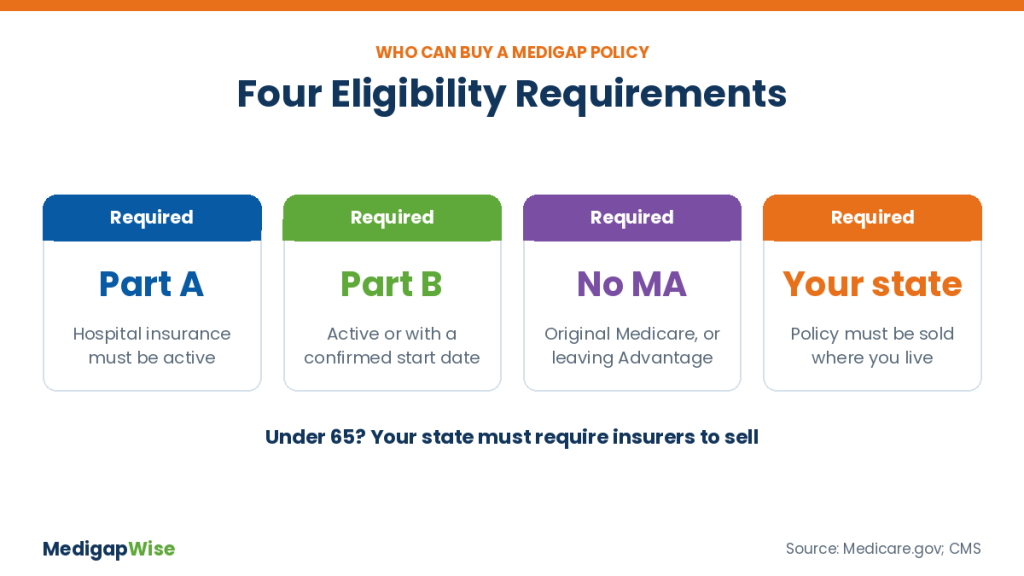
Medicare Supplement eligibility requirements: enrolled in Part A, enrolled in Part B, not keeping a Medicare Advantage plan, and living in the state where the policy is sold

Insurers check the same basic facts on every Medigap application. If any one of them is missing, the company can’t issue the policy, no matter how healthy you are or how much you’re willing to pay.

✔
Medicare Part A is active. Your red, white and blue card shows a Part A start date.
✔
Medicare Part B is active, or has a confirmed start date. Medicare.gov says you have to sign up for both parts before you can buy a policy.
✔
You’re in Original Medicare. You either aren’t in a Medicare Advantage plan or you’re leaving one and returning to Original Medicare.
✔
You live in the state where the policy is filed. Policies are approved and priced state by state, so your residence address decides which plans and rates you’re offered.
✔
You’re 65 or older, or your state covers under-65 enrollees. Federal law generally doesn’t require sales to people under 65.

Notice what isn’t on the list: income, assets, citizenship beyond what Medicare itself requires, or a minimum time on Medicare. Health only matters for acceptance and price, which is covered further down.

Why Part A on Its Own Doesn't Qualify You

Many people who keep working past 65 take premium-free Part A and hold off on Part B while a current employer’s group plan pays first. That’s a reasonable choice, but until Part B begins you can’t be sold a Medicare Supplement policy. Medigap is built to pay the gaps in both parts, so a buyer without Part B has nothing for most of the benefits to attach to.

Delaying Part B also moves your one-time Medigap open enrollment period. It starts in the first month you’re both 65 or older and enrolled in Part B, so a 68-year-old retiree who adds Part B next spring gets six protected months starting then. The application paperwork is covered in how to sign up for Medigap, and the timing of each application window is covered in can I sign up for a Medicare Supplement plan anytime.

Part B timing: Missing the 8-month Special Enrollment Period after employer coverage ends can mean a lifetime Part B late penalty and a wait for the General Enrollment Period, which also pushes back the date you become eligible for a supplement.

Medicare Advantage Members Have to Leave First

A Medicare Supplement policy only pays alongside Original Medicare. It won’t pay copays, deductibles or premiums in a Medicare Advantage plan. Medicare.gov lists it as illegal for anyone to sell you a Medigap policy if they know you’re in a Medicare Advantage plan, unless you’re switching back to Original Medicare.

In practice, a Medicare Advantage member can apply for a supplement, as long as the policy’s start date lines up with the day the Advantage plan ends. Whether the insurer must accept you is another matter. People who joined Medicare Advantage when first eligible at 65, or who dropped a Medigap policy to try Advantage for the first time, and who leave within 12 months, generally have a federal right to buy a policy without health questions, explained in the Medigap trial right. KFF counts 19 states that widen who gets that trial period, and Maine stretches it to three years. For the trade-offs between the two paths, see Medigap vs Medicare Advantage.

Medicare and Medicaid Together: Usually Not Eligible

Searches that pair Medicare with Medicaid, or ask about being dual eligible, regularly land on this site. The short answer is that federal law bars the sale of a Medigap policy to most people with both programs. CMS describes it as longstanding federal law, and KFF’s 2026 review says plainly that Medigap insurers can’t sell policies to people with Medicaid. Full Medicaid already covers most Medicare cost-sharing, so a supplement would pay for little.

CMS names two exceptions: when the state Medicaid program chooses to pay the Medigap premium, and when Medicaid helps only with Medicare premiums, as in the Specified Low-Income Medicare Beneficiary (SLMB) and Qualifying Individual (QI) programs. Other Medicare Savings Program levels may be treated differently by state, so confirm with your state’s insurance department before applying.

Medicaid note: Someone who already owns a Medigap policy when Medicaid begins can suspend it for up to two years. If Medicaid ends inside that window, the policy can be restarted without new underwriting or a new pre-existing condition wait. Losing Medicaid without a prior policy gives no federal right to buy one, though KFF counts 13 states that require insurers to issue a policy in that case.

Compare Medicare Supplement prices you're eligible for

Speak with a licensed insurance agent

1-888-891-0229

Under 65 on Medicare: Your State Decides

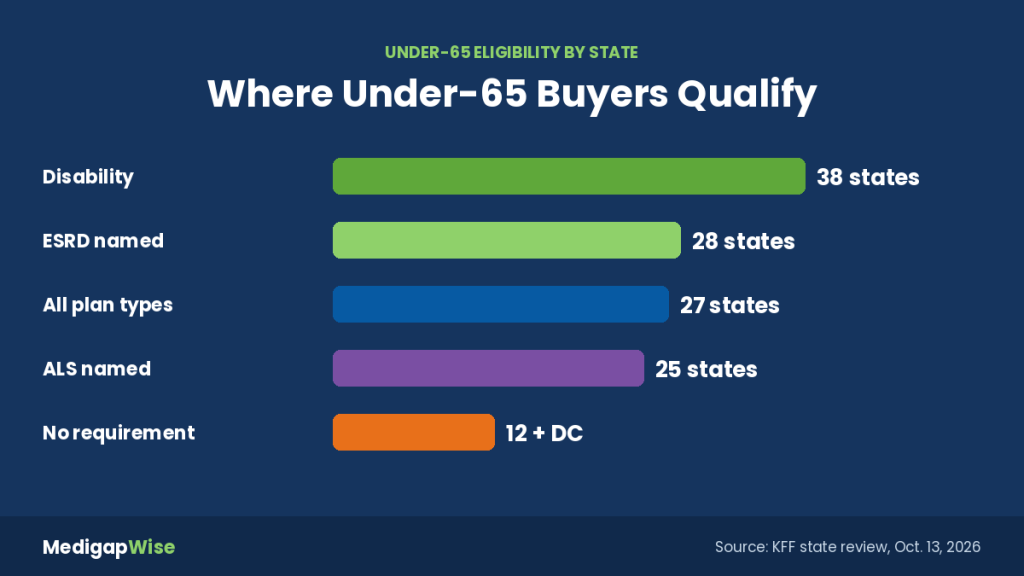
Under-65 Medicare Supplement eligibility by state: 38 states require a policy for disabled enrollees, 28 explicitly include kidney failure, 25 include ALS, and 12 states plus DC require none

People who get Medicare early because of a disability, End-Stage Renal Disease (ESRD) or ALS are only eligible to buy a Medigap policy where state law says so. KFF’s October 13, 2026 review breaks this down further than a simple yes or no: of the 38 states with an under-65 requirement for disabled enrollees, 27 require every plan type, 28 states name ESRD explicitly, and 25 name ALS. California, Massachusetts, Vermont and Nebraska carve ESRD out. Twelve states and DC have no requirement.

Under-65 premiums can be much higher than age-65 rates unless the state limits them. Whatever happens before 65, turning 65 starts a fresh 6-month open enrollment period for anyone already on Part B. State-by-state details are in Medicare Supplement guaranteed issue rights by state.

Questions? Talk to a Licensed Agent

We compare Plan G, Plan N and more from several insurance companies at no cost to you.

☎ 1-888-891-0229

No cost, no obligation to enroll

Plan C and Plan F: Eligibility Depends on Your Medicare Start Date

Since January 1, 2020, federal law has kept Plans C and F, the plan letters that pay the Part B deductible, away from people new to Medicare. The test is when you first became eligible for Medicare, not when you enrolled. Medicare.gov says someone eligible before January 1, 2020 who hasn’t yet enrolled may still be able to buy Plan C or F.

That creates an edge case few guides spell out. A worker born in November 1954 turned 65 in November 2019. Even if she delays Part B until 2027, she can still be sold Plan F where an insurer offers it. A coworker born in February 1955 turned 65 in February 2020 and can’t. Someone who got Medicare through disability in 2018 also keeps Plan F eligibility. Everyone else picks from the remaining letters, with Medicare Supplement Plan G the closest match to F. Costs for those who still qualify are in high deductible Plan F.

Employer Coverage, Retiree Plans and Married Couples

Working, group plan

✔Eligible once Part B starts
✔Often unnecessary while the group plan pays first
✔Six protected months begin with Part B

Retiree coverage

✔Eligible if you have Parts A and B
✔Retiree plan ending can create a 63-day buying right
✔Compare costs before dropping it

Married couples

✔Each spouse needs a separate policy
✔A spouse not yet on Medicare can’t be added
✔Some insurers discount a second policy

Medicare.gov is direct on the last point: a Medigap policy only covers one person. Each spouse qualifies on their own Medicare record, so a 66-year-old can buy now while a 62-year-old spouse waits. Household pricing rules are in the Medicare Supplement household discount. Federal rights tied to losing employer or retiree coverage are listed in open enrollment vs guaranteed issue.

Eligible to Apply vs. Guaranteed Acceptance

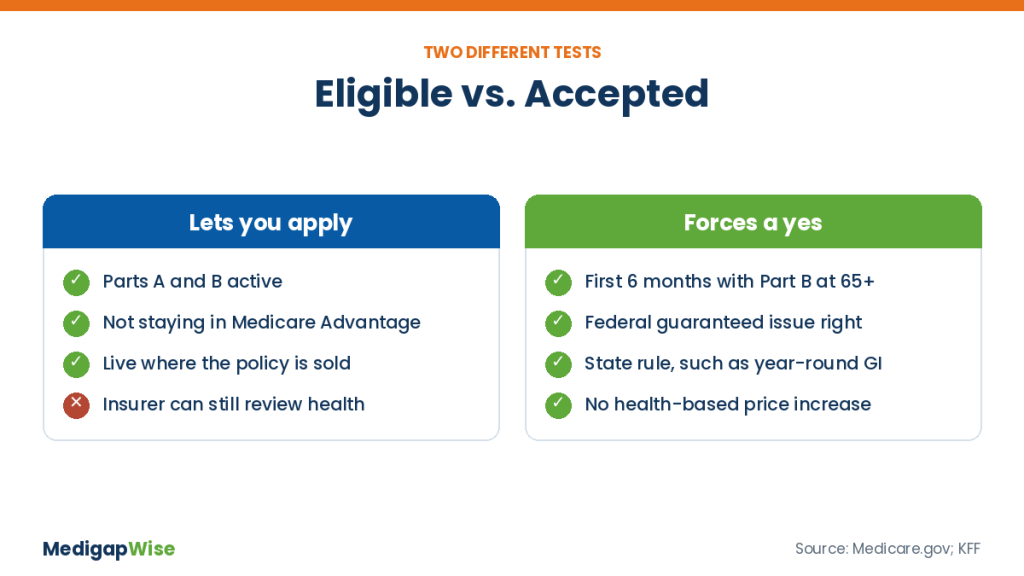
Medicare Supplement eligibility compared with guaranteed acceptance: what lets you apply versus what forces an insurer to say yes

Meeting every condition above only gets your application considered. Outside your 6-month window and without a guaranteed issue right, most states let insurers ask health questions and decline you or charge more; the kinds of questions are in Medigap underwriting questions. Even an accepted policy may delay paying for a condition you already have, as explained in Medicare Supplement pre-existing conditions.

Your situation Eligible to buy? Guaranteed acceptance?
65+, Parts A and B, in first 6 months Yes Yes
65+, Parts A and B, after 6 months Yes Only with a GI right or state rule
Part A only, Part B delayed No, until Part B starts Window opens with Part B
In Medicare Advantage, staying No No
Leaving Medicare Advantage in first year Yes Usually yes (trial right)
Full Medicaid Generally no No
SLMB or QI only Yes Depends on timing
Under 65, disability or ESRD Only if your state requires it Varies by state
New to Medicare in 2020 or later, wants Plan F No for Plans C and F Other plans only

The strongest moment to buy is covered in our guide to Medicare Supplement open enrollment. A licensed agent can check which row fits you before you apply.

Ask an agent if your situation qualifies for guaranteed acceptance

Speak with a licensed insurance agent

1-888-891-0229

Keep Reading

Medicare Birthday Rule States 2027: all 16 states with a yearly Medigap birthday window, side by side, with real 2027 dates for one birthday in every state.

Medicare Supplement Eligibility Questions

➤ What are the requirements to qualify for a Medicare Supplement plan?

You need Medicare Part A and Part B, you can’t keep a Medicare Advantage plan at the same time, and you must live in a state where the policy is sold. If you’re under 65, your state must require insurers to sell to people your age.

➤ Can I get a Medicare Supplement policy with only Part A?

No. Both Part A and Part B are required. If you delayed Part B because of a current employer plan, you become eligible once Part B starts, and your open enrollment period begins then.

➤ Is there an income limit for Medigap eligibility?

No. Income and assets don’t affect whether you can buy a Medicare Supplement policy. Income matters only if it qualifies you for Medicaid, which generally blocks a Medigap sale.

➤ Can someone with Medicare and Medicaid buy a Medicare Supplement plan?

Usually not. Federal law bars selling Medigap to most people with Medicaid. CMS lists exceptions when the state pays the Medigap premium or when Medicaid only helps with Medicare premiums, as in SLMB and QI.

➤ Can my spouse go on my Medicare Supplement policy?

No. Each policy covers one person, so each spouse buys their own once they have Parts A and B. A spouse who isn’t on Medicare yet can’t be covered.

➤ Who is still eligible for Medicare Supplement Plan F?

Anyone who first became eligible for Medicare before January 1, 2020, including people who turned 65 in 2019 but delayed enrolling, and people on Medicare through disability before 2020.

➤ Am I eligible for Medigap if I’m in a Medicare Advantage plan?

Only if you’re returning to Original Medicare. Set the supplement to start the day your Advantage coverage ends, since a Medigap policy won’t pay anything inside an Advantage plan.

➤ Does being eligible mean an insurer has to accept me?

No. Eligibility lets you apply. Acceptance is guaranteed only during your 6-month open enrollment period, with a guaranteed issue right, or under a state rule. Otherwise, the insurer may review your health.

Free Medigap Price Comparison

Call a Licensed Agent Now

Compare Plan G, Plan N and more from several insurance companies in one call.

☎ 1-888-891-0229

No cost, no obligation to enroll