




Speak with a licensed insurance agent

1-888-891-0229

Medicare Supplement Plan F 2027: Exactly What It Covers and Who Can Still Buy It

Reviewed by Russell Noga, Licensed Medicare Insurance Broker (all 50 states) — Last updated November 10, 2026

Key Takeaway

Medicare Supplement Plan F pays every standard gap in Original Medicare, including the Part A and Part B deductibles, Part B excess charges and 80% of emergency care abroad, but only people who first became eligible for Medicare before January 1, 2020 can buy it. Anyone already enrolled can keep it for as long as they pay the premium.

2027 by the Numbers

$1,736

2026 Part A deductible per benefit period, paid in full by Plan F; 2027 amount not yet released (CMS)

$283

2026 Part B deductible, the only benefit Plan F has that Plan G lacks (CMS)

365 days

Extra lifetime hospital days Plan F pays after Medicare’s days run out (Medicare.gov)

4.2 million

People holding Plan F in 2025 (KFF analysis of Medigap enrollment)

Plan F sits at the top of the federal Medigap chart. Of the ten standardized plan letters, it’s the only one still in force that checks every benefit box, which is why millions of people bought it before Congress closed it to new enrollees.

This page looks at Plan F’s coverage line by line, using the Medicare cost-sharing amounts it absorbs, and then at the eligibility rule in detail, including the cases most summaries get wrong. CMS hadn’t published 2027 Part A and Part B amounts when this page went live on November 10, 2026, so the dollar figures below are the 2026 amounts and are labeled that way.

See whether you can still buy Plan F in your state

Speak with a licensed insurance agent

1-888-891-0229

What Medicare Supplement Plan F Pays, Benefit by Benefit

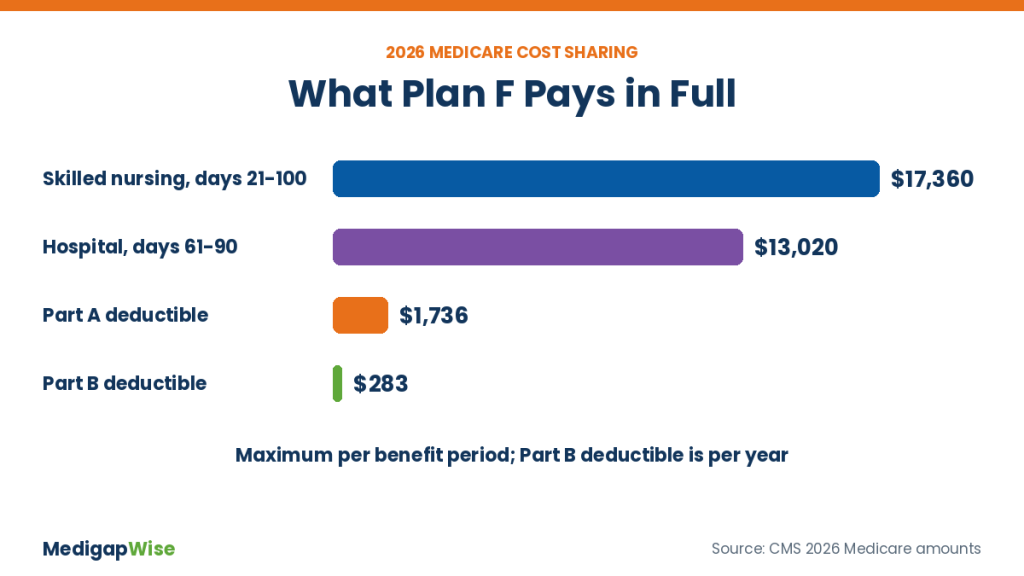
Medicare cost sharing Medicare Supplement Plan F pays in full, using 2026 CMS amounts: up to $17,360 for skilled nursing days 21 to 100, $13,020 for hospital days 61 to 90, the $1,736 Part A deductible and the $283 Part B deductible

Every Plan F policy sold in 47 states carries the same nine benefits, set by federal law, whichever company issues it. The table pairs each benefit with what you’d owe under Original Medicare alone, using CMS’s 2026 figures.

Plan F benefit What Medicare leaves you (2026) Plan F pays
Part A deductible $1,736 per benefit period 100%
Hospital days 61–90 $434 a day 100%
Lifetime reserve days 91–150 $868 a day 100%
After Medicare’s hospital days end Full cost 100% for 365 more days
Skilled nursing days 21–100 $217 a day 100%
Part B deductible $283 a year 100%
Part B coinsurance Usually 20% of approved amount 100%
Part B excess charges Up to 15% above approved amount 100%
Blood, hospice, foreign travel First 3 pints; hospice copays; care abroad 100%, 100%, 80%

Two rows deserve a note. The Part A deductible applies per benefit period, not per year, so two separate hospital stays can mean two deductibles, and Plan F pays both. Foreign travel coverage is the one benefit that isn’t 100%: after a $250 yearly deductible, Plan F pays 80% of emergency care in the first 60 days of a trip, up to a $50,000 lifetime limit. Our page on Medicare Supplement foreign travel coverage walks through how claims abroad work.

Where the Dollars Get Large: A Hospital-to-Rehab Example

Small doctor visits make Plan F look like a convenience. A long hospital stay shows what it’s actually insuring. Take one illustrative stretch of care at 2026 amounts: a 70-day hospital stay, then 30 days in a skilled nursing facility, plus $10,000 in Medicare-approved doctor bills during the year.

1
Hospital, days 1–60: the $1,736 Part A deductible.
2
Hospital, days 61–70: 10 days at $434, or $4,340.
3
Skilled nursing, days 21–30: 10 days at $217, or $2,170. Days 1–20 carry no Medicare coinsurance.
4
Doctor bills: the $283 Part B deductible plus 20% of the remaining $9,717, or $1,943.
5
Total Medicare cost sharing: $10,472, and Plan F pays all of it. Plan G would leave $283; Plan C would leave any excess charges.

The ceiling is far higher than that example. Medicare coinsurance for skilled nursing days 21 through 100 alone can reach $17,360 in a benefit period, which is why the first image above ranks it ahead of the deductibles.

The January 1, 2020 Rule and What “Newly Eligible” Means

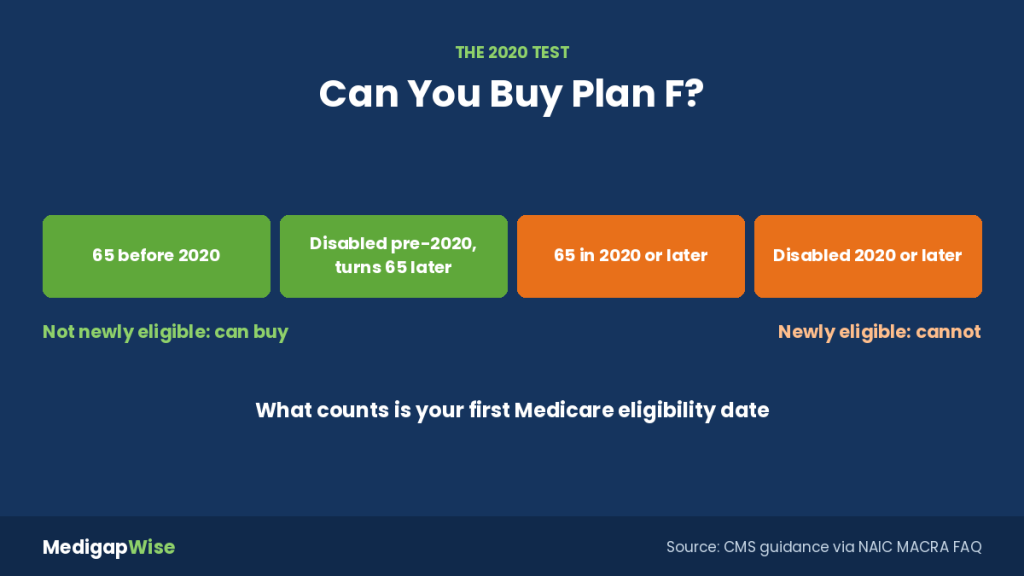
The 2020 Medicare Supplement Plan F eligibility test: turned 65 before 2020 or on Medicare through disability before 2020 can buy Plan F, while first eligible in 2020 or later cannot

The Medicare Access and CHIP Reauthorization Act of 2015 (MACRA) bars insurers from selling a Medigap plan that pays the Part B deductible to anyone “newly eligible” for Medicare on or after January 1, 2020. Plans C and F, including High-Deductible F, are the plans that pay it.

In plain terms, the cutoff follows your first Medicare eligibility, whether it came from age, disability or end-stage renal disease. For people reaching 65, NAIC guidance quoting CMS says you count as newly eligible only if you both turned 65 on or after January 1, 2020 and first became eligible for Medicare on or after that date. Someone who already had Medicare through disability in 2019 fails the second half, so a 65th birthday in a later year doesn’t close Plan F to them. Someone under 65 who first qualifies through disability in 2020 or later is newly eligible from day one.

Eligibility here means the point at which you could have had Medicare, not the date you signed up. The full list of general Medigap requirements is on our Medicare Supplement eligibility page.

Compare Plan F, Plan C and Plan G from several companies

Speak with a licensed insurance agent

1-888-891-0229

Edge Cases: Delayed Part B, Disability Before 2020 and Plan C

✔
Turned 65 before 2020, delayed Part B. CMS’s own example: someone who turned 65 in November 2019 and enrolled in Part B after January 1, 2020 is not newly eligible. Your six-month Medigap open enrollment period starts when Part B does, so Plan F can be bought then without health questions.
✔
On Medicare through disability or ESRD before 2020, turning 65 later. Turning 65 in 2021 or 2027 doesn’t make you newly eligible, because you first became eligible earlier. Federal rules give under-65 enrollees a new Medigap open enrollment period at 65, which can be the easiest moment to pick up Plan F.
✔
Disabled under 65 before 2020, but in a state that doesn’t require sales to under-65 enrollees. You’re allowed to buy Plan F, yet no company may have to sell it to you before 65. State rules decide that part.
✔
Plan C. The same test applies word for word. If you can buy F, you can buy C; if F is closed to you, so is C.
✔
First eligible in 2020 or later, by age or disability. No version of C or F can be sold to you. Plan G is the nearest match.

Check before you apply: Insurers verify eligibility from your Medicare start dates. Keep your Medicare card and Part A entitlement date handy, since an application listing the wrong date can be rejected.

Questions? Talk to a Licensed Agent

We compare Plan G, Plan N and more from several insurance companies at no cost to you.

☎ 1-888-891-0229

No cost, no obligation to enroll

Plan F vs Plan C vs Plan G: The Coverage Gap

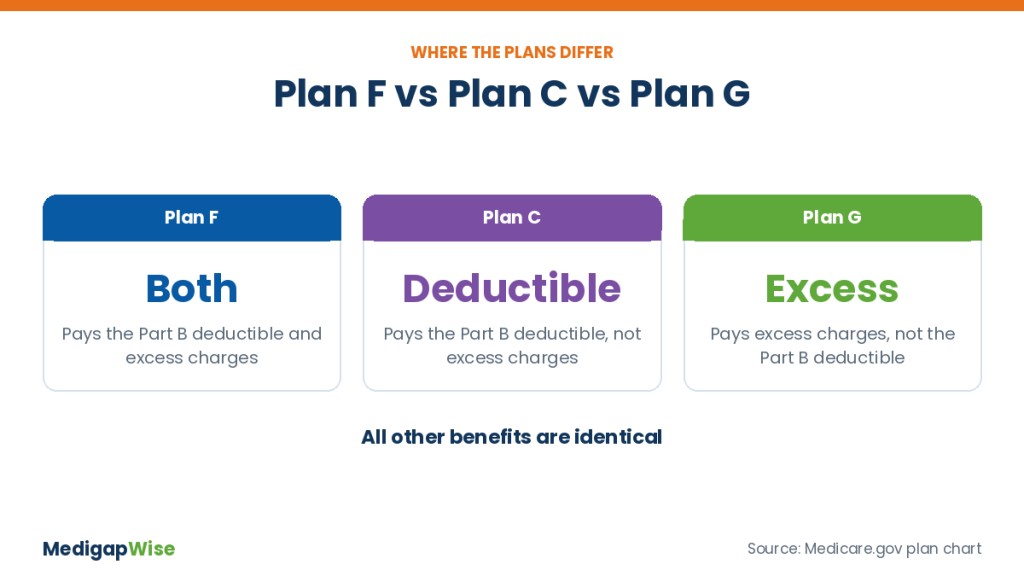
Medicare Supplement Plan F vs Plan C vs Plan G coverage: Plan F pays the Part B deductible and excess charges, Plan C pays the deductible but not excess charges, Plan G pays excess charges but not the deductible

All three plans share the Part A deductible, hospital and skilled nursing coinsurance, Part B coinsurance, blood, hospice and 80% foreign travel benefits. They split on just two lines:

Plan F

✔Pays the Part B deductible
✔Pays Part B excess charges
✔Closed to anyone newly eligible

Plan C

✔Pays the Part B deductible
✔Does not pay excess charges
✔Same 2020 cutoff as Plan F

Plan G

✔Leaves the Part B deductible to you
✔Pays Part B excess charges
✔Open to every Medicare enrollee

In practice, the gap between F and G is the Part B deductible, $283 in 2026, while the gap between F and C only matters if you see doctors who don’t accept Medicare assignment. Whether the extra benefit is worth its premium is a pricing question, covered on our Medicare Supplement Plan F cost page. Full details on the open alternative are in Medicare Supplement Plan G.

Can You Buy Plan F From a Different Company?

Yes, if you meet the eligibility test and a company in your state still files Plan F. Moving a Plan F policy from one insurer to another is a new purchase, so the usual Medigap rules apply:

✔
Inside your Medigap open enrollment period an insurer can’t turn you down or charge more because of your health.
✔
Outside it most states let the new company ask health questions and decline you. A few states with birthday or anniversary rules let you move to a plan with equal or lesser benefits without underwriting during a set window.
✔
With a federal guaranteed issue right, the plan list depends on your date. NAIC model rules treat C and F in those lists as D and G for newly eligible people. Pre-2020 eligibles may still see C and F among the choices where insurers sell them.
✔
Availability is the limit nobody controls. Some companies have stopped issuing new Plan F policies in some states.

State-by-state switching windows are mapped in Medicare Supplement guaranteed issue rights by state.

What Happens to People Who Keep Plan F

Nothing about the coverage changes. Medigap policies are guaranteed renewable, so an insurer can’t cancel your Plan F because it’s no longer sold to new enrollees; it can end coverage only for unpaid premiums or misrepresentation on the application.

The open question is price. Since 2020 no new 65-year-olds have joined Plan F, which makes it what insurance analysts call a closed block. Over time, a closed block tends to get older and file more claims, and many observers expect larger rate increases on such blocks. How fast that happens varies by company and state, and nothing in federal law caps it, so your yearly renewal notice is the best evidence.

Fine print on rate filings: Insurers must file Medigap rate changes with state regulators, and some states publish those filings. Our guide to Medicare Supplement rate increases shows where to look. If the numbers stop adding up, see how to switch from Plan F to Plan G.

Talk with a licensed agent about keeping or replacing Plan F

Speak with a licensed insurance agent

1-888-891-0229

What Plan F Doesn't Cover

Plan F only fills gaps in services Original Medicare approves. It doesn’t add new kinds of benefits, so these stay outside it:

Not covered

✔Prescription drugs (that’s Part D)
✔Routine dental, vision and hearing aids
✔Long-term custodial care

Limited

✔Foreign care: 80%, $50,000 lifetime cap
✔Hospice: only Part A copays
✔Care Medicare doesn’t approve: $0

Massachusetts, Minnesota and Wisconsin standardize Medigap their own way, so residents there won’t see a plan called Plan F; ask for the state’s comparable plan. Those who want a lower-premium version of F with a yearly deductible can read about High-Deductible Plan F. Every other plan letter is compared in our guide to Medicare Supplement plans.

Keep Reading

Medicare vs Medigap 2027: why the two aren’t alternatives, a gap-by-gap table of what each plan letter pays, how crossover claims work, and one year priced with Original Medicare alone, Plan N and Plan G.

Plan F Coverage and Eligibility: Common Questions

➤ Is Medicare Supplement Plan F still available in 2027?

Yes, for people first eligible for Medicare before January 1, 2020, where a company still sells it. It can’t be sold to anyone newly eligible on or after that date.

➤ I was on Medicare through disability in 2018 and turn 65 in 2027. Can I get Plan F?

Yes. CMS guidance says turning 65 after 2020 doesn’t make you newly eligible if you first became eligible for Medicare earlier. Your Medigap open enrollment period at 65 is a good time to apply.

➤ Does Plan F pay the Part A deductible more than once a year?

Yes. The Part A deductible ($1,736 in 2026) applies per benefit period, and Plan F pays it each time a new benefit period starts.

➤ What are Part B excess charges, and does Plan F cover them?

Doctors who don’t accept Medicare assignment can bill up to 15% above the Medicare-approved amount. Plan F pays that extra; Plan C doesn’t.

➤ Is Plan C the same as Plan F?

Almost. Plan C covers everything Plan F does except Part B excess charges, and the same 2020 eligibility cutoff applies to both.

➤ Can my insurer cancel Plan F because it’s closed to new members?

No. Medigap policies are guaranteed renewable, so your coverage continues as long as you pay premiums and your application was truthful.

➤ Does Plan F cover prescriptions or dental care?

No. Plan F fills gaps in Medicare-approved services only. Drugs need a Part D plan, and dental, vision and hearing aids need separate coverage.

➤ What will the 2027 Part A and Part B deductibles be?

CMS hadn’t announced them as of November 10, 2026; it usually does in November. Plan F pays both in full whatever the amounts turn out to be.

Free Medigap Price Comparison

Call a Licensed Agent Now

Compare Plan G, Plan N and more from several insurance companies in one call.

☎ 1-888-891-0229

No cost, no obligation to enroll