




Speak with a licensed insurance agent

1-888-891-0229

Top 5 Medicare Supplement Plans for 2027, Ranked by Real Enrollment

Reviewed by Russell Noga, Licensed Medicare Insurance Broker (all 50 states) — Last updated October 27, 2026

Key Takeaway

The top 5 Medicare Supplement plans, measured by how many people own them, are Plan G (43% of enrollees), Plan F (33%), Plan N (10%), Plan C (2%) and Plan J (2%), according to AHIP’s April 2026 report on NAIC data for 2024. Only Plan G, its high-deductible version and Plan N are open to someone new to Medicare in 2027.

2027 by the Numbers

5.94M

Plan G policyholders at the end of 2024, up 604,789 in one year (AHIP/NAIC)

86%

Share of NAIC-reported Medigap enrollees in Plans G, F and N combined (our calculation)

$3,050

2027 deductible for High-Deductible Plans F, G and J (CMS)

$283

2026 Part B deductible; CMS sets the 2027 amount in November (CMS)

Most “best plan” lists are someone’s opinion. This one isn’t. Every insurer that sells Medigap reports its policy counts to the National Association of Insurance Commissioners (NAIC), and the trade group AHIP publishes the totals each year. Its April 2026 edition counts 14.29 million people with Medigap coverage at the end of 2024, and five plan letters hold nearly nine in ten of them.

Below: the ranking from those filings, why a plan most new enrollees can’t buy still sits at No. 2, a short profile of each plan with its 2027 cost sharing, and a dollar-for-dollar comparison of the three top-ranked plans still open to everyone.

Get quotes on the top-ranked plans in your ZIP code

Speak with a licensed insurance agent

1-888-891-0229

What Are the Top 5 Medicare Supplement Plans?

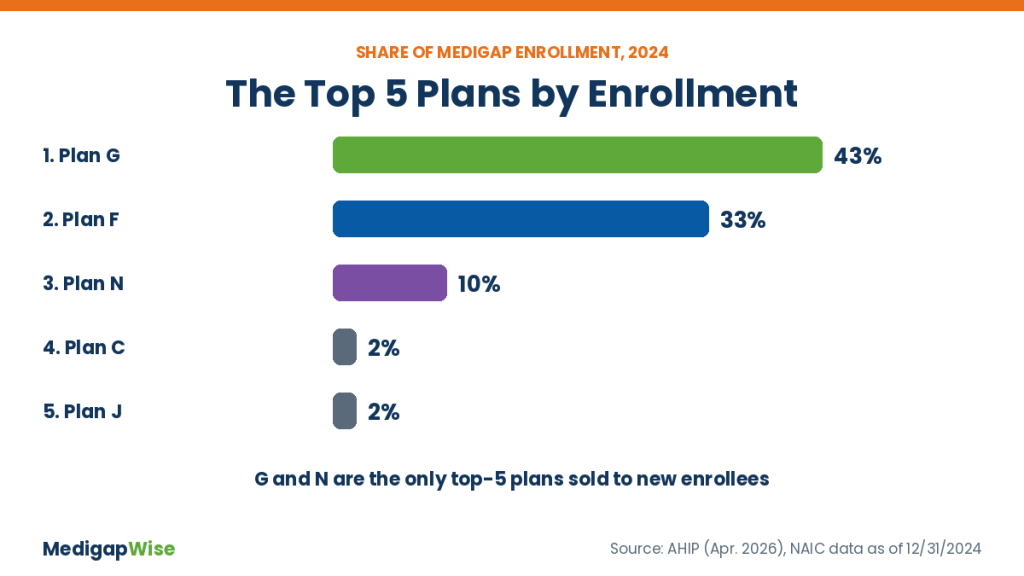
Top 5 Medicare Supplement plans by share of enrollment in 2024 from AHIP and NAIC data: Plan G 43%, Plan F 33%, Plan N 10%, Plan C 2% and Plan J 2%

Ranked by policies in force on December 31, 2024, the five largest standardized plan letters are below. Counts come from Table 4 of AHIP’s The State of Medicare Supplement Coverage (April 2026), which draws on NAIC filings; shares are AHIP’s rounded figures. High-deductible F and G are counted inside Plans F and G because the filings don’t separate them.

Rank Plan Enrollees, 2024 Share Change vs. 2023 Sold to new 2027 enrollees?
1 Plan G 5,941,731 43% +604,789 (+11%) Yes
2 Plan F 4,564,848 33% −355,932 (−7%) No (pre-2020 eligibles only)
3 Plan N 1,433,745 10% +66,491 (+5%) Yes
4 Plan C 315,284 2% −49,106 (−13%) No (pre-2020 eligibles only)
5 Plan J 226,284 2% −25,791 (−10%) No (not sold since 2010)

Massachusetts, Minnesota and Wisconsin use their own state designs, which AHIP groups as “waivered” plans (6% of enrollment); they aren’t a plan letter, so they’re left out of the ranking. For what every letter covers, start with our guide to Medicare Supplement plans.

Our count: Plans G, F and N together hold 11.94 million of the 13.75 million enrollees in NAIC’s plan-level data, about 86.9%. Every other letter combined is smaller than Plan N alone.

How Plan G Overtook Plan F in Five Years

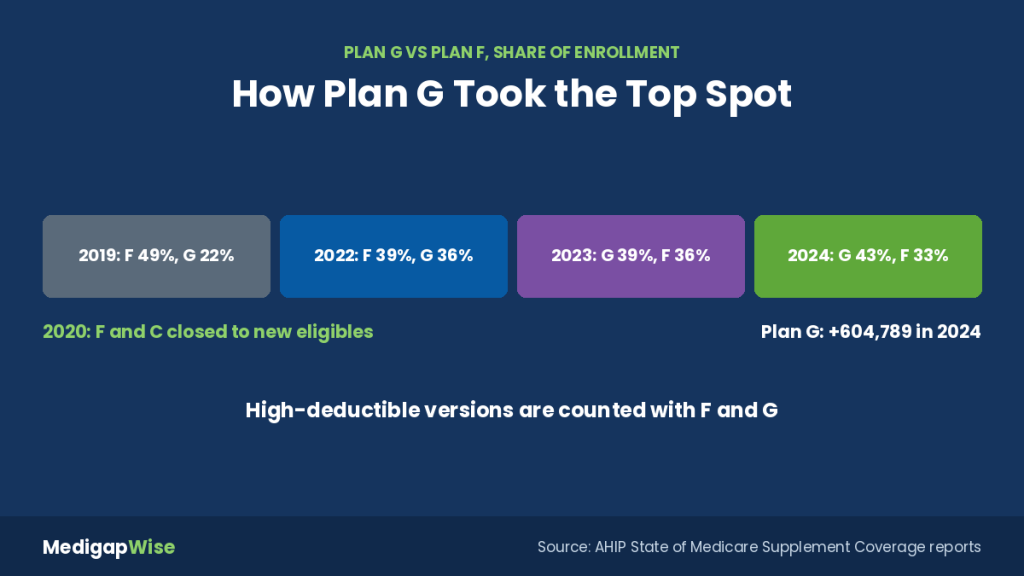
How Plan G overtook Plan F in Medigap enrollment share: F 49% and G 22% in 2019, F 39% and G 36% in 2022, G 39% and F 36% in 2023, G 43% and F 33% in 2024

As recently as 2019, Plan F held about 49% of Medigap enrollment and Plan G about 22%, according to AHIP’s earlier report on that year. The order flipped in 2023 and the gap widened in 2024.

Two forces drive it. First, MACRA, the 2015 law that took effect in 2020, ended sales of Plan F and Plan C to anyone newly eligible for Medicare, so every new 65-year-old who wants broad coverage lands in Plan G. Second, Plan F’s pool keeps shrinking as policyholders die or switch, while no new 65-year-olds join it.

In 2024 that worked out to roughly 1,657 net new Plan G policyholders a day and about 975 fewer Plan F policyholders a day, our math from AHIP’s yearly change figures.

No. 1, Plan G: The Default for New Enrollees

Who it fits: anyone who wants nearly complete coverage of Medicare-approved care and can buy it, which in practice means most people turning 65 since 2020.

2027 cost sharing that matters: you pay only the Part B deductible ($283 in 2026; CMS hadn’t released the 2027 figure as of November 4, 2026). After that, the plan pays your share of covered hospital and medical bills, including Part B excess charges.

The high-deductible option sits inside Plan G’s 43%. It pays nothing until your covered costs reach $3,050 in 2027, then matches standard Plan G. Our Medicare Supplement Plan G guide lists each benefit, and High-Deductible Plan G covers the lower-premium version.

Price Plan G, Plan N and HD Plan G side by side

Speak with a licensed insurance agent

1-888-891-0229

No. 2, Plan F: Large, Loyal and Closed to Newcomers

Plan F ranks second only because of the people who already own it. It’s the one plan that pays the Part B deductible on top of everything Plan G pays, and it led the market for years before 2020.

Who it fits: only people who were eligible for Medicare before January 1, 2020. If that’s you, you can keep it or still buy it where insurers sell it. If you first became eligible in 2020 or later, no insurer may sell it to you. The deductible rules behind that cutoff are on our page about whether Medicare Supplement covers the Part B deductible.

Worth checking each year: Because Plan F’s buyer pool is closed and aging, its premium is worth comparing against Plan G at renewal. Our Plan F cost page and the steps to switch from Plan F to Plan G lay out that decision.

Questions? Talk to a Licensed Agent

We compare Plan G, Plan N and more from several insurance companies at no cost to you.

☎ 1-888-891-0229

No cost, no obligation to enroll

No. 3, Plan N: The Copay Trade-Off

Plan N is the only top-ranked plan besides G that a new enrollee can buy, and it’s still growing, up 5% in 2024.

Who it fits: people who see doctors a moderate number of times a year, mostly use providers that accept Medicare assignment, and would rather take small copays than pay Plan G’s higher premium.

2027 cost sharing that matters: the Part B deductible, a copay of up to $20 for some office visits and up to $50 for an emergency room visit that doesn’t end in an inpatient admission, plus any Part B excess charge of up to 15% from a provider who doesn’t take assignment. Details are in our Medicare Supplement Plan N guide, and moving up later is covered in switching from Plan N to Plan G.

Nos. 4 and 5, Plans C and J: Legacy Coverage

Plan C, 315,284 enrollees

✔Pays the Part B deductible, like Plan F
✔Doesn’t pay Part B excess charges
✔Same pre-2020 eligibility cutoff as Plan F
✔Down 13% in 2024

Plan J, 226,284 enrollees

✔One of four letters (E, H, I, J) dropped for sales on or after June 1, 2010
✔Existing owners keep it as long as they pay the premium
✔Its high-deductible version uses the same $3,050 threshold in 2027
✔Down 10% in 2024

Neither one is a shopping option for most people today. They rank in the top five because owners tend to keep a policy once they have it, and both lists shrink every year.

Worked Example: G vs N vs High-Deductible G in One Year

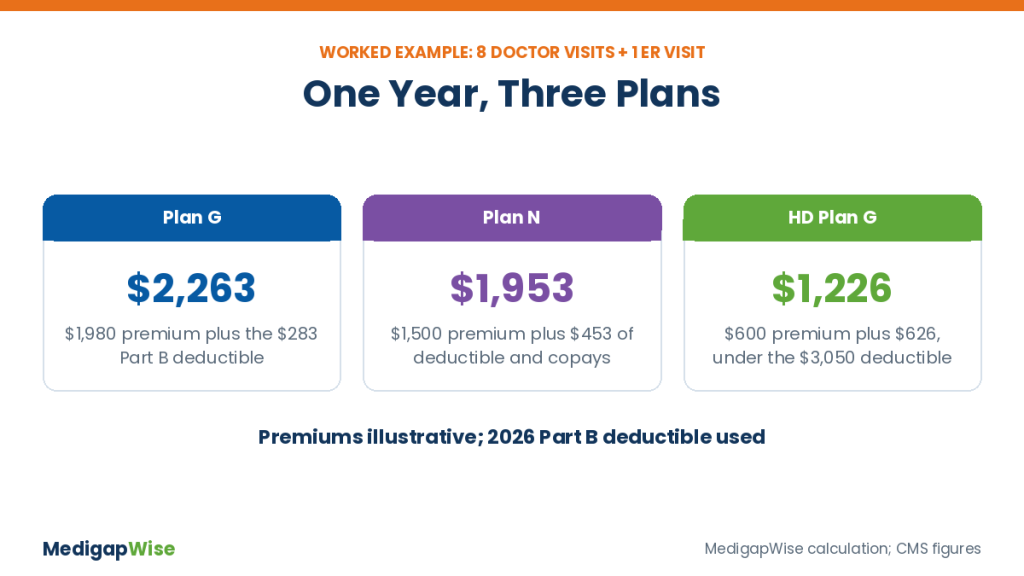
Worked example of yearly cost for eight doctor visits and one ER visit: Plan G $2,263, Plan N $1,953 and High-Deductible Plan G $1,226 with illustrative premiums

Only three versions of the top-ranked plans are open to a 2027 newcomer, so here’s how they compare in one ordinary year. Assumptions: eight doctor visits at $150 Medicare-approved each, plus one ER visit, approved at $800, that doesn’t lead to admission, for $2,000 of Part B charges. The 2026 Part B deductible of $283 stands in for 2027. Premiums are illustrative round numbers, not quotes: $165 a month for G, $125 for N and $50 for High-Deductible G.

✔
Medicare cost sharing with no supplement: $283 deductible + 20% of the remaining $1,717 = $626
✔
Plan G: $1,980 premium + $283 deductible = $2,263
✔
Plan N: $1,500 premium + $283 deductible + six $20 office copays (the first two visits use up the deductible) + $50 ER copay = $1,953
✔
High-Deductible G: $600 premium + the full $626, well under the $3,050 deductible = $1,226

The ranking changes in a bad year. With these premiums, High-Deductible G stays cheaper than Plan G until your Medicare cost sharing passes about $1,663, and it can never cost more than $3,650 for covered care plus premium. Plan N stays ahead of G unless its copays and excess charges top the $480 premium gap. Run the same math with real quotes using our Medicare Supplement plans cost guide.

Ask an agent which of the top 5 you can buy

Speak with a licensed insurance agent

1-888-891-0229

Popular Isn't the Same as Right for You

Enrollment share says what millions of people chose, not what fits your budget or health. A few checks narrow the top five to one:

1
Confirm your eligibility date. Eligible before 2020? All of G, F, N and C may be open to you. Eligible in 2020 or later? Your realistic shortlist is G, High-Deductible G and N.
2
Count last year’s doctor visits. Many office visits make Plan N’s copays add up; few visits favor N or the high-deductible option.
3
Ask about excess charges. If your doctors don’t accept Medicare assignment, Plan N leaves those charges with you.
4
Time the application. Your 6-month Medicare Supplement open enrollment window is the one time no insurer can price or decline you based on health. After it, expect Medigap underwriting questions in most states.
5
Then compare companies. Benefits are identical for each letter, so price and rate history decide it; see the best Medicare Supplement companies.

Keep Reading

High-Deductible Plan F 2027: who can still buy it, the $3,050 deductible, how it differs from HD Plan G and our keep-or-switch break-even table.

Top 5 Medicare Supplement Plans: Common Questions

➤ What are the top 5 Medicare Supplement plans?

By number of enrollees at the end of 2024, Plans G, F, N, C and J, holding about 43%, 33%, 10%, 2% and 2% of Medigap enrollment, per AHIP’s April 2026 report on NAIC data.

➤ Where does this ranking come from?

From the NAIC Medicare Supplement experience data that insurers file every year, as summarized by AHIP. It counts policies in force on December 31, 2024, so it reflects real ownership, not opinions or sales pitches.

➤ Why is Plan F still No. 2 if new enrollees can’t buy it?

Over 4.5 million people bought it before the 2020 cutoff and kept it. Its count fell by about 356,000 in 2024, and without new 65-year-olds joining, that decline is likely to continue.

➤ Can I buy any of the top 5 plans if I turn 65 in 2027?

Yes, two of them: Plan G (including its high-deductible version) and Plan N. Plans F and C are limited to people eligible for Medicare before 2020, and Plan J hasn’t been sold since June 1, 2010.

➤ Where is High-Deductible Plan G in the ranking?

It’s counted inside Plan G’s 43%. AHIP’s report notes the NAIC data doesn’t break out high-deductible versions, so no separate national share is published.

➤ How much is the High-Deductible Plan G deductible in 2027?

$3,050, according to CMS’s 2027 announcement, the same amount that applies to High-Deductible Plans F and J.

➤ Which Medigap plan is growing fastest?

In raw numbers, Plan G, which added 604,789 policyholders in 2024. Plan N also grew, by 5%. Most other letters lost enrollees.

➤ How many people have a Medicare Supplement plan?

About 14.29 million at the end of 2024, or 43% of people in Original Medicare, according to AHIP. That includes roughly 547,000 Californians in plans regulated by the state’s Department of Managed Health Care.

Free Medigap Price Comparison

Call a Licensed Agent Now

Compare Plan G, Plan N and more from several insurance companies in one call.

☎ 1-888-891-0229

No cost, no obligation to enroll