




Speak with a licensed insurance agent

1-888-891-0229

Medicare Supplement for Disabled Under 65 (2027): State Rules, Plan Limits and Price Caps

Reviewed by Russell Noga, Licensed Medicare Insurance Broker (all 50 states) — Last updated November 12, 2026

Key Takeaway

Yes, people under 65 on Medicare because of a disability can buy a Medicare Supplement plan, but only where state law or an insurer’s own choice allows it, because federal law doesn’t make insurers sell Medigap to anyone under 65. In states that do require it, the plan menu can be as short as Plan A and the premium can run up to double the age-65 rate, so the six-month Medigap open enrollment period that arrives at 65 is often the better time to buy.

2027 by the Numbers

Just under 7M

Medicare beneficiaries under 65, nearly all eligible through disability, ESRD or ALS (KFF, Oct. 13, 2026)

8% vs. 50%

Share of Traditional Medicare enrollees with Medigap, under 65 vs. 65 and older, 2024 (KFF)

24 months

SSDI payments needed before Medicare begins, unless you have ALS or ESRD (SSA; CMS)

200%

Ceiling on under-65 premiums for most plans in Indiana, Nevada and Texas, vs. the age-65 rate (state law)

A 52-year-old on Social Security Disability Insurance gets the same red, white and blue Medicare card as a retiree, along with the same 20% Part B coinsurance and the same Part A hospital deductible. What it lacks is the same right to buy a policy that fills those gaps.

Below: how disability leads to Medicare, the states that close the federal gap, the plan letters and price limits they set, and other routes when your state offers nothing before 65.

Check what Medigap plans your state lets you buy before 65

Speak with a licensed insurance agent

1-888-891-0229

Can You Get a Medigap Policy Before 65? The Federal Gap

Medicare.gov is blunt about it: federal law doesn’t require insurance companies to sell Medigap policies to people under 65, and someone with ESRD or a disability may not be able to buy one until 65, depending on the state. There’s no federal carve-out for kidney failure or ALS either. KFF’s October 13, 2026 review says federal law offers no guaranteed issue protections at all for beneficiaries under 65.

States fill the gap unevenly. KFF finds 38 states make insurers offer at least one policy to disabled enrollees under 65 during an initial window, while the other 12 states and Washington, D.C. leave it to the insurers. Even in a state with no rule, an insurer may choose to sell to under-65 buyers, usually at a steep price. The broader buying rules sit in Medicare Supplement eligibility.

The take-up gap: KFF reports that in 2024 only 8% of Traditional Medicare enrollees under 65 had a Medigap policy, against 50% of those 65 and older.

How Disability, ALS and Kidney Failure Lead to Medicare

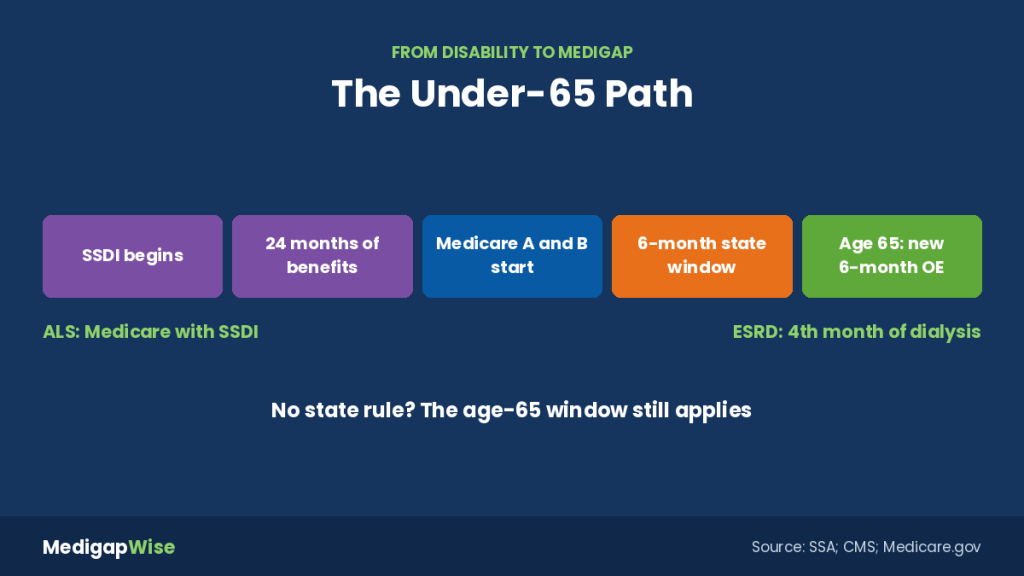
Path from disability to a Medicare Supplement plan: SSDI starts, 24 months of benefits, Medicare Parts A and B begin, a state under-65 window where one exists, then a new 6-month Medigap open enrollment at 65

Your Medicare start date sets any state window, so know which track you’re on:

✔
SSDI for most disabilities: Medicare Parts A and B begin after you’ve received disability benefits for 24 months. Social Security enrolls you automatically and mails your card before the 25th month.
✔
ALS (Lou Gehrig’s disease): Medicare starts the same month SSDI payments start. The ALS Disability Insurance Access Act, signed December 22, 2020, also removed the five-month wait for those payments.
✔
End-Stage Renal Disease: Medicare usually begins the first day of the fourth month of dialysis, and can start in the first month for people who train for home dialysis or are admitted for a kidney transplant.

Your Part B start month matters most. In the states with an under-65 rule, the guaranteed window is usually six months from Part B enrollment, as in North Carolina, Indiana and Texas. Miss it, and the insurer can generally use health questions again until your 65th birthday.

Which Plan Letters States Make Insurers Offer

A state requirement doesn’t always open the whole Medigap menu. KFF counts 27 of the 38 requiring states that extend every plan type to disabled buyers; the rest set a floor that can be one plan. Recent examples show the range:

Short menu

✔Nebraska: insurers must offer at least one plan; the Department of Insurance says only Plan A is currently available
✔Rhode Island: Plan A since July 1, 2023 (Bulletin 2023-01)

Middle ground

✔North Carolina: Plans A, D and G, under G.S. 58-54-45
✔Texas: Plan A for most disabled buyers; every plan for ESRD and ALS since Sept. 1, 2025

Full menu

✔Kentucky: every policy sold in the state, since Jan. 1, 2024
✔Indiana: any plan sold to people 65 and older, since Jan. 1, 2025

Plan A covers the Part A coinsurance, the first three pints of blood, hospice coinsurance and the 20% Part B coinsurance. It doesn’t pay the Part A deductible, skilled nursing coinsurance or excess charges, so a Plan A buyer still carries real hospital-stay exposure. How Plan A compares with richer letters is laid out in Medicare Supplement plans.

Under-65 Premiums: Parity, Caps and the 200% Ceiling

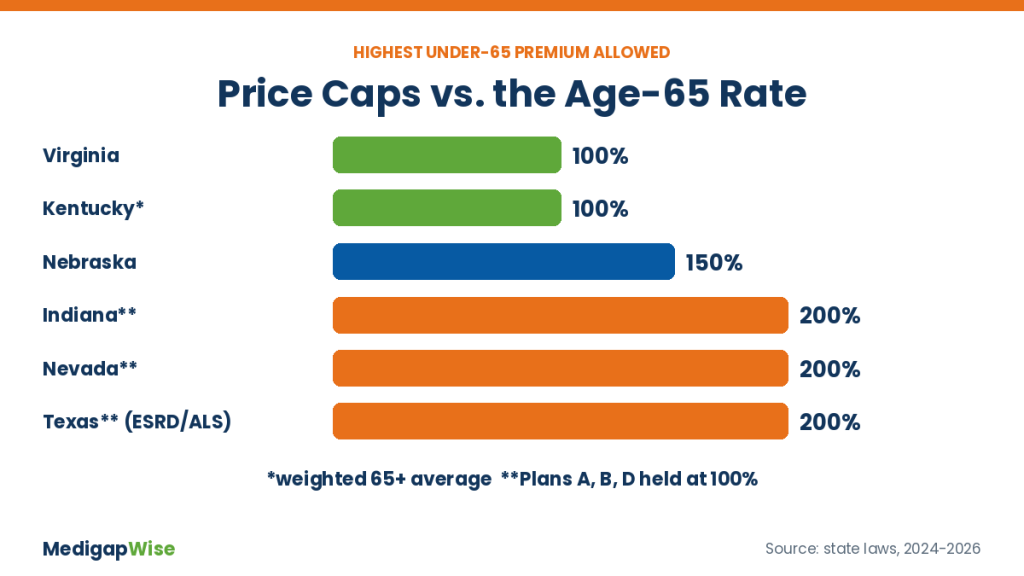
Highest under-65 Medicare Supplement premium allowed as a share of the age-65 rate: Virginia 100%, Kentucky 100% of the weighted average, Nebraska 150%, Indiana 200%, Nevada 200% and Texas 200% for plans other than A, B and D

Insurers price under-65 policies separately, and several states have tied that price to the age-65 rate since 2024. No consumer guide we found lists these limits side by side, so this table comes straight from the statutes and insurance department notices:

State Who’s protected Plans required Under-65 price rule In effect
Virginia Disabled enrollees At least one No higher than the 65+ rate for the same plan Jan. 1, 2024 (§38.2-3610)
Kentucky Anyone under 65 on Medicare All plans sold No higher than the weighted average 65+ rate; no waiting periods Jan. 1, 2024 (2023 Ky. Acts ch. 182)
Indiana Disability and ESRD All plans sold to 65+ A, B, D at the age-65 rate; others up to 200% Jan. 1, 2025 (SEA 215)
Nebraska Disability (ESRD excluded) At least one Up to 150% of the age-65 rate Jan. 1, 2025 (LB 852)
Texas ESRD and ALS Same as 65+ A, B, D at the 65+ rate; others up to 200% Sept. 1, 2025 (HB 2516)
Nevada Disability, including ESRD All plans A, B, D at the 65+ rate; others up to 200% Jan. 1, 2026 (SB 292)
Idaho Under-65 enrollees Varies Higher rate allowed within a 150% limit; drops to the age rate at 65 Idaho DOI
North Carolina Disabled enrollees A, D and G No cap; may cost more than 65+ Jan. 1, 2020 (G.S. 58-54-45)

Sources: Va. Code §38.2-3610(D); Ky. 2023 Acts ch. 182 §1; Indiana SHIP SEA 215 notice; Neb. LB 852 §5; Texas Department of Insurance Bulletin B-0010-25; American Kidney Fund summary of Nev. SB 292 and Nevada Insurance Division Bulletin 25-002; Idaho DOI SHIBA; N.C. Department of Insurance.

Check the date: Several of these laws opened one-time catch-up windows for people already on Medicare, such as Texas from December 1, 2025 to June 1, 2026 and Nevada from October 1, 2025 to April 1, 2026. Those windows have closed; new enrollees rely on the ongoing six-month window.

Compare under-65 Medicare Supplement prices in your ZIP code

Speak with a licensed insurance agent

1-888-891-0229

Worked Example: What a 200% Ceiling Means in Dollars

Illustrative numbers only, not a real insurer’s rates. Suppose a carrier in Indiana charges a 65-year-old $140 a month for Plan G and $95 a month for Plan A. Under SEA 215, here’s the most it may charge a 50-year-old on disability for each:

1
Plan A: Capped at the age-65 rate, so no more than $95 a month, or $1,140 a year.
2
Plan G: Capped at 200% of the age-65 rate, so up to $280 a month, or $3,360 a year.
3
The trade-off: Plan G at the ceiling costs $2,220 a year more than Plan A. It also pays the Part A deductible ($1,736 in 2026) and skilled nursing coinsurance, which Plan A doesn’t.
4
At 65: The same person can re-shop in the six-month open enrollment period and buy Plan G at the regular age-65 price, $140 in this example.

In a state with no cap and no requirement, a voluntary under-65 policy can cost far more than this, which is why the 2027 numbers on Medicare Supplement plans cost assume an age-65 buyer.

Questions? Talk to a Licensed Agent

We compare Plan G, Plan N and more from several insurance companies at no cost to you.

☎ 1-888-891-0229

No cost, no obligation to enroll

Turning 65 Restarts Your Medigap Open Enrollment

This is the one federal protection the under-65 group does get. The Medigap open enrollment period is the six months starting the first day of the month you’re 65 or older and enrolled in Part B, so someone already on Part B through disability gets a full window the month of their 65th birthday. During it, an insurer can’t turn you down or charge more because of your health, whatever you held before. Our guide to Medicare Supplement open enrollment covers how that window works.

✔
Re-shop even if you already own a policy. An under-65 rate doesn’t automatically fall at 65 in most states. Idaho and New Hampshire are exceptions that move the policy to the age-based rate.
✔
Plan F may still be on the table. If you first became eligible for Medicare through disability before January 1, 2020, you aren’t treated as newly eligible, so Medicare Supplement Plan F can be sold to you at 65.
✔
Keep the old policy until the new one is issued. Every Medigap policy is guaranteed renewable, so there’s no rush; renewal rules are in do you have to renew a Medicare Supplement every year.

When Your State Doesn't Sell to Under-65 Buyers

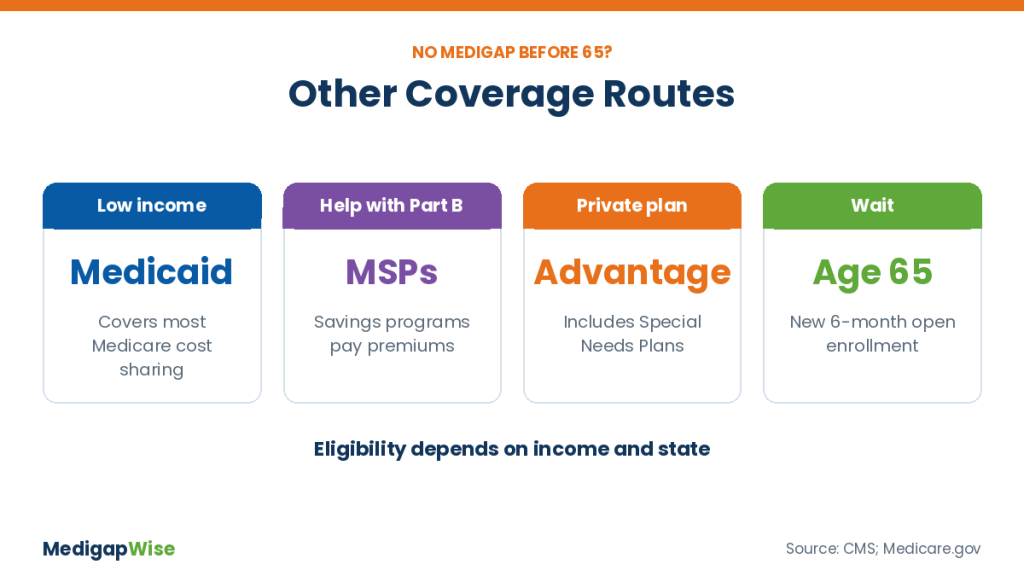
Coverage routes for people under 65 when no Medigap policy is sold to them: Medicaid, Medicare Savings Programs, Medicare Advantage including Special Needs Plans, and waiting for the Medigap open enrollment period at 65

If no insurer will issue a policy before 65, other programs can carry some of the cost in the meantime. Which one fits depends mostly on income:

Medicaid

✔Covers most Medicare cost sharing for full-benefit enrollees
✔Medigap generally can’t be sold alongside it

Savings Programs

✔Medicare Savings Programs pay the Part B premium, and QMB also pays deductibles and coinsurance
✔Income limits set by each state

Medicare Advantage

✔Plans accept any Part A and B enrollee in the service area, including people with ESRD since 2021
✔Special Needs Plans exist for dual-eligible and chronic-condition enrollees

Drug costs are separate from all of these. People with limited income may qualify for Part D Extra Help. A few states also run high-risk pools with a Medicare carve-out plan for under-65 enrollees, Alaska among them, according to the NAIC’s May 11, 2026 state chart.

Before choosing an Advantage plan: Joining one at first eligibility can affect a later move to Medigap. The federal trial right and state switching windows are compared in Medicare Supplement guaranteed issue rights by state.

How to Shop for Medigap as an Under-65 Applicant

1
Find your Part B start date. It’s printed on your Medicare card. Your state’s guaranteed window, where one exists, counts from it.
2
Confirm your state’s rule. Your state insurance department or SHIP office can say whether insurers must sell to you, which plans, and any price limit.
3
Ask each insurer for its under-65 rate. Quotes for a 65-year-old won’t apply. Ask for the disability or ESRD rate for the same plan letter.
4
Weigh Plan A against richer plans. In capped states, Plans A, B and D often sit at the age-65 price while other plans can cost up to twice as much.
5
Mark your 65th birthday month. Set a reminder six months out so you’re ready to compare during your new open enrollment period.

Health questions apply if you apply outside a protected window; see Medigap underwriting questions for what insurers ask. A licensed agent can pull under-65 rates from several insurers in one call.

Ask a licensed agent about your state's disability rule

Speak with a licensed insurance agent

1-888-891-0229

Under 65 and on Disability: Medigap Questions

➤ Can I get a Medicare Supplement plan while I’m on SSDI and under 65?

Yes, in states that require insurers to sell to disabled enrollees, and sometimes elsewhere if an insurer chooses to. Apply within six months of your Part B start date to get the state’s guaranteed window.

➤ Why do Medigap plans cost more for people under 65?

Under-65 enrollees file more claims per person on average, so insurers price them separately. States such as Virginia, Kentucky and Indiana limit how much higher the price can go.

➤ Will my under-65 Medigap premium go down when I turn 65?

Not automatically in most states. Idaho and New Hampshire move you to the age-based rate at 65; elsewhere, use your new six-month open enrollment period to buy a policy at the regular age-65 price.

➤ Can someone with ALS buy a Medigap policy right away?

Medicare begins the same month SSDI does for ALS, so the timing can be quick. Whether an insurer must sell to you depends on the state; KFF counts 25 states that name ALS in their rules, and Texas added it in 2025.

➤ Do people on dialysis under 65 qualify for a Medicare Supplement?

It depends on the state. Some, such as Indiana, Nevada and Texas, explicitly protect ESRD patients, while California, Massachusetts, Vermont and Nebraska exclude them before 65.

➤ Is Plan G available to disabled people under 65?

In some states. North Carolina includes Plan G among the three plans insurers must offer, and Kentucky and Indiana extend every plan sold. In Nebraska, only Plan A is currently offered.

➤ Can there be a waiting period for pre-existing conditions before 65?

Some states allow one. North Carolina permits up to six months unless you had prior creditable coverage, while Kentucky, Indiana and Texas bar waiting periods for qualifying under-65 buyers. More on how they work: Medicare Supplement pre-existing conditions.

➤ Can I buy a Medigap policy from another state if mine has no under-65 rule?

No. Policies are filed and sold by your state of residence. KFF notes Oregon gives guaranteed issue to under-65 people who move there from a state without an under-65 requirement.

Free Medigap Price Comparison

Call a Licensed Agent Now

Compare Plan G, Plan N and more from several insurance companies in one call.

☎ 1-888-891-0229

No cost, no obligation to enroll